
Indian Boiler Regulations, 2026 · Chapter 7 · Pipes and Fittings
Regulation 288. Flexibility
Not yet checked against the official Gazette; verify before relying on it.
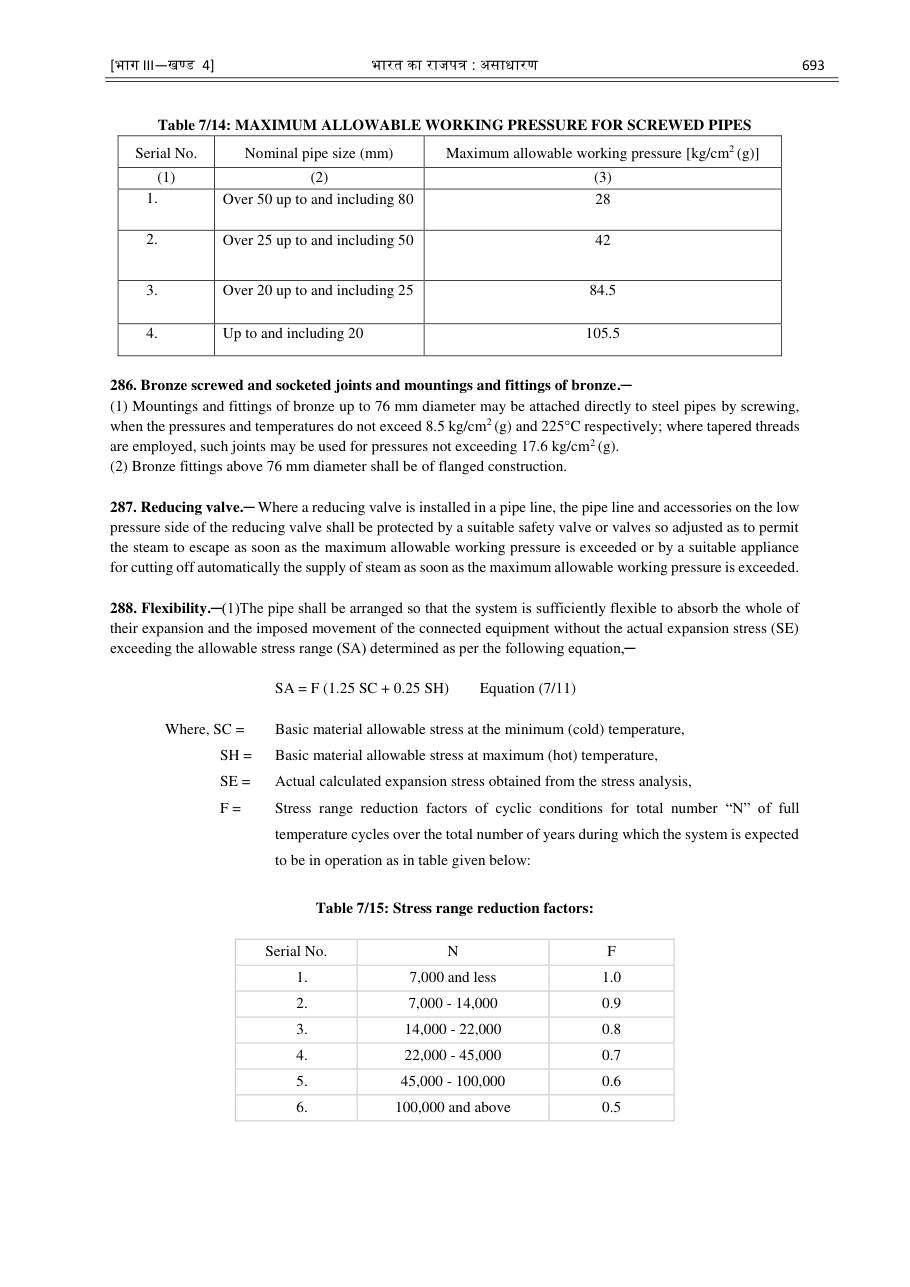
288. Flexibility.─(1)The pipe shall be arranged so that the system is sufficiently flexible to absorb the whole of their expansion and the imposed movement of the connected equipment without the actual expansion stress (SE) exceeding the allowable stress range (SA) determined as per the following equation,─
SA = F (1.25 SC + 0.25 SH) Equation (7/11)
Where, SC = Basic material allowable stress at the minimum (cold) temperature, SH = Basic material allowable stress at maximum (hot) temperature, SE = Actual calculated expansion stress obtained from the stress analysis, F = Stress range reduction factors of cyclic conditions for total number “N” of full temperature cycles over the total number of years during which the system is expected to be in operation as in table given below:
Table 7/15: Stress range reduction factors:
| Serial No. | N | F |
| 1. | 7,000 and less | 1.0 |
| 2. | 7,000 - 14,000 | 0.9 |
| 3. | 14,000 - 22,000 | 0.8 |
| 4. | 22,000 - 45,000 | 0.7 |
| 5. | 45,000 - 100,000 | 0.6 |
| 6. | 100,000 and above | 0.5 |
Table structure read from the Gazette PDF, page 693. Verification status as for the text above.
Show original extracted text (diagnostic, not authoritative)
Serial No.                     N                  F

1.                     7,000 and less             1.0

2.                     7,000 - 14,000             0.9

3.                     14,000 - 22,000            0.8

4.                     22,000 - 45,000            0.7

5.                     45,000 - 100,000           0.6

6.                     100,000 and above          0.5
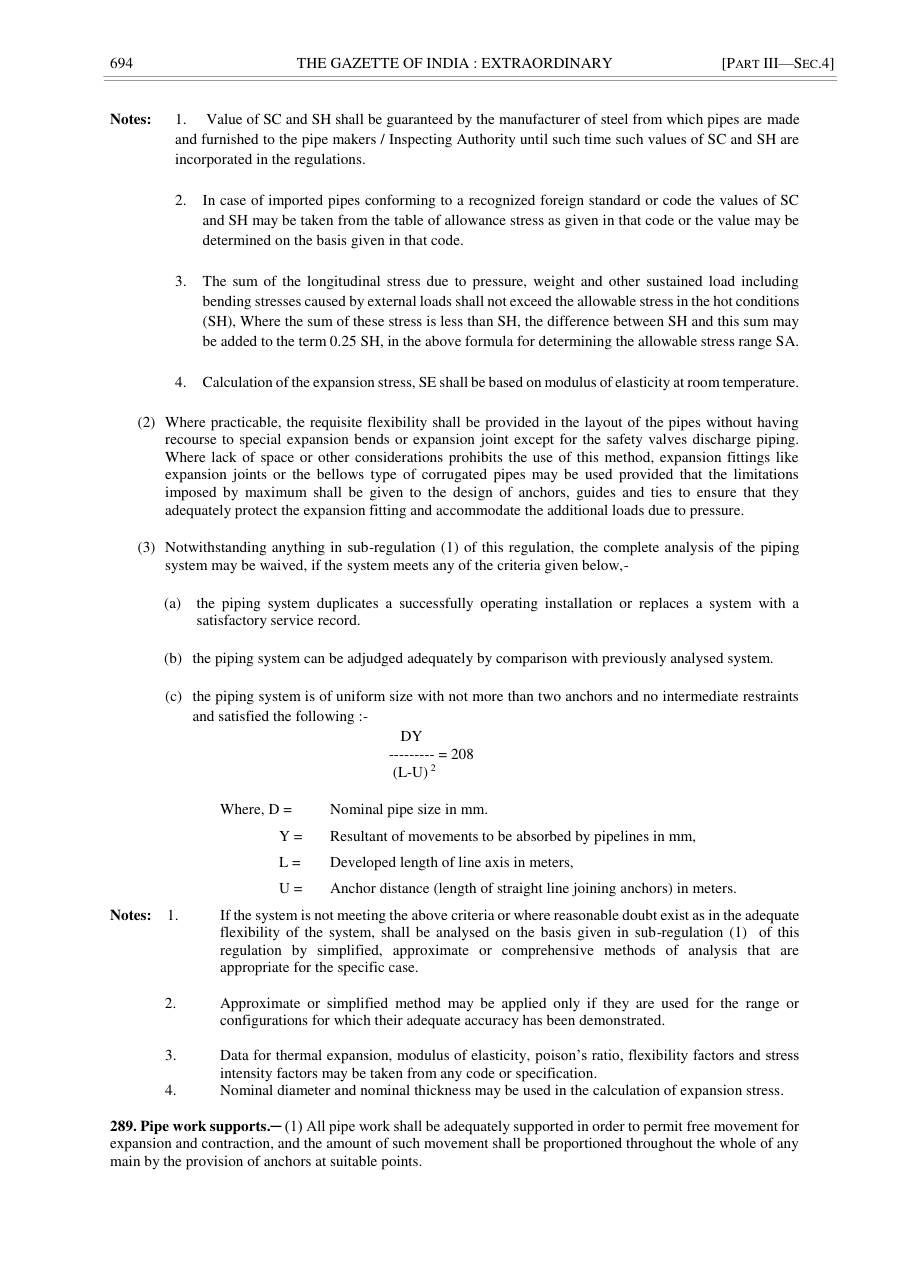
Notes: 1. Value of SC and SH shall be guaranteed by the manufacturer of steel from which pipes are made and furnished to the pipe makers / Inspecting Authority until such time such values of SC and SH are incorporated in the regulations.
2. In case of imported pipes conforming to a recognized foreign standard or code the values of SC and SH may be taken from the table of allowance stress as given in that code or the value may be determined on the basis given in that code.
3. The sum of the longitudinal stress due to pressure, weight and other sustained load including bending stresses caused by external loads shall not exceed the allowable stress in the hot conditions (SH), Where the sum of these stress is less than SH, the difference between SH and this sum may be added to the term 0.25 SH, in the above formula for determining the allowable stress range SA.
4. Calculation of the expansion stress, SE shall be based on modulus of elasticity at room temperature.
(2)Where practicable, the requisite flexibility shall be provided in the layout of the pipes without having recourse to special expansion bends or expansion joint except for the safety valves discharge piping. Where lack of space or other considerations prohibits the use of this method, expansion fittings like expansion joints or the bellows type of corrugated pipes may be used provided that the limitations imposed by maximum shall be given to the design of anchors, guides and ties to ensure that they adequately protect the expansion fitting and accommodate the additional loads due to pressure.
(3)Notwithstanding anything in sub-regulation (1) of this regulation, the complete analysis of the piping system may be waived, if the system meets any of the criteria given below,-
(a)the piping system duplicates a successfully operating installation or replaces a system with a satisfactory service record.
(b)the piping system can be adjudged adequately by comparison with previously analysed system.
(c)the piping system is of uniform size with not more than two anchors and no intermediate restraints and satisfied the following :-
  DY
--------- = 208
 (L-U) 2
Where, D = Nominal pipe size in mm.
Y = Resultant of movements to be absorbed by pipelines in mm,
L = Developed length of line axis in meters,
U = Anchor distance (length of straight line joining anchors) in meters.
Notes: 1. If the system is not meeting the above criteria or where reasonable doubt exist as in the adequate flexibility of the system, shall be analysed on the basis given in sub-regulation (1) of this regulation by simplified, approximate or comprehensive methods of analysis that are appropriate for the specific case.
2. Approximate or simplified method may be applied only if they are used for the range or configurations for which their adequate accuracy has been demonstrated.
3. Data for thermal expansion, modulus of elasticity, poison’s ratio, flexibility factors and stress intensity factors may be taken from any code or specification.
4. Nominal diameter and nominal thickness may be used in the calculation of expansion stress.
Parts of this extracted text look garbled; read the Gazette page before using any value.
Tables and formulae are shown in their extracted layout. Alignment, superscripts and subscripts may be lost. The Gazette page image is authoritative.
In short
Piping must be flexible enough to absorb its own expansion and the movement of connected equipment, without the calculated expansion stress exceeding an allowable stress range.
Key points
- (1) The actual expansion stress SE must not exceed SA = F (1.25 SC + 0.25 SH), Equation (7/11). SC and SH are allowable stresses at cold and hot temperatures. F is a reduction factor from Table 7/15, based on the number N of full temperature cycles over the expected life. It ranges from 1.0 for 7,000 and less down to 0.5 for 100,000 and above.
- Notes: SC and SH are guaranteed by the steel maker until included in the regulations; imported pipes may use their code's values. Sustained longitudinal stresses must not exceed SH, and any margin may be added to the 0.25 SH term. SE is based on modulus of elasticity at room temperature.
- (2) Where practicable, flexibility should come from pipe layout rather than expansion bends or joints, except for safety valve discharge piping. Where expansion joints or bellows are used, anchors, guides and ties must protect them and take the pressure loads (in practice designed for pressure thrust and thermal movement).
- (3) Full analysis may be waived if the system duplicates a successful installation, compares adequately with an analysed system, or is of uniform size with not more than two anchors and no intermediate restraints and meets the D Y / (L-U)2 criterion of 208. The comparison sign is unclear in the extracted text; check the Gazette page.
Watch out
- Systems that do not meet these criteria, or where flexibility is in doubt, must be analysed. Simplified methods may only be used within the range where their accuracy has been demonstrated.
Written by IBRsource editors · last edited 2026-11-20. Explanations simplify and are not a design method, testing procedure or authorisation. Requirements come from the complete regulations, the Gazette and approved documentation.
Comparison pending: the IBR 1950 text in force on 30 September 2026 is not yet established for this provision, so no change is claimed (how this works).
Orientation hints (unverified)
These candidates come from automated heading matching against DPIIT's scanned historical print edition of IBR 1950. That edition uses imperial units and riveted-construction provisions, so it is not the operative 2026 predecessor text. Regulation numbers alone never prove equivalence.
No candidate heading found in the historical print edition.
Images of the official Gazette pages that contain this regulation. Click to zoom. Compare word by word before relying on the extracted text.
Indian Boiler Regulations, 2026, reg. 288, Regulation 288, Gazette of India, Extraordinary, Part III—Section 4, No. 596, 1 October 2026, printed p.693–694. https://egazette.gov.in/WriteReadData/2026/276813.pdf (text consulted via IBRsource, 2026-11-23).
The citation refers to the government publication. Cite the Gazette, not this website.