
Indian Boiler Regulations, 2026 · Chapter 7 · Pipes and Fittings
Regulation 290. Drainage
Not yet checked against the official Gazette; verify before relying on it.
290. Drainage.─ (1) (a) In the case of steam mains, attention shall be paid to the adequate provision of drainage points in the form of drain pockets.
(b)Drainage points connected to stream-traps, shall be provided wherever water can collect under working conditions.
(c)Hand drains shall be provided at all points at which water can collect in any portion of the steam main, by valve leakage or other means, when shut down, or when warning up prior to use.
(2)Wherever practicable, a suitable gradient shall be provided in the pipe work to ensure the passage of condensed water in the direction of flow of steam towards the drainage points.
(3)It is recommended that a bypass shall be fitted at each steam trap.
(4)Where the volume of water deposited is likely to be of serious proportions, separator shall be installed.
(5)Each separator shall be furnished with a steam trap which shall be connected to it by means of a three-way cock, one end of which is connected to a manually operated drain.
In short
Steam mains must be drained so that condensate does not collect.
Key points
- (1)(a)–(b) Provide drain pockets, and drainage points connected to steam traps wherever water can collect under working conditions.
- (1)(c) Provide hand drains wherever water can collect when shut down or warming up, including from valve leakage.
- (2) Where practicable, slope the pipe work so condensate flows with the steam towards the drainage points.
- (3) A bypass at each steam trap is recommended.
- (4)–(5) Where large volumes of water are likely, install a separator. Each separator needs a steam trap connected by a three-way cock, one end leading to a manually operated drain.
Written by IBRsource editors · last edited 2026-11-20. Explanations simplify and are not a design method, testing procedure or authorisation. Requirements come from the complete regulations, the Gazette and approved documentation.
Comparison pending: the IBR 1950 text in force on 30 September 2026 is not yet established for this provision, so no change is claimed (how this works).
Orientation hints (unverified)
These candidates come from automated heading matching against DPIIT's scanned historical print edition of IBR 1950. That edition uses imperial units and riveted-construction provisions, so it is not the operative 2026 predecessor text. Regulation numbers alone never prove equivalence.
| Historical 1950-edition reg. | Heading as OCR'd | Heading similarity | Source image |
|---|---|---|---|
| 299 | Drainage | 100% | Chapter VI (DPIIT scan), image 4 |
| 372 | Drainage | 100% | Chapter VIII (DPIIT scan), image 36 |
IBR 1950 regulation 299 as last published in the DPIIT web edition (archived 2022)
Unofficial archived copy, not verified; see the regulation 299 page for its amendments.
| Reg. 297, Reg. 298, Reg. 299 | ||||||||||||
Reg. 298 Discharge Passage
Reg. 299 Drainage
|
IBR 1950 regulation 372 as last published in the DPIIT web edition (archived 2022)
Unofficial archived copy, not verified; see the regulation 372 page for its amendments.
| Reg. 371, Reg. 372 Pipe work supports
Reg. 372 Drainage
| |||||||||||
Images of the official Gazette pages that contain this regulation. Click to zoom. Compare word by word before relying on the extracted text.
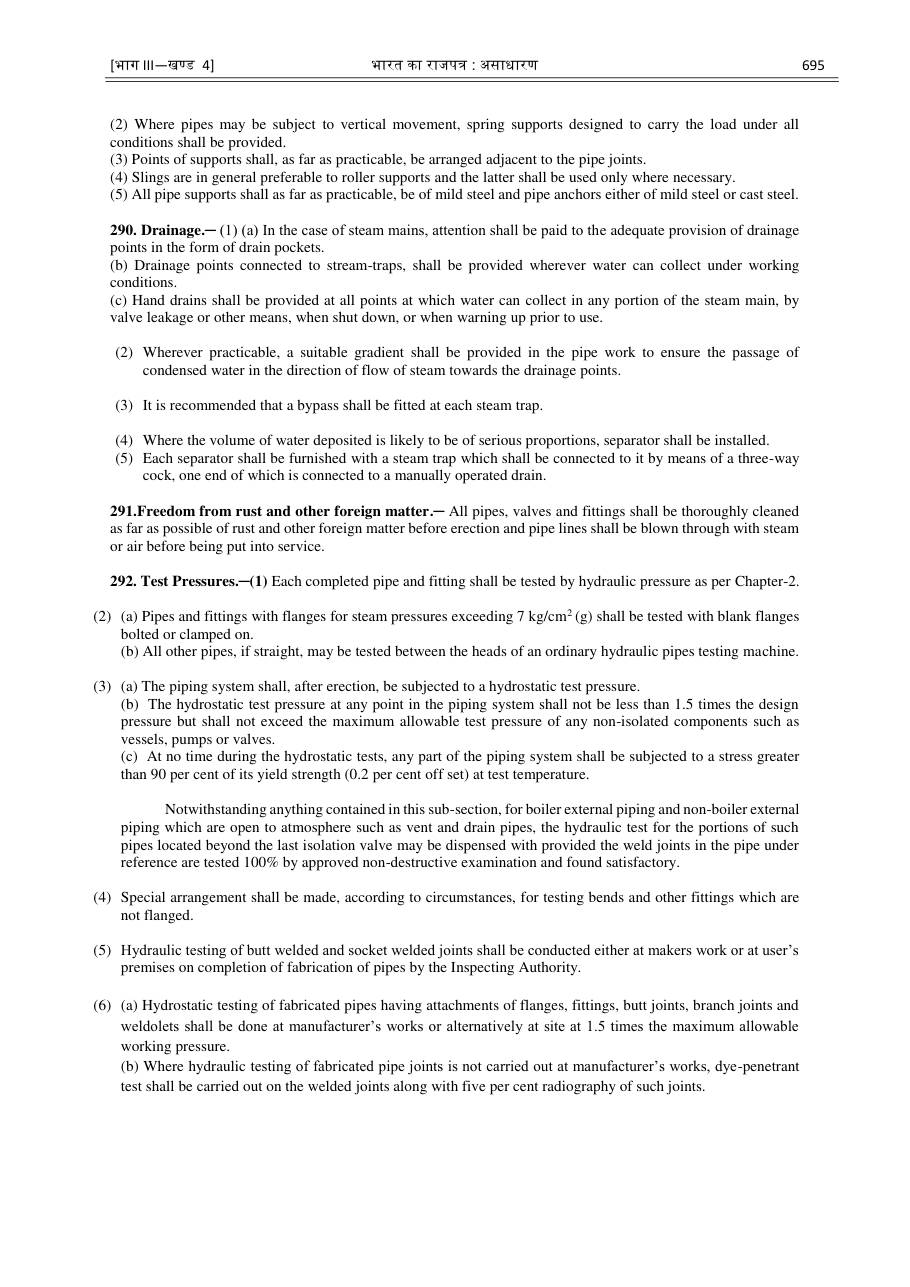
Indian Boiler Regulations, 2026, reg. 290, Regulation 290, Gazette of India, Extraordinary, Part III—Section 4, No. 596, 1 October 2026, printed p.695. https://egazette.gov.in/WriteReadData/2026/276813.pdf (text consulted via IBRsource, 2026-11-23).
The citation refers to the government publication. Cite the Gazette, not this website.