
Indian Boiler Regulations, 2026 · Chapter 7 · Pipes and Fittings
Regulation 249. Pipes
Not yet checked against the official Gazette; verify before relying on it.
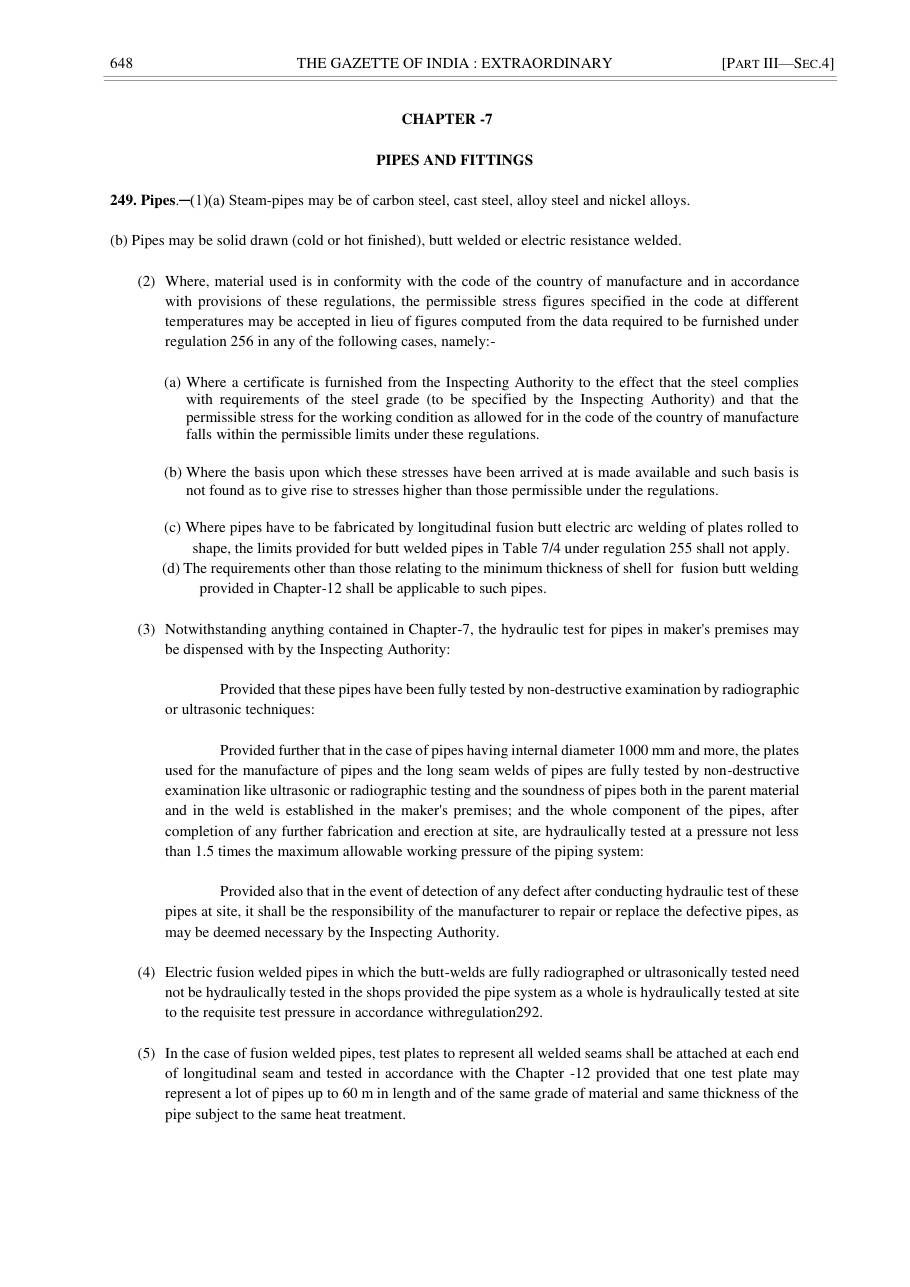
249. Pipes.─(1)(a) Steam-pipes may be of carbon steel, cast steel, alloy steel and nickel alloys.
(b)Pipes may be solid drawn (cold or hot finished), butt welded or electric resistance welded.
(2)Where, material used is in conformity with the code of the country of manufacture and in accordance with provisions of these regulations, the permissible stress figures specified in the code at different temperatures may be accepted in lieu of figures computed from the data required to be furnished under regulation 256 in any of the following cases, namely:-
(a)Where a certificate is furnished from the Inspecting Authority to the effect that the steel complies with requirements of the steel grade (to be specified by the Inspecting Authority) and that the permissible stress for the working condition as allowed for in the code of the country of manufacture falls within the permissible limits under these regulations.
(b)Where the basis upon which these stresses have been arrived at is made available and such basis is not found as to give rise to stresses higher than those permissible under the regulations.
(c)Where pipes have to be fabricated by longitudinal fusion butt electric arc welding of plates rolled to shape, the limits provided for butt welded pipes in Table 7/4 under regulation 255 shall not apply.
(d)The requirements other than those relating to the minimum thickness of shell for fusion butt welding provided in Chapter-12 shall be applicable to such pipes.
(3)Notwithstanding anything contained in Chapter-7, the hydraulic test for pipes in maker's premises may be dispensed with by the Inspecting Authority:
Provided that these pipes have been fully tested by non-destructive examination by radiographic or ultrasonic techniques:
Provided further that in the case of pipes having internal diameter 1000 mm and more, the plates used for the manufacture of pipes and the long seam welds of pipes are fully tested by non-destructive examination like ultrasonic or radiographic testing and the soundness of pipes both in the parent material and in the weld is established in the maker's premises; and the whole component of the pipes, after completion of any further fabrication and erection at site, are hydraulically tested at a pressure not less than 1.5 times the maximum allowable working pressure of the piping system:
Provided also that in the event of detection of any defect after conducting hydraulic test of these pipes at site, it shall be the responsibility of the manufacturer to repair or replace the defective pipes, as may be deemed necessary by the Inspecting Authority.
(4)Electric fusion welded pipes in which the butt-welds are fully radiographed or ultrasonically tested need not be hydraulically tested in the shops provided the pipe system as a whole is hydraulically tested at site to the requisite test pressure in accordance withregulation292.
(5)In the case of fusion welded pipes, test plates to represent all welded seams shall be attached at each end of longitudinal seam and tested in accordance with the Chapter -12 provided that one test plate may represent a lot of pipes up to 60 m in length and of the same grade of material and same thickness of the pipe subject to the same heat treatment.
Tables and formulae are shown in their extracted layout. Alignment, superscripts and subscripts may be lost. The Gazette page image is authoritative.
In short
Regulation 249 sets the permitted materials and forms of steam pipes, when code stress values from the country of manufacture may be used, and when shop hydraulic tests may be skipped.
Key points
- (1) Steam pipes may be carbon steel, cast steel, alloy steel or nickel alloys, and may be solid drawn (cold or hot finished), butt welded or electric resistance welded.
- (2) Where the material conforms to the code of the country of manufacture and these regulations, that code's permissible stresses may be accepted instead of values computed under regulation 256, if (a) the Inspecting Authority certifies the steel grade and that the code stress is within the limits of these regulations, or (b) the basis of those stresses is made available and does not give higher stresses than permitted.
- (2)(c)–(d) Pipes made by longitudinal fusion butt arc welding of rolled plate are not bound by the butt-welded pipe limits in Table 7/4 of regulation 255; Chapter-12 applies to them except its minimum shell thickness rule.
- (3) The Inspecting Authority may dispense with the shop hydraulic test if the pipes are fully examined by radiography or ultrasonics.
- (4) Electric fusion welded pipes with fully radiographed or ultrasonically tested butt welds need no shop hydraulic test if the whole system is hydraulically tested at site per regulation 292.
- (5) Fusion welded pipes need test plates at each end of the longitudinal seam, tested per Chapter-12. One test plate may represent up to 60 m of pipe of the same grade, thickness and heat treatment.
Watch out
- For pipes of internal diameter 1000 mm and more, plates and long seams must be fully examined and the completed system hydraulically tested at site at not less than 1.5 times the maximum allowable working pressure.
- If a defect is found in the site hydraulic test, the manufacturer must repair or replace the pipes as the Inspecting Authority deems necessary.
Written by IBRsource editors · last edited 2026-11-20. Explanations simplify and are not a design method, testing procedure or authorisation. Requirements come from the complete regulations, the Gazette and approved documentation.
Comparison pending: the IBR 1950 text in force on 30 September 2026 is not yet established for this provision, so no change is claimed (how this works).
Orientation hints (unverified)
These candidates come from automated heading matching against DPIIT's scanned historical print edition of IBR 1950. That edition uses imperial units and riveted-construction provisions, so it is not the operative 2026 predecessor text. Regulation numbers alone never prove equivalence.
| Historical 1950-edition reg. | Heading as OCR'd | Heading similarity | Source image |
|---|---|---|---|
| 351 | Cast Steel Pipes | 100% | Chapter VIII (DPIIT scan), image 5 |
| 352 | Copper Pipes | 100% | Chapter VIII (DPIIT scan), image 5 |
| 358 | Flanges of copper pipes | 100% | Chapter VIII (DPIIT scan), image 6 |
Amendment history of the candidate IBR 1950 regulations: Reg. 351 (1 amendment)
IBR 1950 regulation 351 as last published in the DPIIT web edition (archived 2022)
Unofficial archived copy, not verified; see the regulation 351 page for its amendments.
| Reg. 351 Cast Steel Pipes
|
IBR 1950 regulation 352 as last published in the DPIIT web edition (archived 2022)
Unofficial archived copy, not verified; see the regulation 352 page for its amendments.
| Reg. 352 Copper Pipes
| ||||||||||||||||||||||||||||||||||||||||||||||||
IBR 1950 regulation 358 as last published in the DPIIT web edition (archived 2022)
Unofficial archived copy, not verified; see the regulation 358 page for its amendments.
| Reg. 358, Reg. 359 Flanges of copper pipes
| ||||
Images of the official Gazette pages that contain this regulation. Click to zoom. Compare word by word before relying on the extracted text.
Indian Boiler Regulations, 2026, reg. 249, Regulation 249, Gazette of India, Extraordinary, Part III—Section 4, No. 596, 1 October 2026, printed p.648–649. https://egazette.gov.in/WriteReadData/2026/276813.pdf (text consulted via IBRsource, 2026-11-23).
The citation refers to the government publication. Cite the Gazette, not this website.