
Indian Boiler Regulations, 2026 · Chapter 7 · Pipes and Fittings
Regulation 292. Test Pressures
Not yet checked against the official Gazette; verify before relying on it.
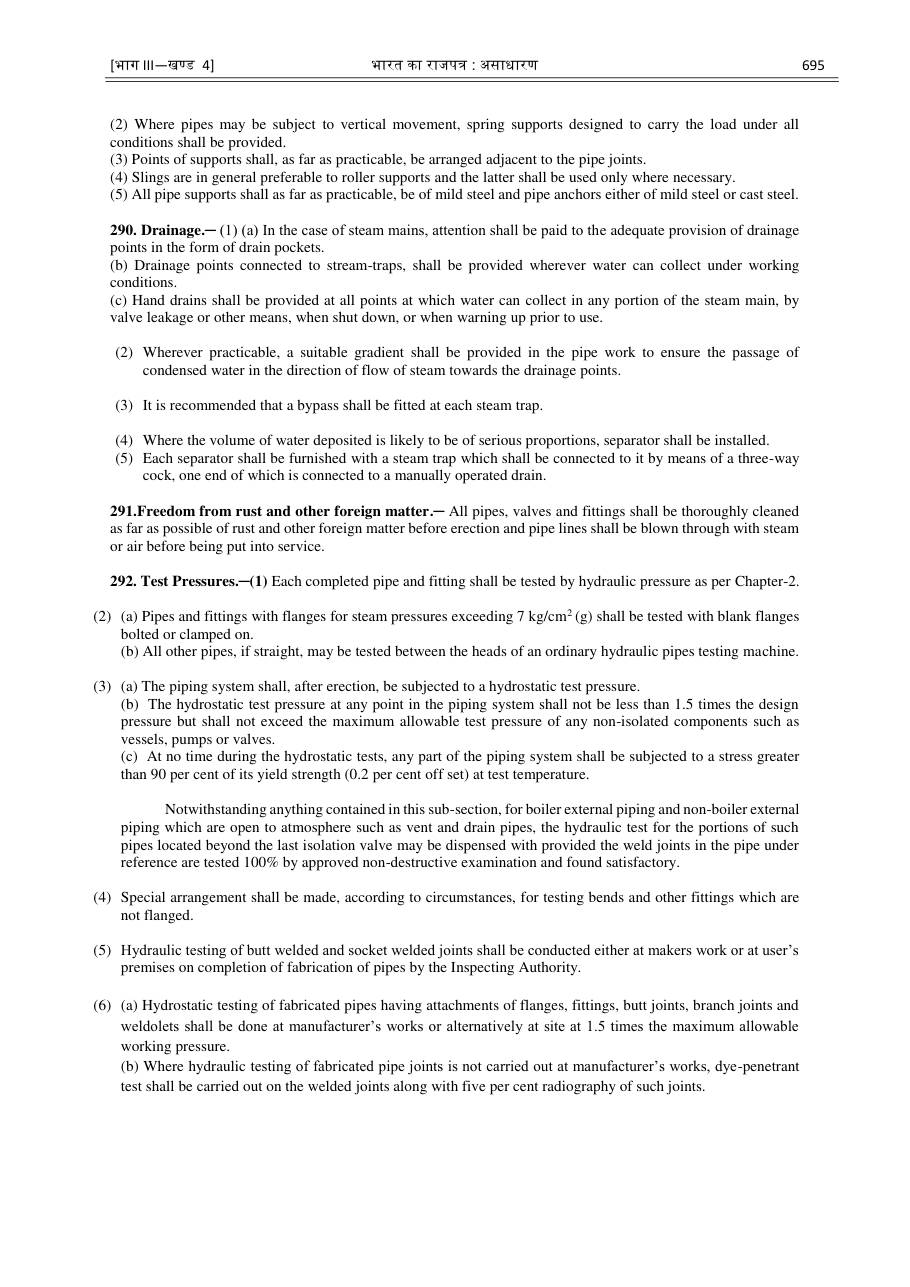
292. Test Pressures.─(1) Each completed pipe and fitting shall be tested by hydraulic pressure as per Chapter-2.
(2)(a) Pipes and fittings with flanges for steam pressures exceeding 7 kg/cm2 (g) shall be tested with blank flanges bolted or clamped on.
(b)All other pipes, if straight, may be tested between the heads of an ordinary hydraulic pipes testing machine.
(3)(a) The piping system shall, after erection, be subjected to a hydrostatic test pressure.
(b)The hydrostatic test pressure at any point in the piping system shall not be less than 1.5 times the design pressure but shall not exceed the maximum allowable test pressure of any non-isolated components such as vessels, pumps or valves.
(c)At no time during the hydrostatic tests, any part of the piping system shall be subjected to a stress greater than 90 per cent of its yield strength (0.2 per cent off set) at test temperature.
Notwithstanding anything contained in this sub-section, for boiler external piping and non-boiler external piping which are open to atmosphere such as vent and drain pipes, the hydraulic test for the portions of such pipes located beyond the last isolation valve may be dispensed with provided the weld joints in the pipe under reference are tested 100% by approved non-destructive examination and found satisfactory.
(4)Special arrangement shall be made, according to circumstances, for testing bends and other fittings which are not flanged.
(5)Hydraulic testing of butt welded and socket welded joints shall be conducted either at makers work or at user’s premises on completion of fabrication of pipes by the Inspecting Authority.
(6)(a) Hydrostatic testing of fabricated pipes having attachments of flanges, fittings, butt joints, branch joints and weldolets shall be done at manufacturer’s works or alternatively at site at 1.5 times the maximum allowable working pressure.
(b)Where hydraulic testing of fabricated pipe joints is not carried out at manufacturer’s works, dye-penetrant test shall be carried out on the welded joints along with five per cent radiography of such joints.
In short
This regulation sets hydraulic test requirements for pipes and fittings, and for the erected piping system.
Key points
- (1) Each completed pipe and fitting is hydraulically tested as per Chapter-2.
- (2) Flanged pipes and fittings for steam pressures over 7 kg/cm2 (g) are tested with blank flanges bolted or clamped on. Other straight pipes may be tested in an ordinary pipe testing machine.
- (3) After erection, the system gets a hydrostatic test of not less than 1.5 times the design pressure at any point. It must not exceed the allowable test pressure of any non-isolated component, and no part may be stressed above 90 per cent of yield strength (0.2 per cent offset) at test temperature.
- (4) Special arrangements are made for unflanged bends and fittings.
- (5) Butt and socket welded joints are hydraulically tested by the Inspecting Authority at the maker's works or the user's premises.
- (6) Fabricated pipes with flanges, fittings, butt and branch joints and weldolets are tested at 1.5 times the maximum allowable working pressure, at the works or at site. If not tested at the works, welds get dye-penetrant testing plus five per cent radiography.
Watch out
- Vent and drain pipes open to atmosphere need no hydraulic test beyond the last isolation valve, if their welds are 100% tested by approved NDE and found satisfactory.
Written by IBRsource editors · last edited 2026-11-20. Explanations simplify and are not a design method, testing procedure or authorisation. Requirements come from the complete regulations, the Gazette and approved documentation.
Comparison pending: the IBR 1950 text in force on 30 September 2026 is not yet established for this provision, so no change is claimed (how this works).
Orientation hints (unverified)
These candidates come from automated heading matching against DPIIT's scanned historical print edition of IBR 1950. That edition uses imperial units and riveted-construction provisions, so it is not the operative 2026 predecessor text. Regulation numbers alone never prove equivalence.
No candidate heading found in the historical print edition.
Images of the official Gazette pages that contain this regulation. Click to zoom. Compare word by word before relying on the extracted text.
Indian Boiler Regulations, 2026, reg. 292, Regulation 292, Gazette of India, Extraordinary, Part III—Section 4, No. 596, 1 October 2026, printed p.695–696. https://egazette.gov.in/WriteReadData/2026/276813.pdf (text consulted via IBRsource, 2026-11-23).
The citation refers to the government publication. Cite the Gazette, not this website.