
Indian Boiler Regulations, 2026 · Chapter 7 · Pipes and Fittings
Regulation 289. Pipe work supports
Not yet checked against the official Gazette; verify before relying on it.
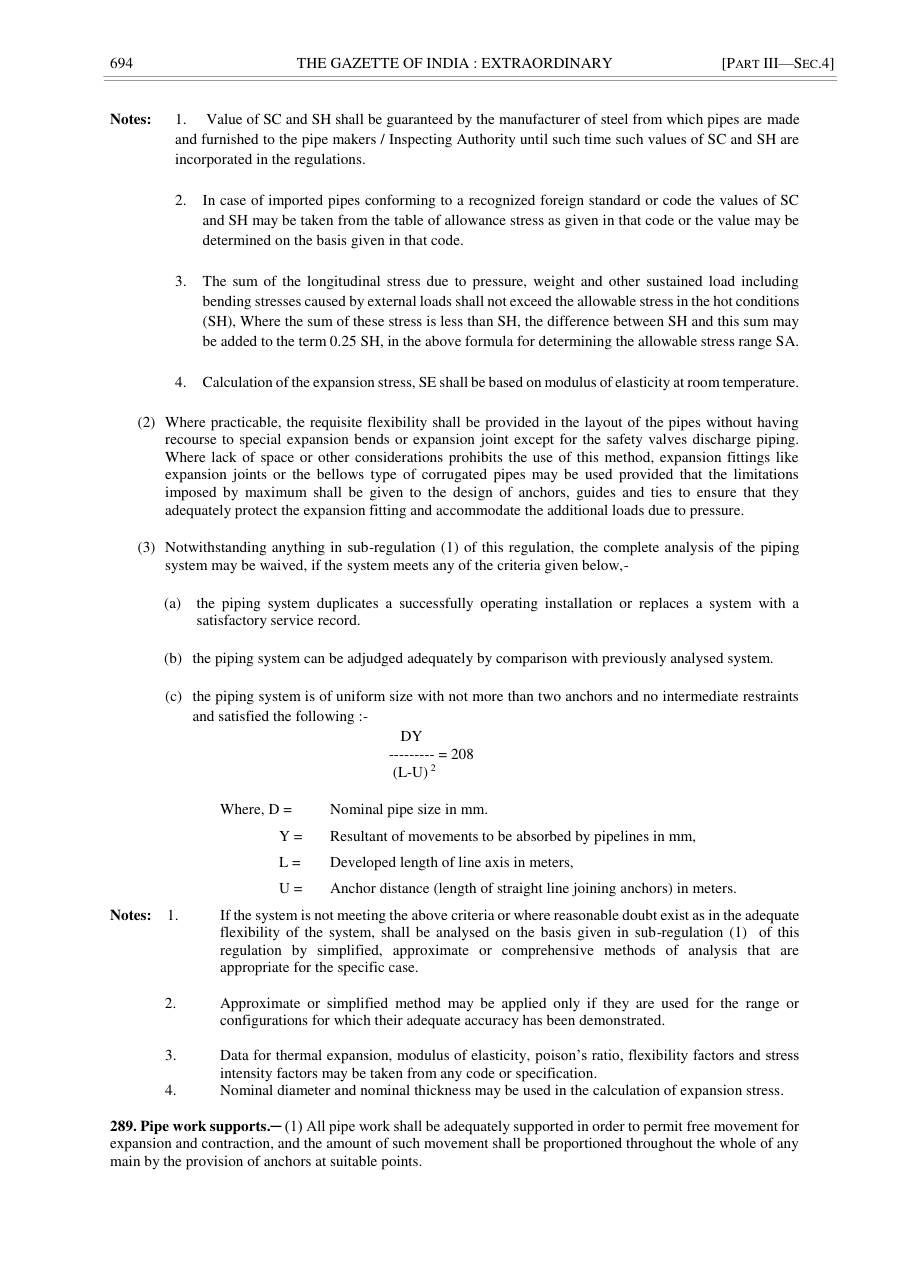
289. Pipe work supports.─ (1) All pipe work shall be adequately supported in order to permit free movement for expansion and contraction, and the amount of such movement shall be proportioned throughout the whole of any main by the provision of anchors at suitable points.
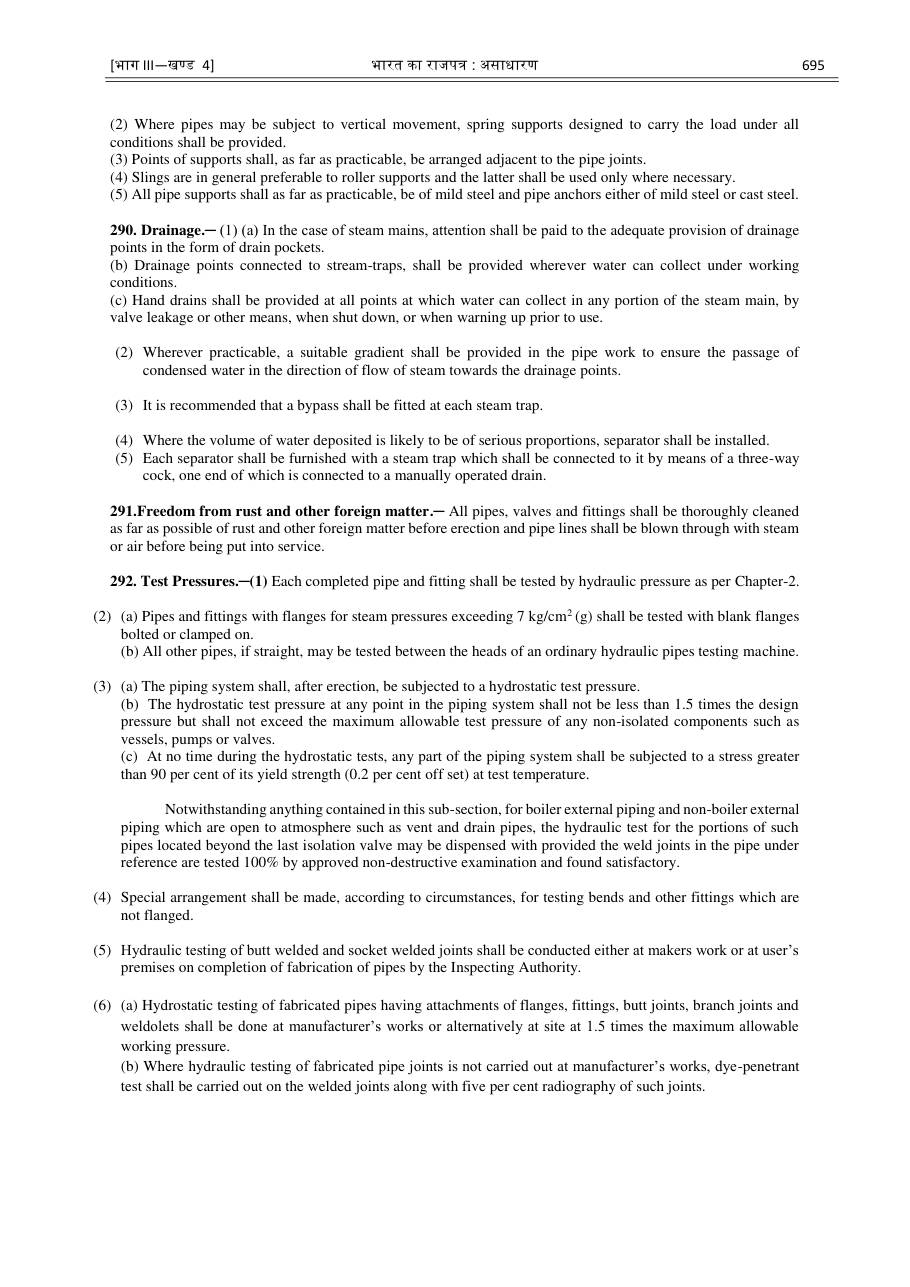
(2)Where pipes may be subject to vertical movement, spring supports designed to carry the load under all conditions shall be provided.
(3)Points of supports shall, as far as practicable, be arranged adjacent to the pipe joints.
(4)Slings are in general preferable to roller supports and the latter shall be used only where necessary.
(5)All pipe supports shall as far as practicable, be of mild steel and pipe anchors either of mild steel or cast steel.
In short
Pipe work must be properly supported so that it can expand and contract freely.
Key points
- (1) Anchors at suitable points must spread the expansion movement throughout each main.
- (2) Pipes subject to vertical movement need spring supports designed for the load under all conditions.
- (3) Supports should, as far as practicable, be next to pipe joints.
- (4) Slings are generally preferable to roller supports; rollers only where necessary.
- (5) Supports should as far as practicable be mild steel; anchors mild steel or cast steel.
Written by IBRsource editors · last edited 2026-11-20. Explanations simplify and are not a design method, testing procedure or authorisation. Requirements come from the complete regulations, the Gazette and approved documentation.
Comparison pending: the IBR 1950 text in force on 30 September 2026 is not yet established for this provision, so no change is claimed (how this works).
Orientation hints (unverified)
These candidates come from automated heading matching against DPIIT's scanned historical print edition of IBR 1950. That edition uses imperial units and riveted-construction provisions, so it is not the operative 2026 predecessor text. Regulation numbers alone never prove equivalence.
No candidate heading found in the historical print edition.
Images of the official Gazette pages that contain this regulation. Click to zoom. Compare word by word before relying on the extracted text.
Indian Boiler Regulations, 2026, reg. 289, Regulation 289, Gazette of India, Extraordinary, Part III—Section 4, No. 596, 1 October 2026, printed p.694–695. https://egazette.gov.in/WriteReadData/2026/276813.pdf (text consulted via IBRsource, 2026-11-23).
The citation refers to the government publication. Cite the Gazette, not this website.