
Indian Boiler Regulations, 2026 · Chapter 7 · Pipes and Fittings
Regulation 254. Method of manufacture, heat treatment and marking
Not yet checked against the official Gazette; verify before relying on it.
254. Method of manufacture, heat treatment and marking.─ (1) On completion of any work which involves heating, whether for hot bending of the pipe or for any other similar purpose, the pipe shall be carefully annealed.
(2)(a) The cold drawn seamless carbon steel pipes and welded carbon steel pipes shall be supplied in normalised condition.
(b)Hot finished seamless carbon steel pipes shall be supplied in hot finished condition or in normalised condition at the option of the manufacturer.
(c)The seamless alloy steel pipe either cold finished or hot finished and welded pipes shall be supplied in normalised and tempered condition.
(d)By agreement between the users and the manufacturer, the pipes may be delivered in a condition other than normalised and tempered condition in which case they shall be suitable for subsequent manipulation and the user shall be informed of the heat-treatment necessary to give required properties.
(3)(a) (i) Pipe bending and forming (reducing or swaging) operation shall be done by any hot or cold method and to any radius which shall result in a surface free from cracks, buckles or other defects as determined by the method of inspection specified in the design.
(ii)A post bending or post forming heat treatment for carbon steel material is required with a nominal wall thickness in excess of 19 mm unless the bending or forming operation are performed and completed at normalizing temperatures, where no further heat treatment is required.
(iii)The heat treatment where required, shall be normalised or stress relieved, as the case may be.
(b)A post bending or post forming heat treatment shall be required for all ferritic alloy steel material with nominal pipe size 100 mm and larger or with a nominal thickness 13 mm or greater.
(c)(i) If hot bending or forming is performed the material shall receive normalize and temper or tempering heat-treatment as required by the design.
(ii)For cold operation, tempering heat-treatment shall be applied.
(4)Marking shall be carried out in accordance with regulation 329.
In short
This regulation covers heat treatment of pipes after heating, bending and forming, the delivery condition of pipes, and marking.
Key points
- (1) After any work involving heating, such as hot bending, the pipe must be carefully annealed.
- (2) Delivery condition: cold drawn seamless and welded carbon steel pipes normalised; hot finished seamless carbon steel pipes hot finished or normalised (manufacturer's option); seamless and welded alloy steel pipes normalised and tempered. By agreement, another condition is allowed if the pipes suit later manipulation and the user is told the heat treatment needed.
- (3)(a) Bending and forming may be hot or cold to any radius giving a surface free of cracks, buckles or other defects. Carbon steel with nominal wall thickness over 19 mm needs post bending or forming heat treatment (normalised or stress relieved), unless the work is done and completed at normalizing temperature.
- (3)(b) Ferritic alloy steel needs post bending or forming heat treatment for nominal pipe size 100 mm and larger or nominal thickness 13 mm or greater.
- (3)(c) Hot bending or forming: normalize and temper, or temper, as the design requires. Cold operations: tempering.
- (4) Marking per regulation 329.
Written by IBRsource editors · last edited 2026-11-20. Explanations simplify and are not a design method, testing procedure or authorisation. Requirements come from the complete regulations, the Gazette and approved documentation.
Comparison pending: the IBR 1950 text in force on 30 September 2026 is not yet established for this provision, so no change is claimed (how this works).
Orientation hints (unverified)
These candidates come from automated heading matching against DPIIT's scanned historical print edition of IBR 1950. That edition uses imperial units and riveted-construction provisions, so it is not the operative 2026 predecessor text. Regulation numbers alone never prove equivalence.
| Historical 1950-edition reg. | Heading as OCR'd | Heading similarity | Source image |
|---|---|---|---|
| 348 | Method of manufacture, Heat treatment and Marking | 100% | Chapter VIII (DPIIT scan), image 3 |
| 423 | Heat Treatment | 100% | Chapter X (DPIIT scan), image 7 |
| 629 | Heat Treatment | 100% | Chapter XV (DPIIT scan), image 2 |
Amendment history of the candidate IBR 1950 regulations: Reg. 348 (1 amendment)
IBR 1950 regulation 348 as last published in the DPIIT web edition (archived 2022)
Unofficial archived copy, not verified; see the regulation 348 page for its amendments.
| Reg. 348 Method of manufacture, Heat treatment and Marking
|
IBR 1950 regulation 423 as last published in the DPIIT web edition (archived 2022)
Unofficial archived copy, not verified; see the regulation 423 page for its amendments.
| Reg. 420, Reg. 421, Reg. 422, Reg. 423
Reg. 421
Reg. 422
Reg. 423
|
Images of the official Gazette pages that contain this regulation. Click to zoom. Compare word by word before relying on the extracted text.
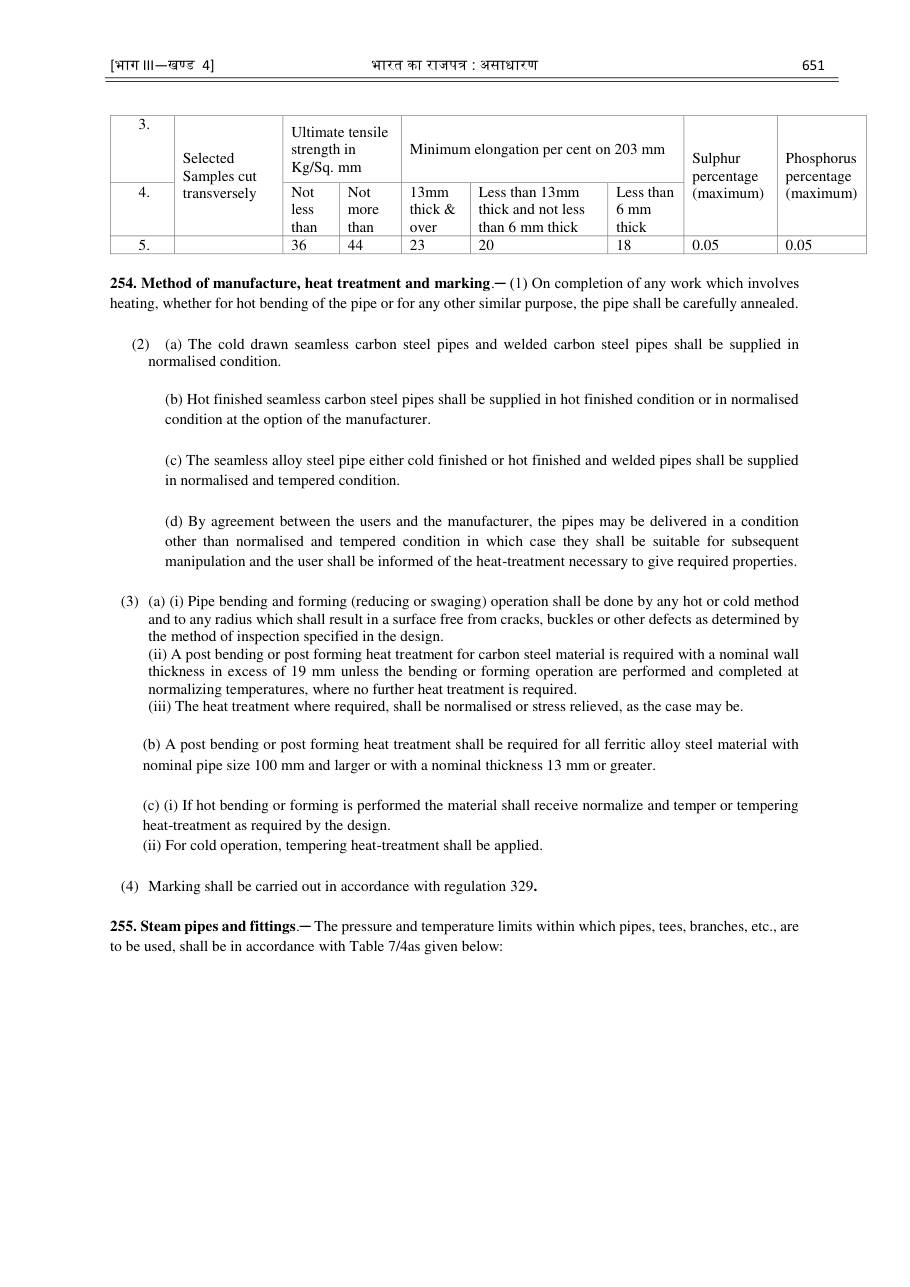
Indian Boiler Regulations, 2026, reg. 254, Regulation 254, Gazette of India, Extraordinary, Part III—Section 4, No. 596, 1 October 2026, printed p.651. https://egazette.gov.in/WriteReadData/2026/276813.pdf (text consulted via IBRsource, 2026-11-23).
The citation refers to the government publication. Cite the Gazette, not this website.