
Indian Boiler Regulations, 2026 · Chapter 5 · Valves, Gauges and Auxiliaries
Regulation 212. Materials
Not yet checked against the official Gazette; verify before relying on it.
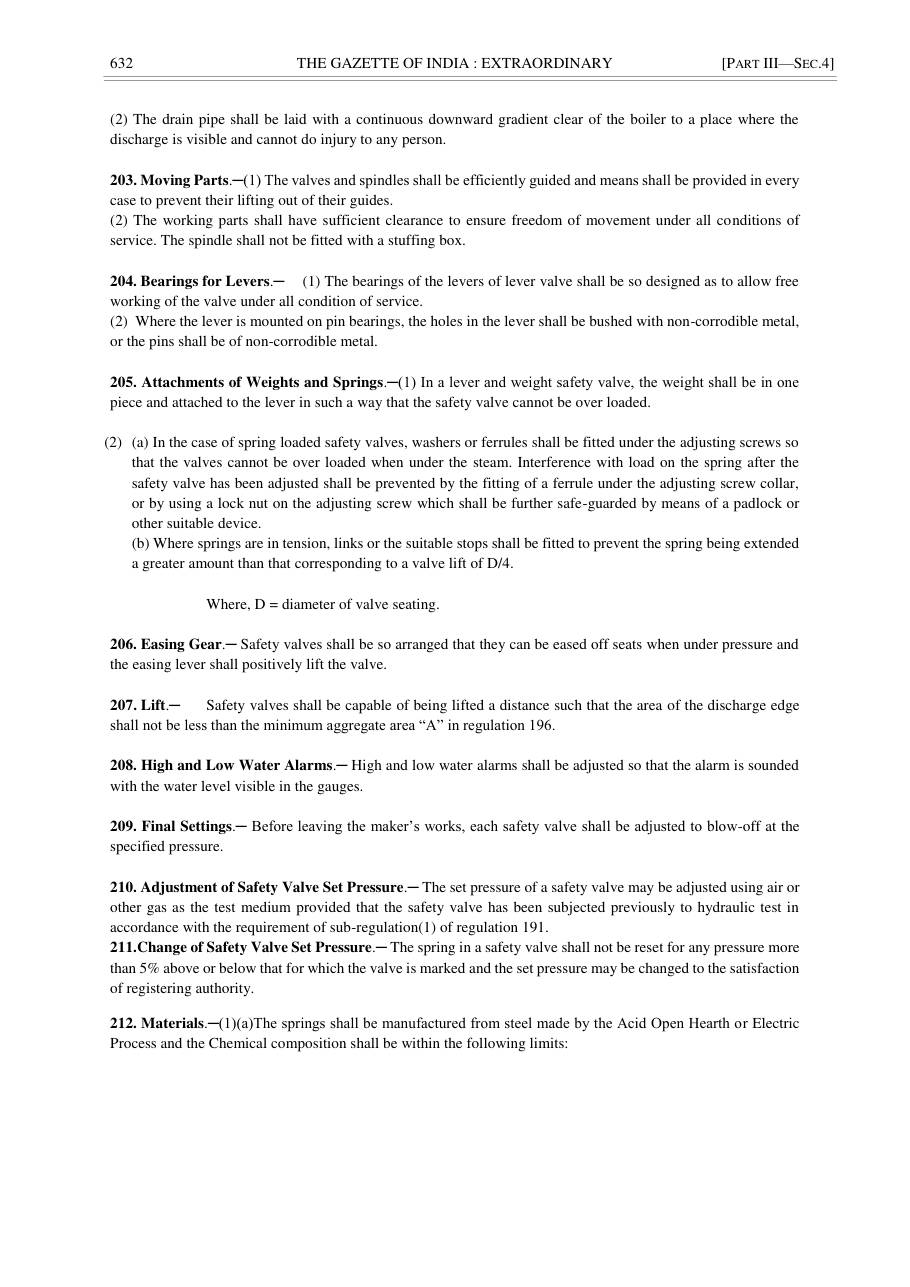
212. Materials.─(1)(a)The springs shall be manufactured from steel made by the Acid Open Hearth or Electric Process and the Chemical composition shall be within the following limits:
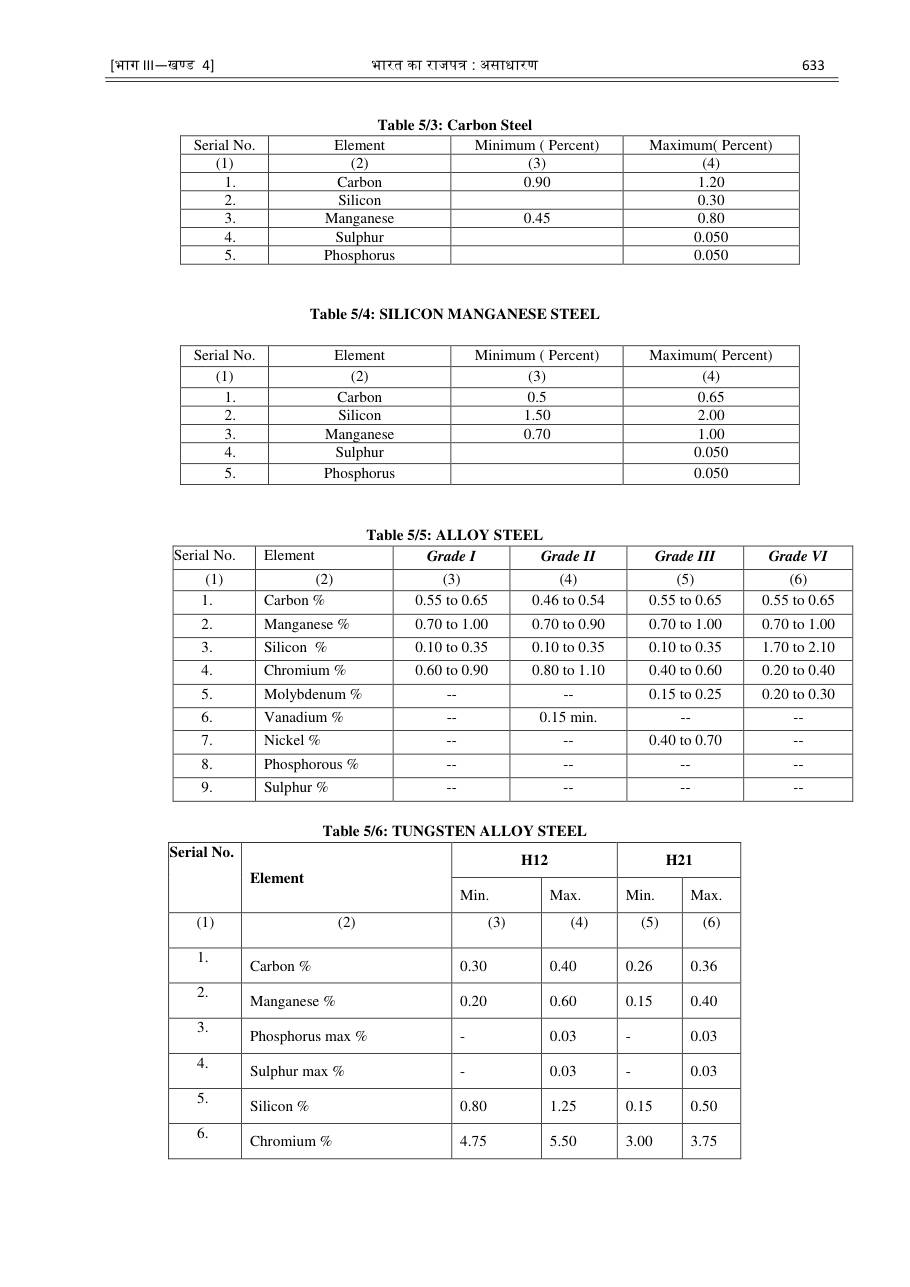
| Serial No. | Element | Minimum ( Percent) | Maximum( Percent) |
|---|---|---|---|
| (1) | (2) | (3) | (4) |
| 1. | Carbon | 0.90 | 1.20 |
| 2. | Silicon | 0.30 | |
| 3. | Manganese | 0.45 | 0.80 |
| 4. | Sulphur | 0.050 | |
| 5. | Phosphorus | 0.050 | |
| 1. | Carbon | 0.5 | 0.65 |
| 2. | Silicon | 1.50 | 2.00 |
| 3. | Manganese | 0.70 | 1.00 |
| 4. | Sulphur | 0.050 | |
| 5. | Phosphorus | 0.050 |
Table structure read from the Gazette PDF, page 633. Verification status as for the text above.
Show original extracted text (diagnostic, not authoritative)
                Serial No.                     Table 5/3: Carbon Steel                  Maximum( Percent)
                     (1)                                                                          (4)
                      1.                  Element         Minimum ( Percent)                     1.20
                      2.                                                                         0.30
                      3.                  (2)                     (3)                            0.80
                      4.
                      5.                  Carbon                  0.90                          0.050
                                                                                                0.050
                                          Silicon

                                      Manganese                   0.45

                                          Sulphur

                                      Phosphorus

                            Table 5/4: SILICON MANGANESE STEEL

Serial No.                              Element           Minimum ( Percent)            Maximum( Percent)
    (1)                                    (2)                      (3)                           (4)
      1.                                                            0.5                          0.65
      2.                                Carbon                     1.50                          2.00
      3.                                Silicon                    0.70                          1.00
4. Manganese
Original extracted text of the table above, continued (diagnostic)
5.                                Sulphur                                                 0.050
                                Phosphorus                                                0.050
Table 5/5: ALLOY STEEL
| Serial No. | Element | Grade I | Grade II | Grade III | Grade VI |
|---|---|---|---|---|---|
| (1) | (2) | (3) | (4) | (5) | (6) |
| 1. | Carbon % | 0.55 to 0.65 | 0.46 to 0.54 | 0.55 to 0.65 | 0.55 to 0.65 |
| 2. | Manganese % | 0.70 to 1.00 | 0.70 to 0.90 | 0.70 to 1.00 | 0.70 to 1.00 |
| 3. | Silicon % | 0.10 to 0.35 | 0.10 to 0.35 | 0.10 to 0.35 | 1.70 to 2.10 |
| 4. | Chromium % | 0.60 to 0.90 | 0.80 to 1.10 | 0.40 to 0.60 | 0.20 to 0.40 |
| 5. | Molybdenum % | -- | -- | 0.15 to 0.25 | 0.20 to 0.30 |
| 6. | Vanadium % | -- | 0.15 min. | -- | -- |
| 7. | Nickel % | -- | -- | 0.40 to 0.70 | -- |
| 8. | Phosphorous % | -- | -- | -- | -- |
| 9. | Sulphur % | -- | -- | -- | -- |
| Serial No. | Element | H12 | H21 | ||
| Min. | Max. | Min. | Max. | ||
| (1) | (2) | (3) | (4) | (5) | (6) |
| 1. | Carbon % | 0.30 | 0.40 | 0.26 | 0.36 |
| 2. | Manganese % | 0.20 | 0.60 | 0.15 | 0.40 |
| 3. | Phosphorus max % | - | 0.03 | - | 0.03 |
| 4. | Sulphur max % | - | 0.03 | - | 0.03 |
| 5. | Silicon % | 0.80 | 1.25 | 0.15 | 0.50 |
| 6. | Chromium % | 4.75 | 5.50 | 3.00 | 3.75 |
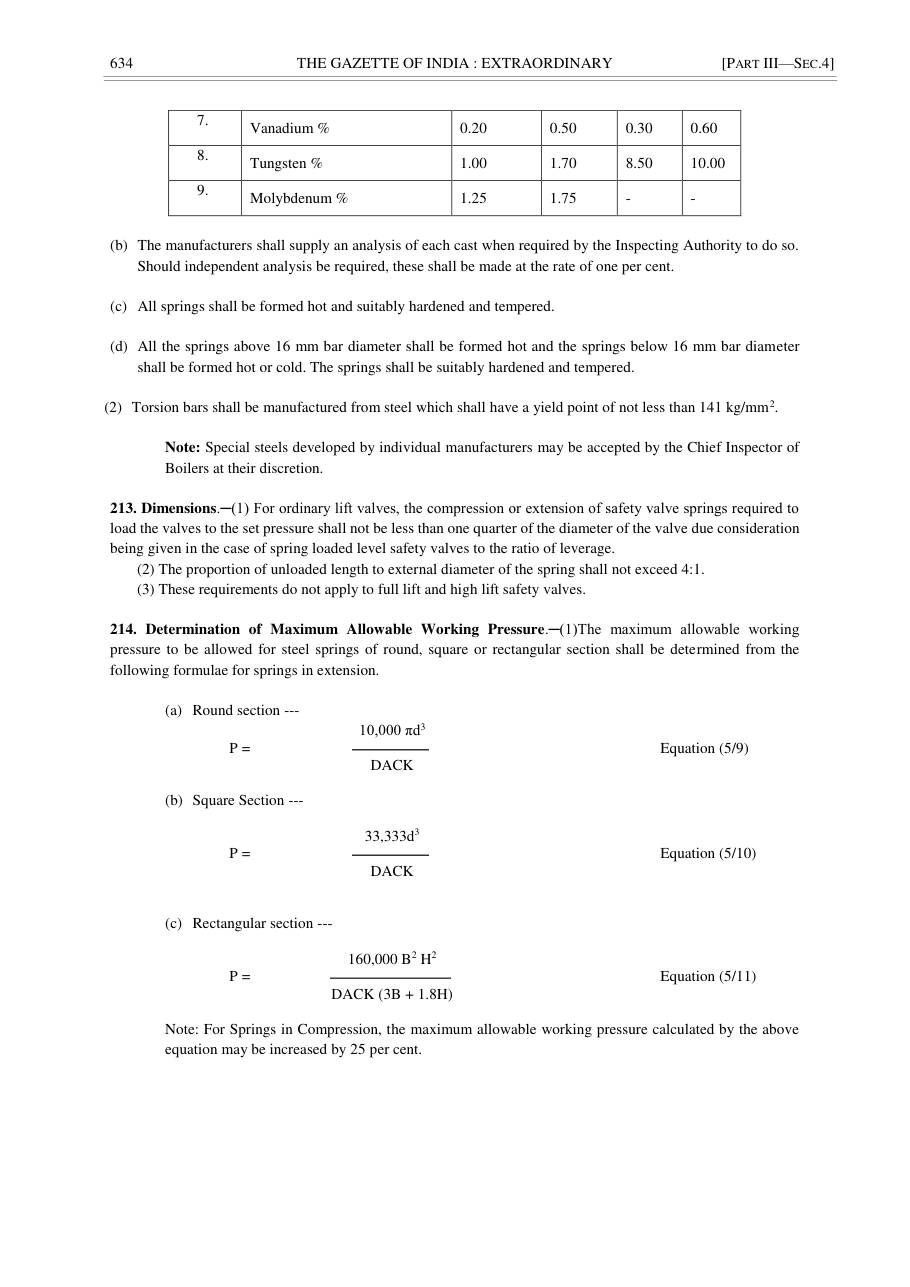
| 7. | Vanadium % | 0.20 | 0.50 | 0.30 | 0.60 |
| 8. | Tungsten % | 1.00 | 1.70 | 8.50 | 10.00 |
| 9. | Molybdenum % | 1.25 | 1.75 | - | - |
Table structure read from the Gazette PDF, pages 633, 634. Verification status as for the text above.
Show original extracted text (diagnostic, not authoritative)
Serial No.                  Element                Grade I                Grade II       Grade III     Grade VI
      (1)                                                                                    (5)           (6)
     1.                              (2)           (3)                    (4)
     2.                                                                                 0.55 to 0.65  0.55 to 0.65
     3.                     Carbon %               0.55 to 0.65   0.46 to 0.54          0.70 to 1.00  0.70 to 1.00
     4.                                                                                 0.10 to 0.35  1.70 to 2.10
     5.                     Manganese %            0.70 to 1.00   0.70 to 0.90          0.40 to 0.60  0.20 to 0.40
     6.                                                                                 0.15 to 0.25  0.20 to 0.30
     7.                     Silicon %              0.10 to 0.35   0.10 to 0.35
     8.                                                                                       --            --
     9.                     Chromium %             0.60 to 0.90   0.80 to 1.10          0.40 to 0.70        --
                                                                                                            --
                            Molybdenum %           --                     --                  --            --
                                                                                              --
                            Vanadium %             --                     0.15 min.

                            Nickel %               --                     --

                            Phosphorous %          --                     --

                            Sulphur %              --                     --

Serial No.                            Table 5/6: TUNGSTEN ALLOY STEEL                        H21
     (1)                                                                     H12

            Element

                                                       Min.               Max.       Min.    Max.
                                                                                        (5)    (6)
                                          (2)                (3)          (4)

1. Carbon %                                            0.30               0.40       0.26    0.36
2. Manganese %
3. Phosphorus max %                                    0.20               0.60       0.15    0.40
4. Sulphur max %
5. Silicon %                                           -                  0.03       -       0.03
6. Chromium %
                                                       -                  0.03       -       0.03

                                                       0.80               1.25       0.15    0.50

                                                       4.75               5.50       3.00    3.75


     7. Vanadium %                            0.20  0.50                 0.30  0.60
     8. Tungsten %
     9. Molybdenum %                          1.00  1.70                 8.50  10.00
Original extracted text of the table above, continued (diagnostic)
1.25 1.75 - -
(b)The manufacturers shall supply an analysis of each cast when required by the Inspecting Authority to do so. Should independent analysis be required, these shall be made at the rate of one per cent.
(c)All springs shall be formed hot and suitably hardened and tempered.
(d)All the springs above 16 mm bar diameter shall be formed hot and the springs below 16 mm bar diameter shall be formed hot or cold. The springs shall be suitably hardened and tempered.
(2)Torsion bars shall be manufactured from steel which shall have a yield point of not less than 141 kg/mm2.
Note: Special steels developed by individual manufacturers may be accepted by the Chief Inspector of Boilers at their discretion.
Parts of this extracted text look garbled; read the Gazette page before using any value.
Tables and formulae are shown in their extracted layout. Alignment, superscripts and subscripts may be lost. The Gazette page image is authoritative.
In short
Regulation 212 sets material requirements for safety valve springs and torsion bars.
Key points
- (1)(a) Springs are made from steel produced by the Acid Open Hearth or Electric Process, with chemical composition within Tables 5/3 (carbon steel), 5/4 (silicon manganese steel), 5/5 (alloy steel) and 5/6 (tungsten alloy steel). The tables are broken in the extracted text, so check the Gazette page for the exact limits.
- (1)(b) Manufacturers must supply an analysis of each cast when the Inspecting Authority asks. Independent analyses, if required, are made at the rate of one per cent.
- (1)(c) and (d) Springs must be suitably hardened and tempered. Springs above 16 mm bar diameter are formed hot; springs below 16 mm may be formed hot or cold.
- (2) Torsion bars must be made from steel with a yield point of not less than 141 kg/mm².
Watch out
- Clause (c) says all springs are formed hot, while clause (d) allows springs below 16 mm to be formed hot or cold. Read both together on the Gazette page.
- A note allows the Chief Inspector of Boilers, at their discretion, to accept special steels developed by individual manufacturers.
Written by IBRsource editors · last edited 2026-11-20. Explanations simplify and are not a design method, testing procedure or authorisation. Requirements come from the complete regulations, the Gazette and approved documentation.
Comparison pending: the IBR 1950 text in force on 30 September 2026 is not yet established for this provision, so no change is claimed (how this works).
Orientation hints (unverified)
These candidates come from automated heading matching against DPIIT's scanned historical print edition of IBR 1950. That edition uses imperial units and riveted-construction provisions, so it is not the operative 2026 predecessor text. Regulation numbers alone never prove equivalence.
| Historical 1950-edition reg. | Heading as OCR'd | Heading similarity | Source image |
|---|---|---|---|
| 6 | Standard specifications for materials | 100% | Chapter I (DPIIT scan), image 3 |
| 626 | Materials | 100% | Chapter XV (DPIIT scan), image 1 |
Amendment history of the candidate IBR 1950 regulations: Reg. 626 (1 amendment)
IBR 1950 regulation 6 as last published in the DPIIT web edition (archived 2022)
Unofficial archived copy, not verified; see the regulation 6 page for its amendments.
| Reg. 6 Standard specifications for materials. |
| The standard specifications for steel wrought iron and copper plates and bar, and for cast steel shall be those prescribed in Chapter II. |
IBR 1950 regulation 626 as last published in the DPIIT web edition (archived 2022)
Unofficial archived copy, not verified; see the regulation 626 page for its amendments.
| Reg. 626 FEED WATER FOR BOILER | |||||||||||||||||||||||||||||||||||||||||||||||||||||||||||||||||||||||||||||||||||||||||||||||||||||||||||||||||||||||||||||||||||||||||||||||||||||||||||||||||||||||||||||||||||||||||||||||||||||||||
Tests shall be carried out as prescribed in the appropriate clauses of IS : 3025-1964* and IS : 3550-1965! as indicated against the characteristics in Table 1.
| |||||||||||||||||||||||||||||||||||||||||||||||||||||||||||||||||||||||||||||||||||||||||||||||||||||||||||||||||||||||||||||||||||||||||||||||||||||||||||||||||||||||||||||||||||||||||||||||||||||||||
Images of the official Gazette pages that contain this regulation. Click to zoom. Compare word by word before relying on the extracted text.
Indian Boiler Regulations, 2026, reg. 212, Regulation 212, Gazette of India, Extraordinary, Part III—Section 4, No. 596, 1 October 2026, printed p.632–634. https://egazette.gov.in/WriteReadData/2026/276813.pdf (text consulted via IBRsource, 2026-11-23).
The citation refers to the government publication. Cite the Gazette, not this website.