
Indian Boiler Regulations, 2026 · Chapter 5 · Valves, Gauges and Auxiliaries
Regulation 217. Number of Effective Coils
Not yet checked against the official Gazette; verify before relying on it.
217. Number of Effective Coils.─ The number of effective or free coils in a compression or extension spring shall be determined from the following formulae:
(i)For Round or Square wire
KCd4 Equation (5/15)
N =
SD3
(ii)For Rectangular Wire Equation (5/16)
66B3H3K
N =
(B2 + H2) SD2
Where,
N = Number of effective coils,
K = Compression or tension in inches at set pressure,
C = 22 for round, 30 for square steel,
d = diameter or side of square steel in 16th of an inch,
S = load on spring in lbs. at blow off pressure,
D = mean diameter of coil in inches,
B= breadth of wire in 16th of an inch,
H= Depth of wire in 16th of an inch.
Tables and formulae are shown in their extracted layout. Alignment, superscripts and subscripts may be lost. The Gazette page image is authoritative.
In short
Regulation 217 gives the formulae for the number of effective (free) coils in a compression or extension spring.
Key points
- (i) Round or square wire: Equation (5/15).
- (ii) Rectangular wire: Equation (5/16).
- Symbols: N is the number of effective coils, K the compression or tension in inches at set pressure, S the load on the spring in lbs at blow off pressure, and D the mean coil diameter in inches. C is 22 for round and 30 for square steel.
Watch out
- Wire size d (and breadth B and depth H for rectangular wire) are in 16th of an inch, not inches.
Written by IBRsource editors · last edited 2026-11-20. Explanations simplify and are not a design method, testing procedure or authorisation. Requirements come from the complete regulations, the Gazette and approved documentation.
Comparison pending: the IBR 1950 text in force on 30 September 2026 is not yet established for this provision, so no change is claimed (how this works).
Orientation hints (unverified)
These candidates come from automated heading matching against DPIIT's scanned historical print edition of IBR 1950. That edition uses imperial units and riveted-construction provisions, so it is not the operative 2026 predecessor text. Regulation numbers alone never prove equivalence.
No candidate heading found in the historical print edition.
Images of the official Gazette pages that contain this regulation. Click to zoom. Compare word by word before relying on the extracted text.
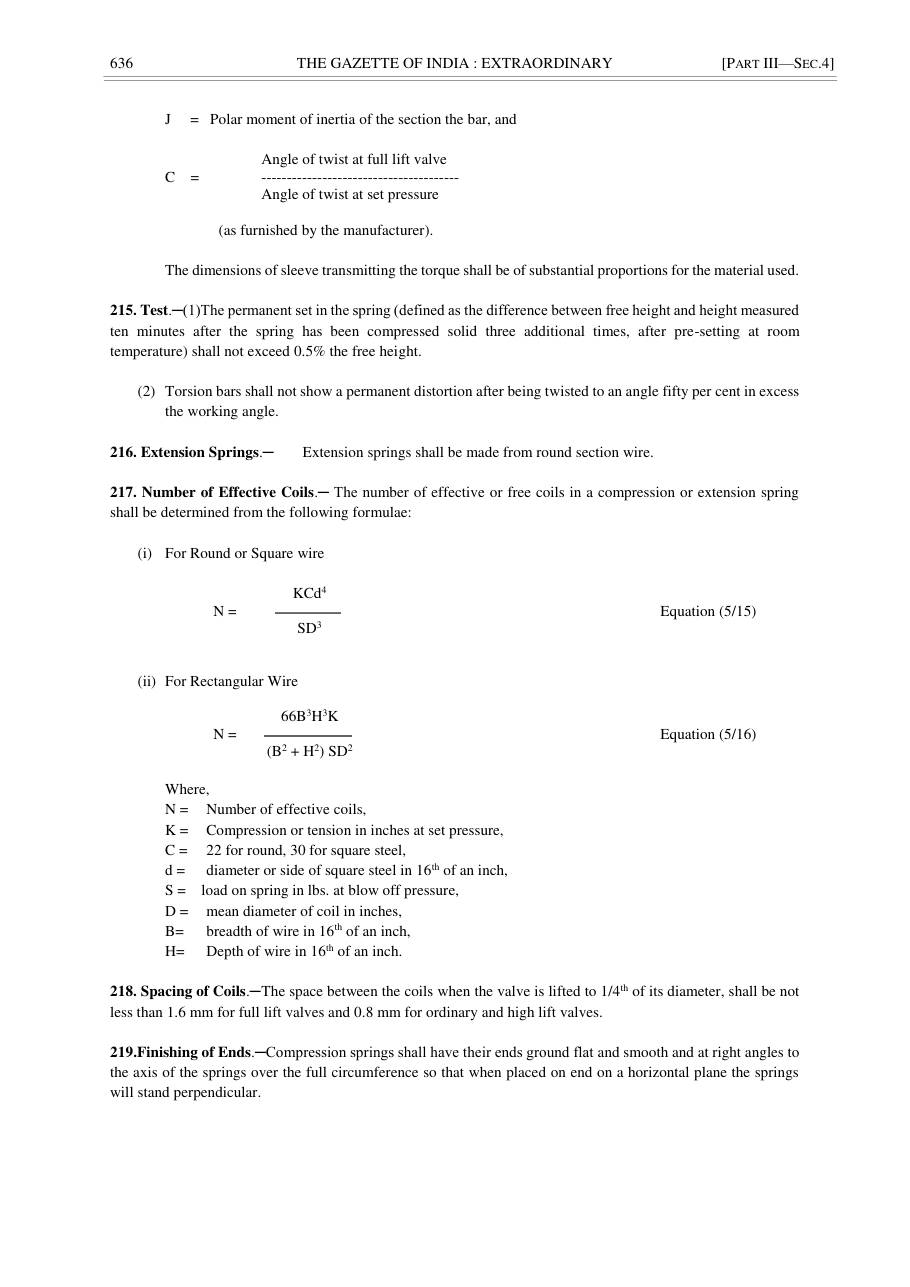
Indian Boiler Regulations, 2026, reg. 217, Regulation 217, Gazette of India, Extraordinary, Part III—Section 4, No. 596, 1 October 2026, printed p.636. https://egazette.gov.in/WriteReadData/2026/276813.pdf (text consulted via IBRsource, 2026-11-23).
The citation refers to the government publication. Cite the Gazette, not this website.