
Indian Boiler Regulations, 2026 · Chapter 5 · Valves, Gauges and Auxiliaries
Regulation 182. Additional Requirements for Automatic Boilers
Not yet checked against the official Gazette; verify before relying on it.
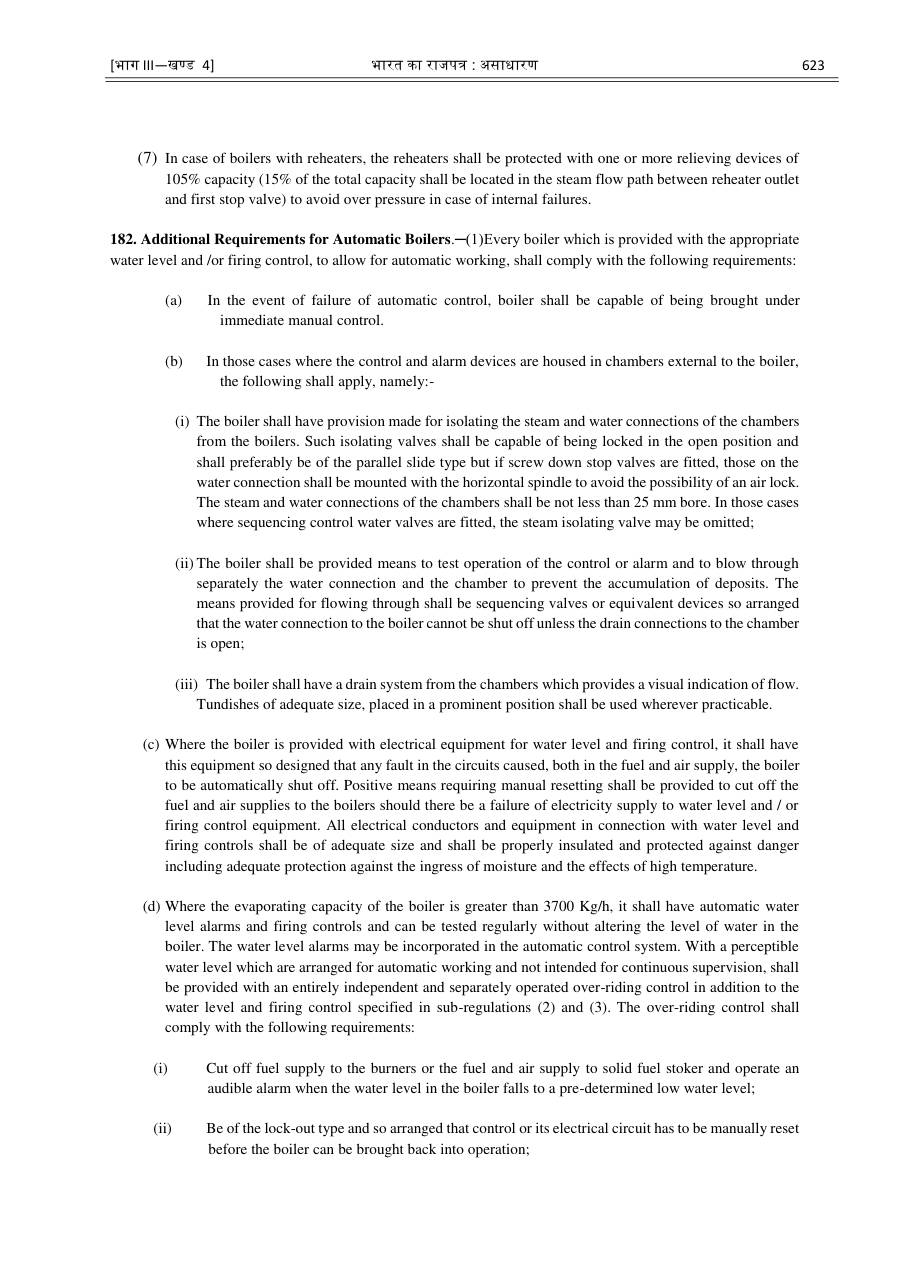
182. Additional Requirements for Automatic Boilers.─(1)Every boiler which is provided with the appropriate water level and /or firing control, to allow for automatic working, shall comply with the following requirements:
(a)In the event of failure of automatic control, boiler shall be capable of being brought under immediate manual control.
(b)In those cases where the control and alarm devices are housed in chambers external to the boiler, the following shall apply, namely:-
(i)The boiler shall have provision made for isolating the steam and water connections of the chambers from the boilers. Such isolating valves shall be capable of being locked in the open position and shall preferably be of the parallel slide type but if screw down stop valves are fitted, those on the water connection shall be mounted with the horizontal spindle to avoid the possibility of an air lock. The steam and water connections of the chambers shall be not less than 25 mm bore. In those cases where sequencing control water valves are fitted, the steam isolating valve may be omitted;
(ii)The boiler shall be provided means to test operation of the control or alarm and to blow through separately the water connection and the chamber to prevent the accumulation of deposits. The means provided for flowing through shall be sequencing valves or equivalent devices so arranged that the water connection to the boiler cannot be shut off unless the drain connections to the chamber is open;
(iii)The boiler shall have a drain system from the chambers which provides a visual indication of flow. Tundishes of adequate size, placed in a prominent position shall be used wherever practicable.
(c)Where the boiler is provided with electrical equipment for water level and firing control, it shall have this equipment so designed that any fault in the circuits caused, both in the fuel and air supply, the boiler to be automatically shut off. Positive means requiring manual resetting shall be provided to cut off the fuel and air supplies to the boilers should there be a failure of electricity supply to water level and / or firing control equipment. All electrical conductors and equipment in connection with water level and firing controls shall be of adequate size and shall be properly insulated and protected against danger including adequate protection against the ingress of moisture and the effects of high temperature.
(d)Where the evaporating capacity of the boiler is greater than 3700 Kg/h, it shall have automatic water level alarms and firing controls and can be tested regularly without altering the level of water in the boiler. The water level alarms may be incorporated in the automatic control system. With a perceptible water level which are arranged for automatic working and not intended for continuous supervision, shall be provided with an entirely independent and separately operated over-riding control in addition to the water level and firing control specified in sub-regulations (2) and (3). The over-riding control shall comply with the following requirements:
(i)Cut off fuel supply to the burners or the fuel and air supply to solid fuel stoker and operate an audible alarm when the water level in the boiler falls to a pre-determined low water level;
(ii)Be of the lock-out type and so arranged that control or its electrical circuit has to be manually reset before the boiler can be brought back into operation;
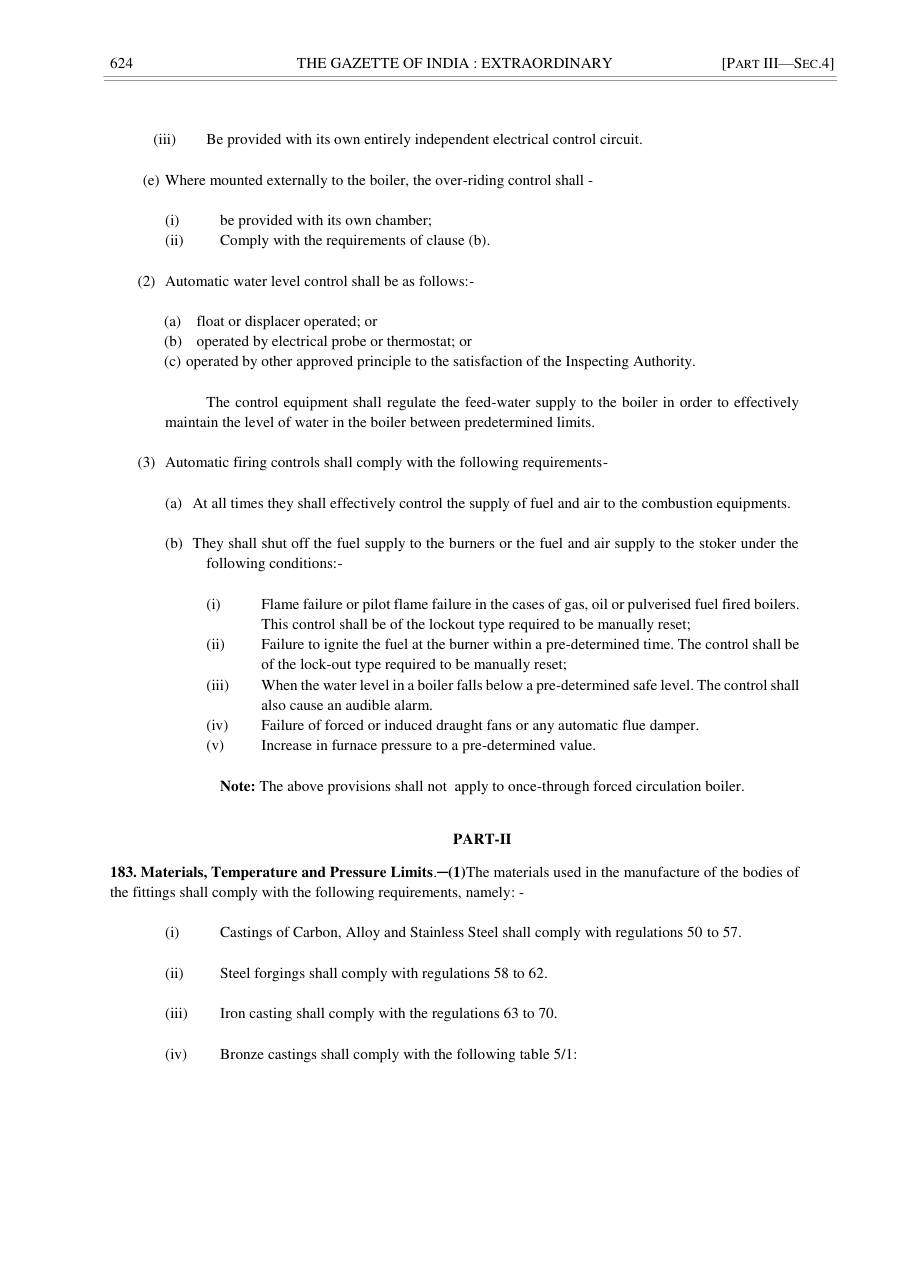
(iii)Be provided with its own entirely independent electrical control circuit.
(e)Where mounted externally to the boiler, the over-riding control shall -
(i)be provided with its own chamber;
(ii)Comply with the requirements of clause (b).
(2)Automatic water level control shall be as follows:-
(a)float or displacer operated; or
(b)operated by electrical probe or thermostat; or
(c)operated by other approved principle to the satisfaction of the Inspecting Authority.
The control equipment shall regulate the feed-water supply to the boiler in order to effectively maintain the level of water in the boiler between predetermined limits.
(3)Automatic firing controls shall comply with the following requirements-
(a)At all times they shall effectively control the supply of fuel and air to the combustion equipments.
(b)They shall shut off the fuel supply to the burners or the fuel and air supply to the stoker under the following conditions:-
(i)Flame failure or pilot flame failure in the cases of gas, oil or pulverised fuel fired boilers.
This control shall be of the lockout type required to be manually reset;
(ii)Failure to ignite the fuel at the burner within a pre-determined time. The control shall be of the lock-out type required to be manually reset;
(iii)When the water level in a boiler falls below a pre-determined safe level. The control shall also cause an audible alarm.
(iv)Failure of forced or induced draught fans or any automatic flue damper.
(v)Increase in furnace pressure to a pre-determined value.
Note: The above provisions shall not apply to once-through forced circulation boiler.
In short
Regulation 182 sets extra requirements for boilers fitted with water level and/or firing controls so that they can work automatically. It does not apply to once-through forced circulation boilers (see the note). It covers manual override, external control chambers, electrical safety, over-riding low-water control, and what the automatic water level and firing controls must do.
Key points
- (1)(a) If the automatic control fails, the boiler must be capable of being brought under immediate manual control.
- (1)(b) Where control and alarm devices sit in chambers outside the boiler:
- (i) the steam and water connections of the chambers must be isolatable from the boiler, with isolating valves that can be locked open. Parallel slide valves are preferred; if screw-down stop valves are used, those on the water connection must have a horizontal spindle to avoid an air lock. Connections must be not less than 25 mm bore;
- (ii) there must be a means to test the control or alarm and to blow through the water connection and the chamber separately, using sequencing valves or equivalent devices so the water connection cannot be shut off unless the chamber drain is open;
- (iii) the chamber drain system must give a visual indication of flow, with tundishes in a prominent position wherever practicable.
- (1)(c) With electrical water level and firing control, a circuit fault must automatically shut off the boiler's fuel and air supply. A failure of electricity supply to this equipment must cut off fuel and air by positive means that need manual resetting. Conductors and equipment must be properly sized, insulated and protected, including against moisture and high temperature.
- (1)(d) Boilers with evaporating capacity greater than 3700 Kg/h need automatic water level alarms and firing controls that can be tested without altering the water level. Boilers with a perceptible water level, arranged for automatic working and not intended for continuous supervision, also need an entirely independent, separately operated over-riding control. It must cut off fuel (or fuel and air to a solid fuel stoker) and sound an audible alarm at a pre-determined low water level, be of the lock-out type needing manual reset, and have its own independent electrical circuit.
- (1)(e) An externally mounted over-riding control needs its own chamber and must meet clause (b).
- (2) Automatic water level control may be float or displacer operated, electrical probe or thermostat operated, or another principle approved by the Inspecting Authority. It must keep the water level between predetermined limits.
- (3) Automatic firing controls must always control fuel and air, and must shut off fuel on flame or pilot flame failure (gas, oil or pulverised fuel), failure to ignite within a pre-determined time, low water level (with an audible alarm), failure of draught fans or an automatic flue damper, and furnace pressure rising to a pre-determined value. The flame failure and ignition failure controls must be lock-out type with manual reset.
Watch out
- Where sequencing control water valves are fitted, the steam isolating valve on the chambers may be omitted.
- A note says these provisions do not apply to once-through forced circulation boilers.
Written by IBRsource editors · last edited 2026-11-20. Explanations simplify and are not a design method, testing procedure or authorisation. Requirements come from the complete regulations, the Gazette and approved documentation.
Comparison pending: the IBR 1950 text in force on 30 September 2026 is not yet established for this provision, so no change is claimed (how this works).
Orientation hints (unverified)
These candidates come from automated heading matching against DPIIT's scanned historical print edition of IBR 1950. That edition uses imperial units and riveted-construction provisions, so it is not the operative 2026 predecessor text. Regulation numbers alone never prove equivalence.
| Historical 1950-edition reg. | Heading as OCR'd | Heading similarity | Source image |
|---|---|---|---|
| 66 | Additional Tests | 77% | Chapter II (DPIIT scan), image 13 |
| 94 | General requirements | 75% | Chapter II (DPIIT scan), image 19 |
| 625 | General requirements | 75% | Chapter XV (DPIIT scan), image 1 |
Amendment history of the candidate IBR 1950 regulations: Reg. 625 (1 amendment)
IBR 1950 regulation 94 as last published in the DPIIT web edition (archived 2019)
Unofficial archived copy, not verified; see the regulation 94 page for its amendments.
| Reg. 94 MATERIALS OF CONSTRUCTION COVERED ELECTRODES FOR METAL ARC WELDING OF MILD STEEL General requirements |
| (1) Application.- The following Regulations apply to electrodes of sizes 3/32 inch (12 S.W.G.) and larger in diameter for metal arc welding of carbon steels having ultimate tensile strength not exceeding 33 tons per square inch and Sulphur and Phosphorus contents not greater than 0.06 per cent each. Electrodes less than 3/32 inch in diameter shall not be used in boilers. The electrodes shall comply with the requirements of physical tests prescribed for each class. Their characteristics and behaviour under ordinary working conditions shall be such that satisfactory weld deposits can be made by a welder of average skill and experience and that the following characteristics are also obtained:-
(2) Classification.- The electrodes shall be classified into:
(3) Manufacture.- Electrodes may be made by any method that shall yield a product conforming to the requirements of these Regulations. (4) Size of Electrodes.- The nominal size of the electrodes shall refer to the diameter of the core wire and the length shall not exceed 18 inches. Provision shall be made for end or centre gripping. The tolerances on the specified diameter of the core wire of the electrodes shall be plus or minus 0.002 inch. (5) Covering.- The flux covering shall be sufficiently robust to withstand the normal conditions of transport, storage, handling and use, without damage and shall be uniform in thickness all over so that it fuses evenly. The variation in the thickness shall not exceed 3 per cent. (6) (a) Packing and storage.- Electrodes shall be suitably packed to guard against damage during transportation. When stored, the electrodes shall be kept in their original bundles or packings in a dry store room and under such conditions, the electrodes shall for a period of at least six months be capable of giving results similar to those which they would have given on the date of their despatch from the manufacturer. (b) Marking.- Each package shall be marked with the following information:-
(7) Tests.- The electrodes shall be subjected to Initial tests, Periodic check tests and Production control to ensure that the requirements of these Regulations are fulfilled. Electrodes intended for use with more than one type of current or polarity shall be tested using each type of current and polarity. Where any test specimen fails to satisfy the requirements of any particular test, two further test specimens shall be prepared using the electrodes from the same batch and submitted to the same test. The batch of electrodes shall be accepted as having passed the test provided that the tests of both the additional specimens are satisfactory. (8) Test Certificates.- The manufacturers shall, when called upon, produce the results of the most recent Periodic check tests carried out within the preceding 12 months, on electrodes representative of the electrodes supplied. |
IBR 1950 regulation 625 as last published in the DPIIT web edition (archived 2022)
Unofficial archived copy, not verified; see the regulation 625 page for its amendments.
| Reg. 623, Reg. 624, Reg. 625 | |||||||||||
Reg. 624 Requirements
Reg. 625 Sampling Sampling shall be done following general directions given in 2 of IS:3025-1964*. In particular, the following points shall be observed :
| |||||||||||
Images of the official Gazette pages that contain this regulation. Click to zoom. Compare word by word before relying on the extracted text.
Indian Boiler Regulations, 2026, reg. 182, Regulation 182, Gazette of India, Extraordinary, Part III—Section 4, No. 596, 1 October 2026, printed p.623–624. https://egazette.gov.in/WriteReadData/2026/276813.pdf (text consulted via IBRsource, 2026-11-23).
The citation refers to the government publication. Cite the Gazette, not this website.