
Indian Boiler Regulations, 2026 · Chapter 5 · Valves, Gauges and Auxiliaries
Regulation 223. Blow-Down mountings
Not yet checked against the official Gazette; verify before relying on it.
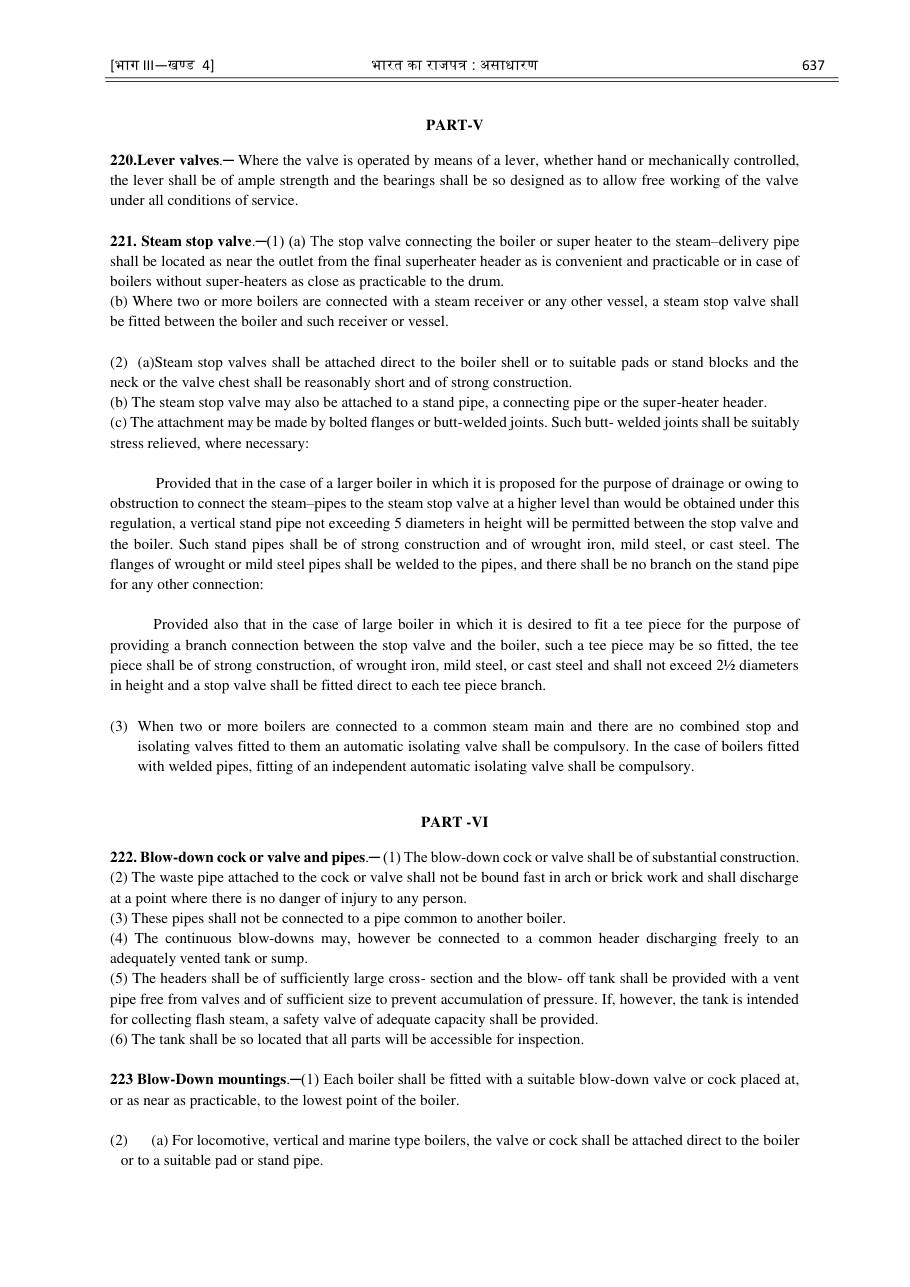
223 Blow-Down mountings.─(1) Each boiler shall be fitted with a suitable blow-down valve or cock placed at, or as near as practicable, to the lowest point of the boiler.
(2)(a) For locomotive, vertical and marine type boilers, the valve or cock shall be attached direct to the boiler or to a suitable pad or stand pipe.
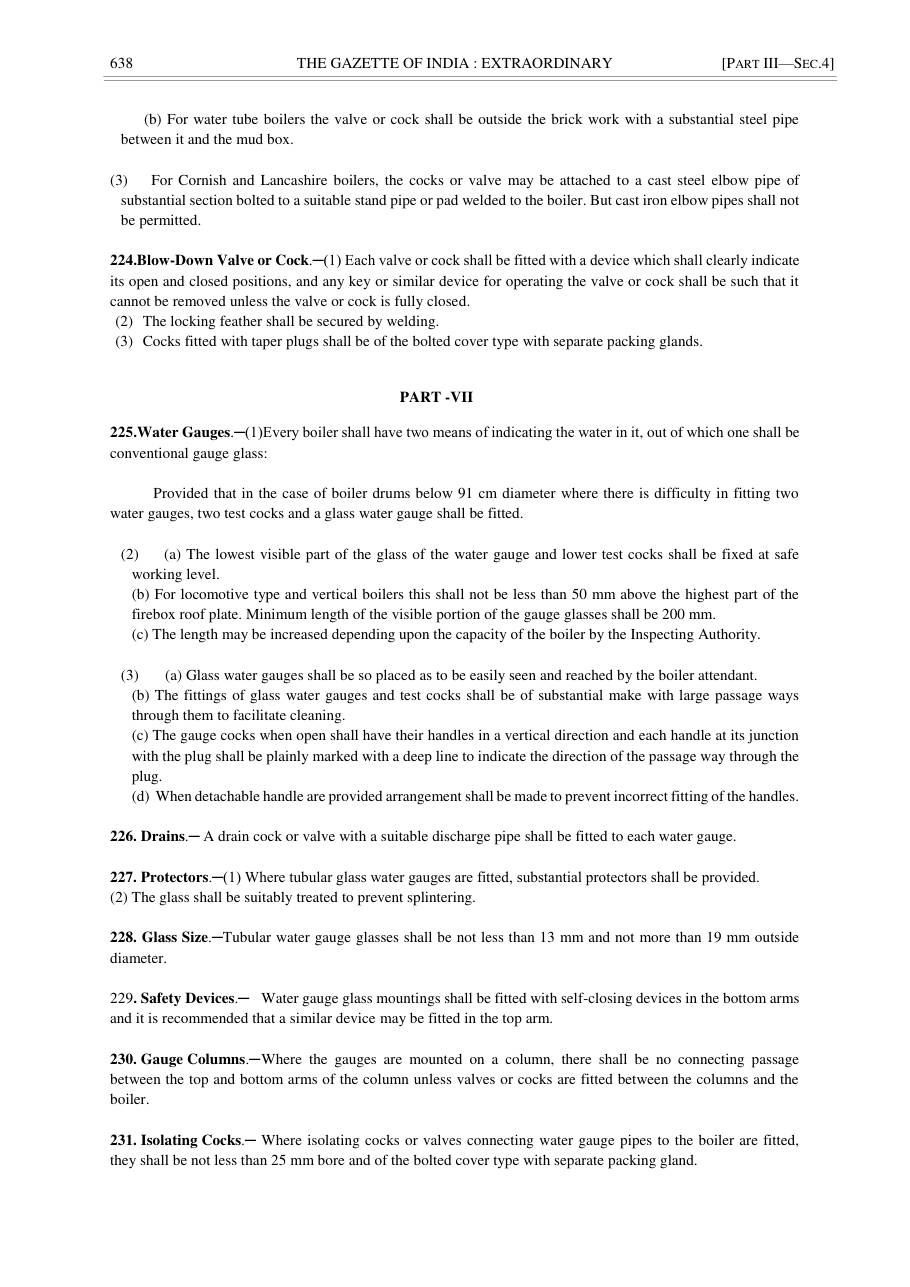
(b)For water tube boilers the valve or cock shall be outside the brick work with a substantial steel pipe between it and the mud box.
(3)For Cornish and Lancashire boilers, the cocks or valve may be attached to a cast steel elbow pipe of substantial section bolted to a suitable stand pipe or pad welded to the boiler. But cast iron elbow pipes shall not be permitted.
In short
Regulation 223 requires every boiler to have a blow-down valve or cock at, or as near as practicable to, its lowest point, and says how it is attached for different boiler types.
Key points
- (1) One suitable blow-down valve or cock per boiler, at or near the lowest point.
- (2)(a) Locomotive, vertical and marine type boilers: attach the valve or cock directly to the boiler or to a suitable pad or stand pipe.
- (2)(b) Water tube boilers: place the valve or cock outside the brick work, with a substantial steel pipe between it and the mud box.
- (3) Cornish and Lancashire boilers: the cock or valve may be attached to a substantial cast steel elbow pipe bolted to a stand pipe or pad welded to the boiler.
Watch out
- (3) Cast iron elbow pipes are not permitted.
Written by IBRsource editors · last edited 2026-11-20. Explanations simplify and are not a design method, testing procedure or authorisation. Requirements come from the complete regulations, the Gazette and approved documentation.
Comparison pending: the IBR 1950 text in force on 30 September 2026 is not yet established for this provision, so no change is claimed (how this works).
Orientation hints (unverified)
These candidates come from automated heading matching against DPIIT's scanned historical print edition of IBR 1950. That edition uses imperial units and riveted-construction provisions, so it is not the operative 2026 predecessor text. Regulation numbers alone never prove equivalence.
No candidate heading found in the historical print edition.
Images of the official Gazette pages that contain this regulation. Click to zoom. Compare word by word before relying on the extracted text.
Indian Boiler Regulations, 2026, reg. 223, Regulation 223, Gazette of India, Extraordinary, Part III—Section 4, No. 596, 1 October 2026, printed p.637–638. https://egazette.gov.in/WriteReadData/2026/276813.pdf (text consulted via IBRsource, 2026-11-23).
The citation refers to the government publication. Cite the Gazette, not this website.