
Indian Boiler Regulations, 2026 · Chapter 5 · Valves, Gauges and Auxiliaries
Regulation 221. Steam stop valve
Not yet checked against the official Gazette; verify before relying on it.
221. Steam stop valve.─(1) (a) The stop valve connecting the boiler or super heater to the steam–delivery pipe shall be located as near the outlet from the final superheater header as is convenient and practicable or in case of boilers without super-heaters as close as practicable to the drum.
(b)Where two or more boilers are connected with a steam receiver or any other vessel, a steam stop valve shall be fitted between the boiler and such receiver or vessel.
(2)(a)Steam stop valves shall be attached direct to the boiler shell or to suitable pads or stand blocks and the neck or the valve chest shall be reasonably short and of strong construction.
(b)The steam stop valve may also be attached to a stand pipe, a connecting pipe or the super-heater header.
(c)The attachment may be made by bolted flanges or butt-welded joints. Such butt- welded joints shall be suitably stress relieved, where necessary:
Provided that in the case of a larger boiler in which it is proposed for the purpose of drainage or owing to obstruction to connect the steam–pipes to the steam stop valve at a higher level than would be obtained under this regulation, a vertical stand pipe not exceeding 5 diameters in height will be permitted between the stop valve and the boiler. Such stand pipes shall be of strong construction and of wrought iron, mild steel, or cast steel. The flanges of wrought or mild steel pipes shall be welded to the pipes, and there shall be no branch on the stand pipe for any other connection:
Provided also that in the case of large boiler in which it is desired to fit a tee piece for the purpose of providing a branch connection between the stop valve and the boiler, such a tee piece may be so fitted, the tee piece shall be of strong construction, of wrought iron, mild steel, or cast steel and shall not exceed 2½ diameters in height and a stop valve shall be fitted direct to each tee piece branch.
(3)When two or more boilers are connected to a common steam main and there are no combined stop and isolating valves fitted to them an automatic isolating valve shall be compulsory. In the case of boilers fitted with welded pipes, fitting of an independent automatic isolating valve shall be compulsory.
In short
Regulation 221 covers where the steam stop valve goes, how it is attached, and when an automatic isolating valve is compulsory. The stop valve is one of the fittings listed in regulation 181.
Key points
- (1)(a) The stop valve between the boiler or superheater and the steam-delivery pipe is placed as near the final superheater header outlet as is convenient and practicable, or, without a superheater, as close as practicable to the drum.
- (1)(b) Where two or more boilers connect to a steam receiver or other vessel, a stop valve is fitted between each boiler and that vessel.
- (2)(a) Stop valves attach directly to the shell or to suitable pads or stand blocks, with a reasonably short and strong neck or chest.
- (2)(b) They may also attach to a stand pipe, connecting pipe or superheater header.
- (2)(c) Attachment may be by bolted flanges or butt-welded joints, stress relieved where necessary.
- (3) Where two or more boilers share a common steam main without combined stop and isolating valves, an automatic isolating valve is compulsory. For boilers with welded pipes, an independent automatic isolating valve is compulsory.
Watch out
- First proviso: on a larger boiler, a vertical stand pipe not exceeding 5 diameters in height may be fitted between stop valve and boiler, for drainage or to clear obstructions. It must be strong, of wrought iron, mild steel or cast steel, with flanges welded to wrought or mild steel pipes and no branch for any other connection.
- Second proviso: on a large boiler, a tee piece of similar materials, not exceeding 2½ diameters in height, may be fitted between stop valve and boiler, with a stop valve fitted direct to each branch.
Written by IBRsource editors · last edited 2026-11-20. Explanations simplify and are not a design method, testing procedure or authorisation. Requirements come from the complete regulations, the Gazette and approved documentation.
Comparison pending: the IBR 1950 text in force on 30 September 2026 is not yet established for this provision, so no change is claimed (how this works).
Orientation hints (unverified)
These candidates come from automated heading matching against DPIIT's scanned historical print edition of IBR 1950. That edition uses imperial units and riveted-construction provisions, so it is not the operative 2026 predecessor text. Regulation numbers alone never prove equivalence.
No candidate heading found in the historical print edition.
Images of the official Gazette pages that contain this regulation. Click to zoom. Compare word by word before relying on the extracted text.
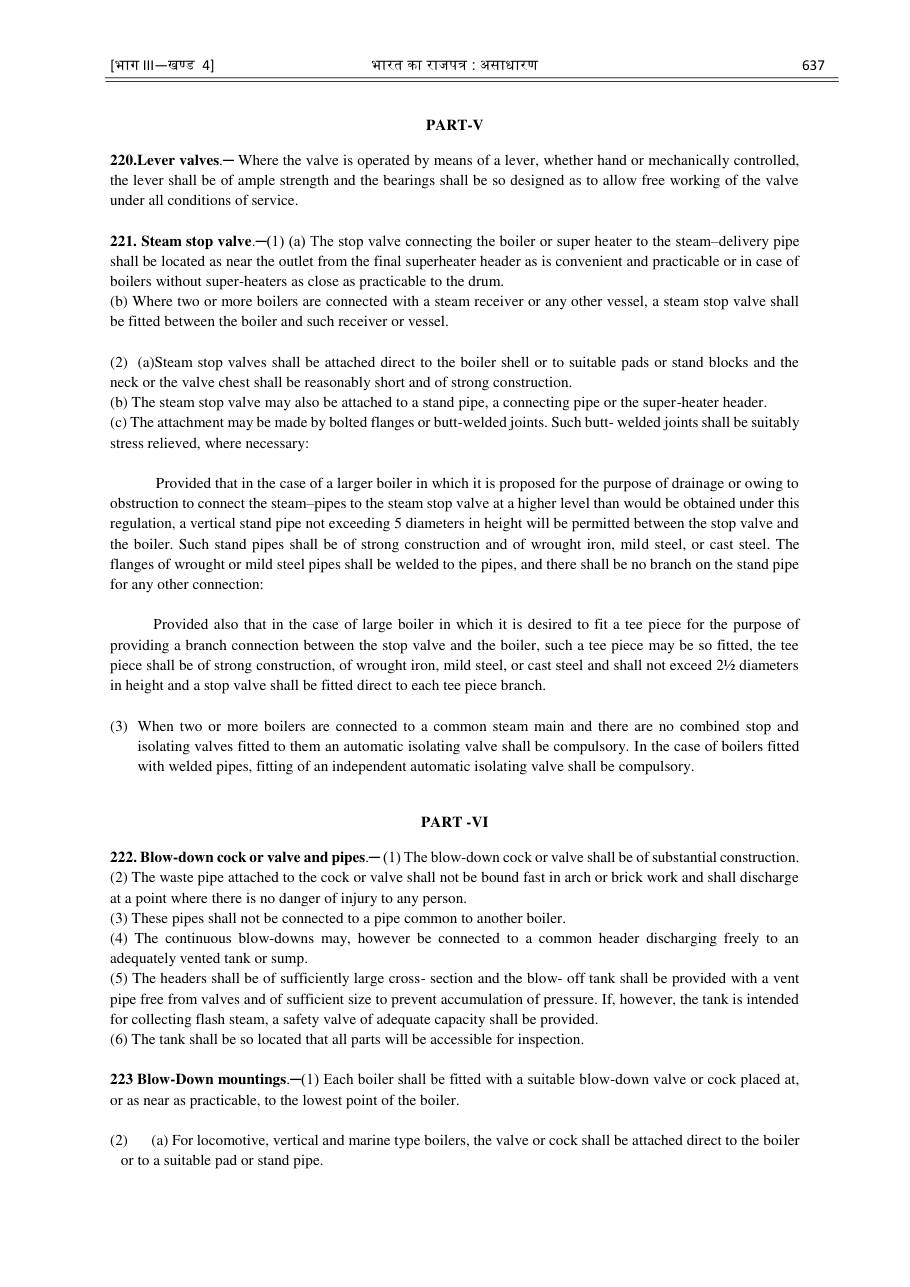
Indian Boiler Regulations, 2026, reg. 221, Regulation 221, Gazette of India, Extraordinary, Part III—Section 4, No. 596, 1 October 2026, printed p.637. https://egazette.gov.in/WriteReadData/2026/276813.pdf (text consulted via IBRsource, 2026-11-23).
The citation refers to the government publication. Cite the Gazette, not this website.