
Indian Boiler Regulations, 2026 · Chapter 5 · Valves, Gauges and Auxiliaries
Regulation 205. Attachments of Weights and Springs
Not yet checked against the official Gazette; verify before relying on it.
205. Attachments of Weights and Springs.─(1) In a lever and weight safety valve, the weight shall be in one piece and attached to the lever in such a way that the safety valve cannot be over loaded.
(2)(a) In the case of spring loaded safety valves, washers or ferrules shall be fitted under the adjusting screws so that the valves cannot be over loaded when under the steam. Interference with load on the spring after the safety valve has been adjusted shall be prevented by the fitting of a ferrule under the adjusting screw collar, or by using a lock nut on the adjusting screw which shall be further safe-guarded by means of a padlock or other suitable device.
(b)Where springs are in tension, links or the suitable stops shall be fitted to prevent the spring being extended a greater amount than that corresponding to a valve lift of D/4.
Where, D = diameter of valve seating.
Tables and formulae are shown in their extracted layout. Alignment, superscripts and subscripts may be lost. The Gazette page image is authoritative.
In short
Regulation 205 is about stopping safety valves from being overloaded or tampered with after adjustment.
Key points
- (1) On a lever and weight safety valve, the weight must be one piece and attached so the valve cannot be overloaded.
- (2)(a) On spring loaded valves, washers or ferrules go under the adjusting screws so the valve cannot be overloaded under steam. After adjustment, interference with the spring load is prevented by a ferrule under the adjusting screw collar, or a lock nut on the adjusting screw further safeguarded by a padlock or other suitable device.
- (2)(b) Where springs are in tension, links or stops must stop the spring extending beyond the amount for a valve lift of D/4, where D is the diameter of the valve seating.
Written by IBRsource editors · last edited 2026-11-20. Explanations simplify and are not a design method, testing procedure or authorisation. Requirements come from the complete regulations, the Gazette and approved documentation.
Comparison pending: the IBR 1950 text in force on 30 September 2026 is not yet established for this provision, so no change is claimed (how this works).
Orientation hints (unverified)
These candidates come from automated heading matching against DPIIT's scanned historical print edition of IBR 1950. That edition uses imperial units and riveted-construction provisions, so it is not the operative 2026 predecessor text. Regulation numbers alone never prove equivalence.
No candidate heading found in the historical print edition.
Images of the official Gazette pages that contain this regulation. Click to zoom. Compare word by word before relying on the extracted text.
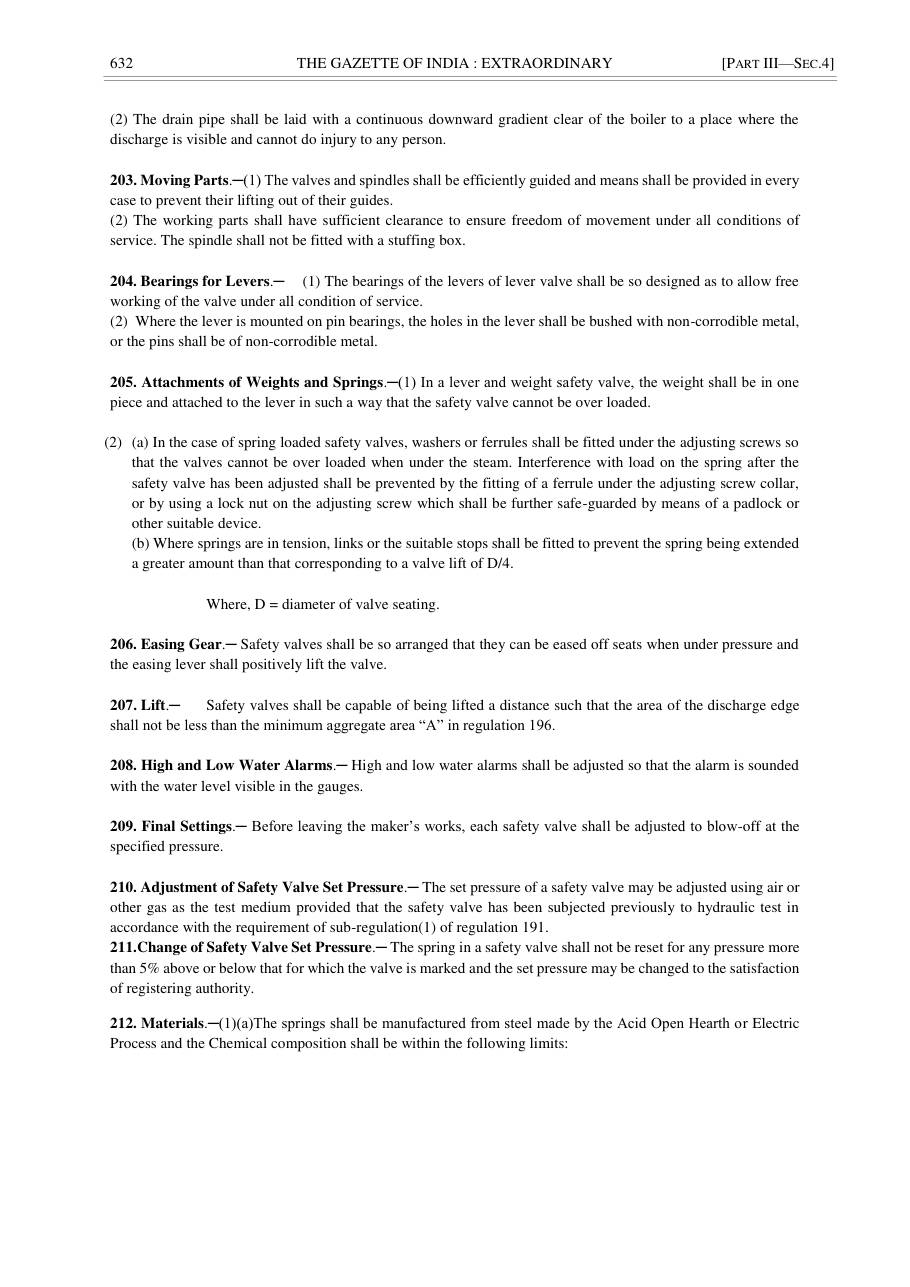
Indian Boiler Regulations, 2026, reg. 205, Regulation 205, Gazette of India, Extraordinary, Part III—Section 4, No. 596, 1 October 2026, printed p.632. https://egazette.gov.in/WriteReadData/2026/276813.pdf (text consulted via IBRsource, 2026-11-23).
The citation refers to the government publication. Cite the Gazette, not this website.