
Indian Boiler Regulations, 2026 · Chapter 5 · Valves, Gauges and Auxiliaries
Regulation 189. Flanges
Not yet checked against the official Gazette; verify before relying on it.
189. Flanges.─(1) Flanges shall be in accordance with the tables for the appropriate pressure (Appendix-F).
(2)In the case of safety valves the drilling, thickness and bolting of inlet flanges shall be in accordance with tables for the appropriate pressure and material and for the diameter of flange adopted. In the case of outlet flanges the pressure taken shall be the pressure on the outlet side of the valve.
(3)For the purpose of determining particulars of flanges for blow down and scum pipe fittings, the design pressure of the fittings shall be assumed to be design pressure of the boiler.
(4)All flanges shall be machined on the face, spot faced, or machined at the back, and the bolt holes shall be drilled.
In short
Regulation 189 says how flanges on boiler fittings are to be sized, drilled and finished.
Key points
- (1) Flanges must follow the tables for the appropriate pressure in Appendix-F.
- (2) For safety valves, drilling, thickness and bolting of inlet flanges follow the tables for the appropriate pressure, material and flange diameter. For outlet flanges, use the pressure on the outlet side of the valve.
- (3) For blow down and scum pipe fittings, the design pressure of the fittings is taken as the design pressure of the boiler when choosing flange particulars.
- (4) All flanges must be machined on the face, and spot faced or machined at the back. Bolt holes must be drilled.
Written by IBRsource editors · last edited 2026-11-20. Explanations simplify and are not a design method, testing procedure or authorisation. Requirements come from the complete regulations, the Gazette and approved documentation.
Comparison pending: the IBR 1950 text in force on 30 September 2026 is not yet established for this provision, so no change is claimed (how this works).
Orientation hints (unverified)
These candidates come from automated heading matching against DPIIT's scanned historical print edition of IBR 1950. That edition uses imperial units and riveted-construction provisions, so it is not the operative 2026 predecessor text. Regulation numbers alone never prove equivalence.
| Historical 1950-edition reg. | Heading as OCR'd | Heading similarity | Source image |
|---|---|---|---|
| 358 | Flanges of copper pipes | 100% | Chapter VIII (DPIIT scan), image 6 |
| 359 | Standard Flanges | 100% | Chapter VIII (DPIIT scan), image 7 |
| 410 | Flanges | 100% | Chapter X (DPIIT scan), image 4 |
IBR 1950 regulation 358 as last published in the DPIIT web edition (archived 2022)
Unofficial archived copy, not verified; see the regulation 358 page for its amendments.
| Reg. 358, Reg. 359 Flanges of copper pipes
| ||||
IBR 1950 regulation 359 as last published in the DPIIT web edition (archived 2022)
Unofficial archived copy, not verified; see the regulation 359 page for its amendments.
| Reg. 358, Reg. 359 Flanges of copper pipes
| ||||
IBR 1950 regulation 410 as last published in the DPIIT web edition (archived 2022)
Unofficial archived copy, not verified; see the regulation 410 page for its amendments.
| Reg. 410, Reg. 411, Reg. 412
Reg. 411
Reg. 412
|
Images of the official Gazette pages that contain this regulation. Click to zoom. Compare word by word before relying on the extracted text.
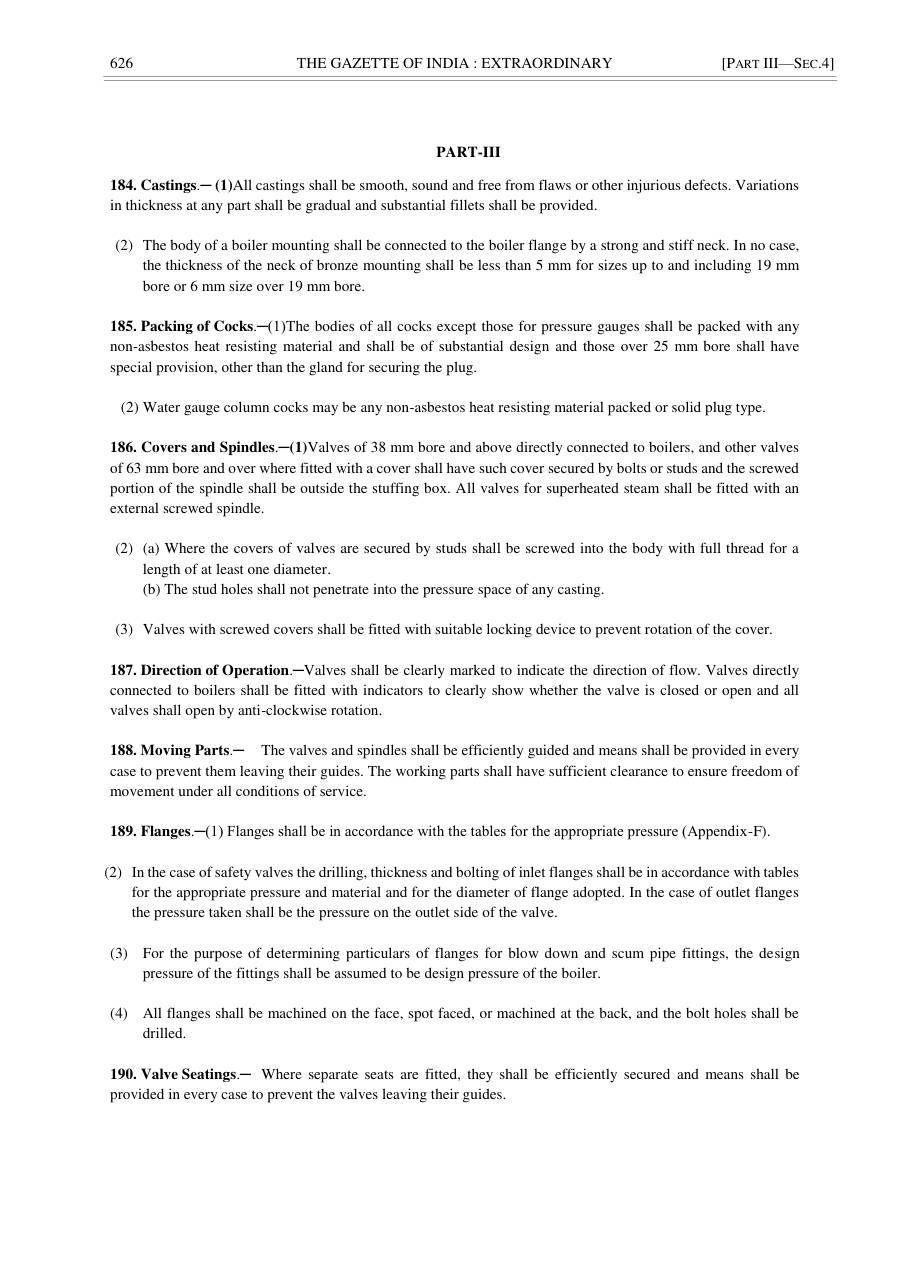
Indian Boiler Regulations, 2026, reg. 189, Regulation 189, Gazette of India, Extraordinary, Part III—Section 4, No. 596, 1 October 2026, printed p.626. https://egazette.gov.in/WriteReadData/2026/276813.pdf (text consulted via IBRsource, 2026-11-23).
The citation refers to the government publication. Cite the Gazette, not this website.