
Indian Boiler Regulations, 2026 · Chapter 5 · Valves, Gauges and Auxiliaries
Regulation 196. Discharge Capacity of Safety Valves
Not yet checked against the official Gazette; verify before relying on it.
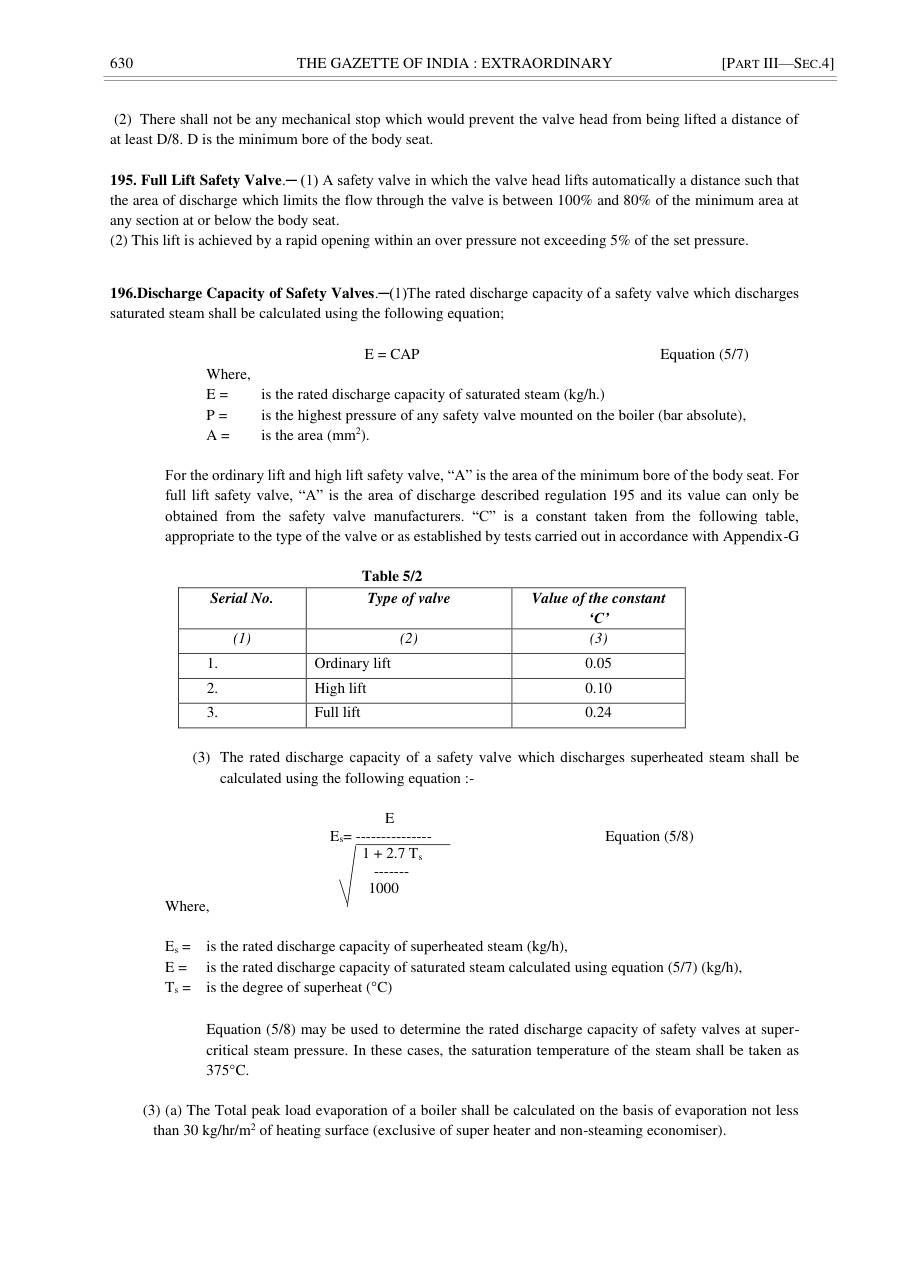
196.Discharge Capacity of Safety Valves.─(1)The rated discharge capacity of a safety valve which discharges saturated steam shall be calculated using the following equation;
E = CAP Equation (5/7)
Where, is the rated discharge capacity of saturated steam (kg/h.) E = is the highest pressure of any safety valve mounted on the boiler (bar absolute), P = is the area (mm2).
A =
For the ordinary lift and high lift safety valve, “A” is the area of the minimum bore of the body seat. For full lift safety valve, “A” is the area of discharge described regulation 195 and its value can only be obtained from the safety valve manufacturers. “C” is a constant taken from the following table, appropriate to the type of the valve or as established by tests carried out in accordance with Appendix-G
Serial No. Table 5/2 Value of the constant
| Serial No. | Type of valve | Value of the constant ‘C’ |
|---|---|---|
| (1) | (2) | (3) |
| 1. | Ordinary lift | 0.05 |
| 2. | High lift | 0.10 |
| 3. | Full lift | 0.24 |
Table structure read from the Gazette PDF, page 630. Verification status as for the text above.
Show original extracted text (diagnostic, not authoritative)
                      Type of valve             ‘C’
     (1)                                        (3)
1.                           (2)               0.05
2.          Ordinary lift                      0.10
3.          High lift                          0.24
Full lift(3)The rated discharge capacity of a safety valve which discharges superheated steam shall be calculated using the following equation :-
          E              Equation (5/8)
Es= ---------------

      1 + 2.7 Ts
        -------
       1000
Where,
Es = is the rated discharge capacity of superheated steam (kg/h), E = is the rated discharge capacity of saturated steam calculated using equation (5/7) (kg/h), Ts = is the degree of superheat (°C)
Equation (5/8) may be used to determine the rated discharge capacity of safety valves at super-critical steam pressure. In these cases, the saturation temperature of the steam shall be taken as 375°C.
(3)(a) The Total peak load evaporation of a boiler shall be calculated on the basis of evaporation not less than 30 kg/hr/m2 of heating surface (exclusive of super heater and non-steaming economiser).
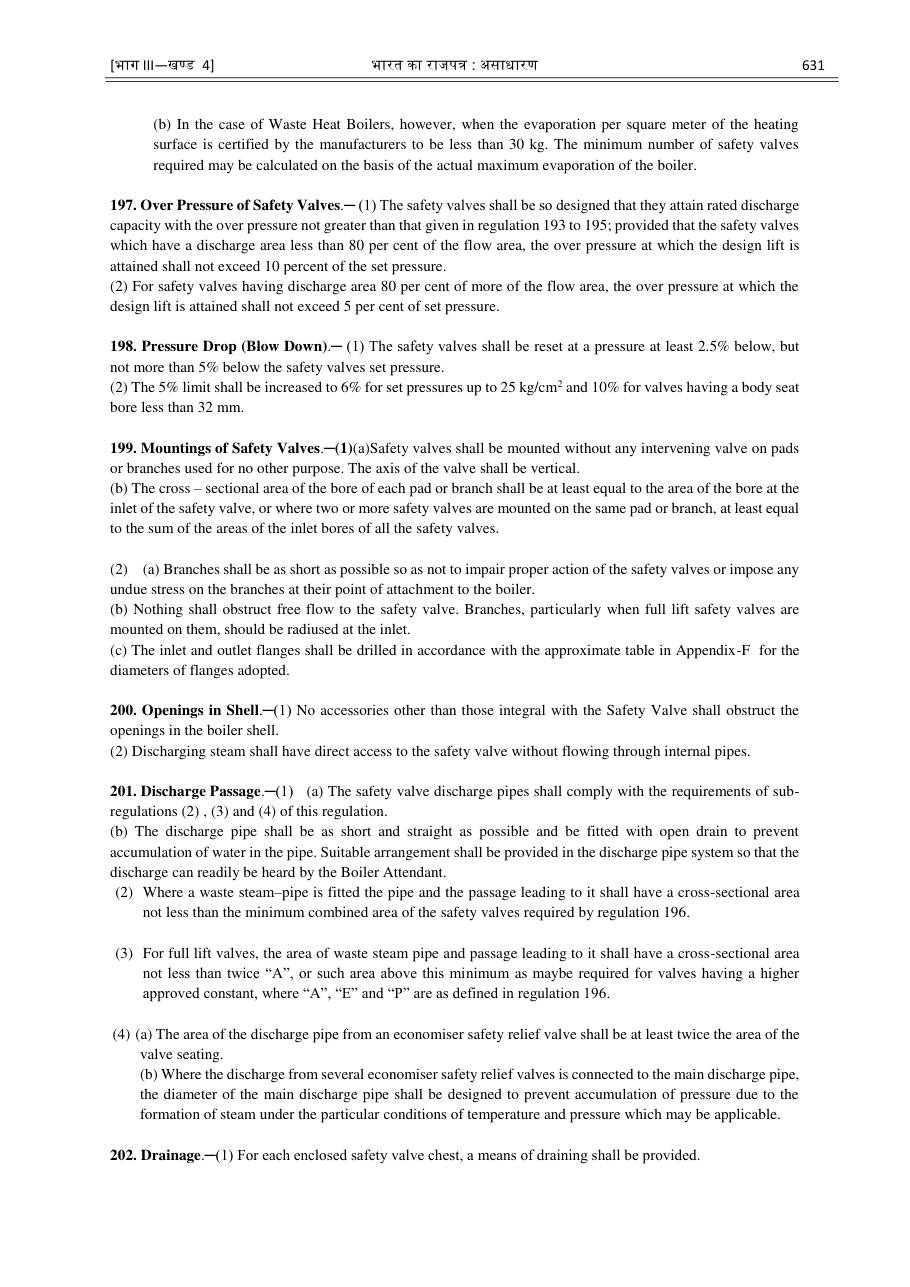
(b)In the case of Waste Heat Boilers, however, when the evaporation per square meter of the heating surface is certified by the manufacturers to be less than 30 kg. The minimum number of safety valves required may be calculated on the basis of the actual maximum evaporation of the boiler.
Parts of this extracted text look garbled; read the Gazette page before using any value.
Tables and formulae are shown in their extracted layout. Alignment, superscripts and subscripts may be lost. The Gazette page image is authoritative.
In short
Regulation 196 gives the equations for the rated discharge capacity of safety valves on saturated and superheated steam, and the basis for a boiler's total peak load evaporation.
Key points
- (1) Saturated steam: Equation (5/7), E = CAP. E is the rated discharge capacity (kg/h), P is the pressure (bar absolute), A is the area (mm²) and C is a constant.
- For ordinary and high lift valves, A is the area of the minimum bore of the body seat. For full lift valves, A is the area of discharge in regulation 195, obtainable only from the valve manufacturer.
- C comes from Table 5/2 for the valve type (the extracted table reads 0.05, 0.10 and 0.24 for ordinary, high and full lift), or from tests under Appendix-G. Check the Gazette page for the exact values.
- (3) Superheated steam: Equation (5/8) divides E by a factor based on the degree of superheat Ts (°C). It may also be used at super-critical pressure, taking the saturation temperature as 375°C.
- The second (3)(a): total peak load evaporation is calculated on evaporation not less than 30 kg/hr/m² of heating surface, excluding superheater and non-steaming economiser.
Watch out
- The second (3)(b): for waste heat boilers whose manufacturer certifies evaporation below 30 kg per square meter of heating surface, the minimum number of safety valves may be based on the boiler's actual maximum evaporation.
- The symbol list under Equation (5/7) is misaligned in the extracted text; check the Gazette page.
Written by IBRsource editors · last edited 2026-11-20. Explanations simplify and are not a design method, testing procedure or authorisation. Requirements come from the complete regulations, the Gazette and approved documentation.
Comparison pending: the IBR 1950 text in force on 30 September 2026 is not yet established for this provision, so no change is claimed (how this works).
Orientation hints (unverified)
These candidates come from automated heading matching against DPIIT's scanned historical print edition of IBR 1950. That edition uses imperial units and riveted-construction provisions, so it is not the operative 2026 predecessor text. Regulation numbers alone never prove equivalence.
No candidate heading found in the historical print edition.
Images of the official Gazette pages that contain this regulation. Click to zoom. Compare word by word before relying on the extracted text.
Indian Boiler Regulations, 2026, reg. 196, Regulation 196, Gazette of India, Extraordinary, Part III—Section 4, No. 596, 1 October 2026, printed p.630–631. https://egazette.gov.in/WriteReadData/2026/276813.pdf (text consulted via IBRsource, 2026-11-23).
The citation refers to the government publication. Cite the Gazette, not this website.