Indian Boiler Regulations, 2026
Appendix G — SAFETY VALVE DISCHARGE EFFICIENCY TESTING
Not yet checked against the official Gazette; verify before relying on it.
Open the official Gazette at this appendix
APPENDIX-G
SAFETY VALVE DISCHARGE EFFICIENCY TESTING
A. General.
(i)The purpose and manner of testing shall be such as to provide suitable data from which a constant 'c' may be determined in Equation (5/7). To this end the following information shall be supplied to the Inspecting Authority before testing is undertaken:
(a)Full particulars on the values to be tested and range of valves and springs which they represent.
(b)Details of the testing rig including instrumentation and proposed calibration procedure.
(c)Proposed source, capacity, pressure, temperature of steam used for the test.
(ii)All testing shall be witnessed by Inspecting Authority or the Competent Person.
(iii)Tests shall be made to determine the operative characteristics of the safety valves for which a constant is to be determined and also to establish the discharge efficiency of the safety valve.
(iv)Where possible, the tests to determine operating characteristics and discharge efficiency shall be carried out using the same steam, the same pressure conditions and the same location. When the tests are carried out separately, the valves in each case shall be complete and shall include all internals, e.g. blow-down adjustments rings.
(v)The set pressure at which the operating characteristics are determined shall be the minimum set pressure for which the spring used is designed. The tests shall be carried out using steam and shall determine the set pressure, the lift at the over pressure specified for the type of valve, as defined in regulations 193 to 195.
(vi)The Inspecting Authority may dispense with Operating Characteristic tests described in A(v).
(vii)Discharge efficiency tests shall be carried out using steam and shall be carried out relative to the operative characteristic tests described in A(v).
(viii)When the Inspecting Authority is satisfied that the design of valve shall operate satisfactorily it shall if desired, be permissible to hold the valve head mechanically at the proven lift while carrying out the tests to ascertain the discharge efficiency.
B. VALVES USED IN THE TEST PROGRAMME. ─
(i)The safety valves tested shall, as far as is practicable, be representative of the pressure and size range of valve manufactured.
(ii)The tests for operative characteristics and the discharge efficiency test shall be carried out on the three sizes or half the number of sizes in the range, whichever is smaller, with a minimum of two sizes.
(iii)When the range is extended, due consideration shall be given, in consultation with the Inspecting Authority, to whether further witnessed tests are necessary.
(iv)The test for operating characteristics shall be carried out at three significantly different set pressure for each size of valve.
(v)The discharge efficiency tests shall be carried out relative to one set pressure for each size of valve.
(vi)Each tests shall be carried out a minimum of three times to obtain acceptable average results.
(vii)For the case of valves of either novel or special design of which one size only is being manufactured, tests at one set pressure are permitted by agreement with the Inspecting Authority. When the range of sizes or pressure is extended, due consideration shall be given in consultation with the Inspecting Authority, to whether further witnessed tests are necessary.
C. DETERMINATION OF CONSTANT ‘C’. ─
Let
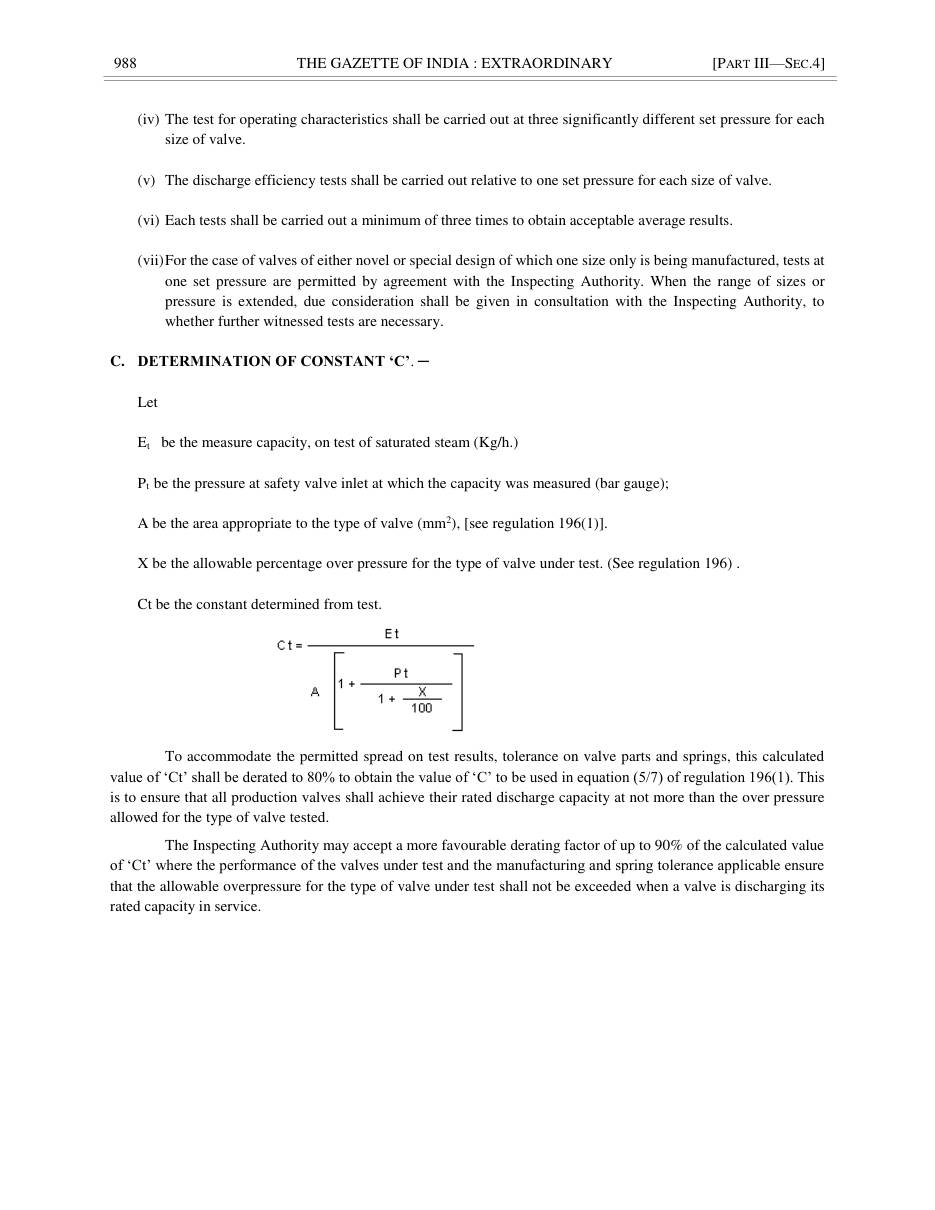
Et be the measure capacity, on test of saturated steam (Kg/h.)
Pt be the pressure at safety valve inlet at which the capacity was measured (bar gauge); A be the area appropriate to the type of valve (mm2), [see regulation 196(1)].
X be the allowable percentage over pressure for the type of valve under test. (See regulation 196) .
Ct be the constant determined from test.
To accommodate the permitted spread on test results, tolerance on valve parts and springs, this calculated value of ‘Ct’ shall be derated to 80% to obtain the value of ‘C’ to be used in equation (5/7) of regulation 196(1). This is to ensure that all production valves shall achieve their rated discharge capacity at not more than the over pressure allowed for the type of valve tested.
The Inspecting Authority may accept a more favourable derating factor of up to 90% of the calculated value of ‘Ct’ where the performance of the valves under test and the manufacturing and spring tolerance applicable ensure that the allowable overpressure for the type of valve under test shall not be exceeded when a valve is discharging its rated capacity in service.
Gazette pages