
Indian Boiler Regulations, 2026 · Chapter 5 · Valves, Gauges and Auxiliaries
Regulation 201. Discharge Passage
Not yet checked against the official Gazette; verify before relying on it.
201. Discharge Passage.─(1) (a) The safety valve discharge pipes shall comply with the requirements of sub-regulations (2) , (3) and (4) of this regulation.
(b)The discharge pipe shall be as short and straight as possible and be fitted with open drain to prevent accumulation of water in the pipe. Suitable arrangement shall be provided in the discharge pipe system so that the discharge can readily be heard by the Boiler Attendant.
(2)Where a waste steam–pipe is fitted the pipe and the passage leading to it shall have a cross-sectional area not less than the minimum combined area of the safety valves required by regulation 196.
(3)For full lift valves, the area of waste steam pipe and passage leading to it shall have a cross-sectional area not less than twice “A”, or such area above this minimum as maybe required for valves having a higher approved constant, where “A”, “E” and “P” are as defined in regulation 196.
(4)(a) The area of the discharge pipe from an economiser safety relief valve shall be at least twice the area of the valve seating.
(b)Where the discharge from several economiser safety relief valves is connected to the main discharge pipe, the diameter of the main discharge pipe shall be designed to prevent accumulation of pressure due to the formation of steam under the particular conditions of temperature and pressure which may be applicable.
In short
Regulation 201 sets requirements for safety valve discharge pipes, waste steam pipes and economiser relief valve discharges.
Key points
- (1)(a) Discharge pipes must meet sub-regulations (2), (3) and (4).
- (1)(b) The discharge pipe must be as short and straight as possible, with an open drain to prevent water collecting. The system must let the Boiler Attendant readily hear the discharge.
- (2) A waste steam-pipe and its passage must have a cross-sectional area not less than the minimum combined area of the safety valves required by regulation 196.
- (3) For full lift valves, the waste steam pipe and passage area must be not less than twice "A" (as defined in regulation 196), or more for valves with a higher approved constant.
- (4)(a) The discharge pipe from an economiser safety relief valve must have at least twice the area of the valve seating.
- (4)(b) Where several economiser relief valves discharge into a main pipe, its diameter must prevent pressure build-up from steam forming under the applicable conditions.
Written by IBRsource editors · last edited 2026-11-20. Explanations simplify and are not a design method, testing procedure or authorisation. Requirements come from the complete regulations, the Gazette and approved documentation.
Comparison pending: the IBR 1950 text in force on 30 September 2026 is not yet established for this provision, so no change is claimed (how this works).
Orientation hints (unverified)
These candidates come from automated heading matching against DPIIT's scanned historical print edition of IBR 1950. That edition uses imperial units and riveted-construction provisions, so it is not the operative 2026 predecessor text. Regulation numbers alone never prove equivalence.
| Historical 1950-edition reg. | Heading as OCR'd | Heading similarity | Source image |
|---|---|---|---|
| 298 | Discharge Passage | 100% | Chapter VI (DPIIT scan), image 4 |
IBR 1950 regulation 298 as last published in the DPIIT web edition (archived 2022)
Unofficial archived copy, not verified; see the regulation 298 page for its amendments.
| Reg. 297, Reg. 298, Reg. 299 | ||||||||||||
Reg. 298 Discharge Passage
Reg. 299 Drainage
|
Images of the official Gazette pages that contain this regulation. Click to zoom. Compare word by word before relying on the extracted text.
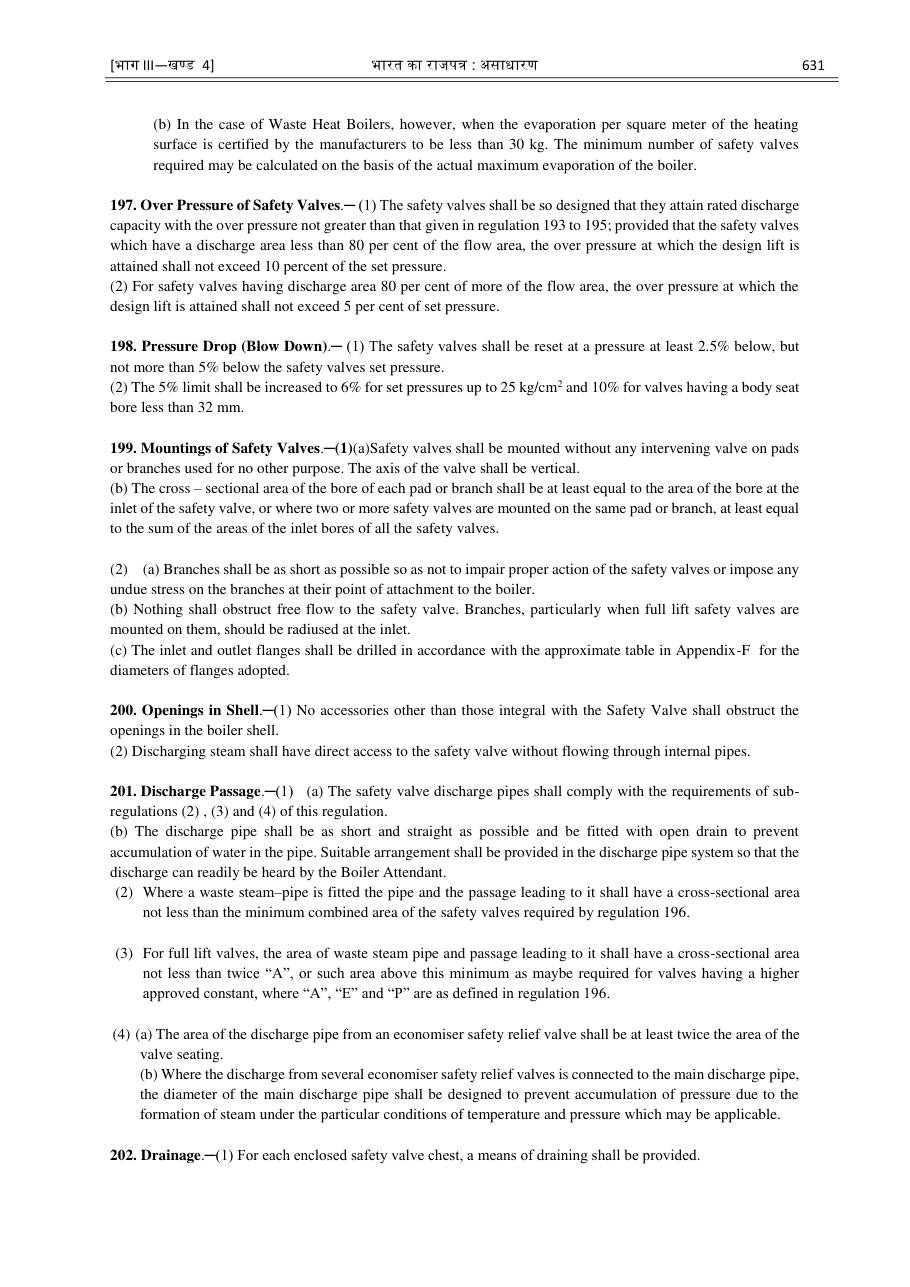
Indian Boiler Regulations, 2026, reg. 201, Regulation 201, Gazette of India, Extraordinary, Part III—Section 4, No. 596, 1 October 2026, printed p.631. https://egazette.gov.in/WriteReadData/2026/276813.pdf (text consulted via IBRsource, 2026-11-23).
The citation refers to the government publication. Cite the Gazette, not this website.