
Indian Boiler Regulations, 2026 · Chapter 2 · Materials of Construction
Regulation 56. Additional Tests
Not yet checked against the official Gazette; verify before relying on it.
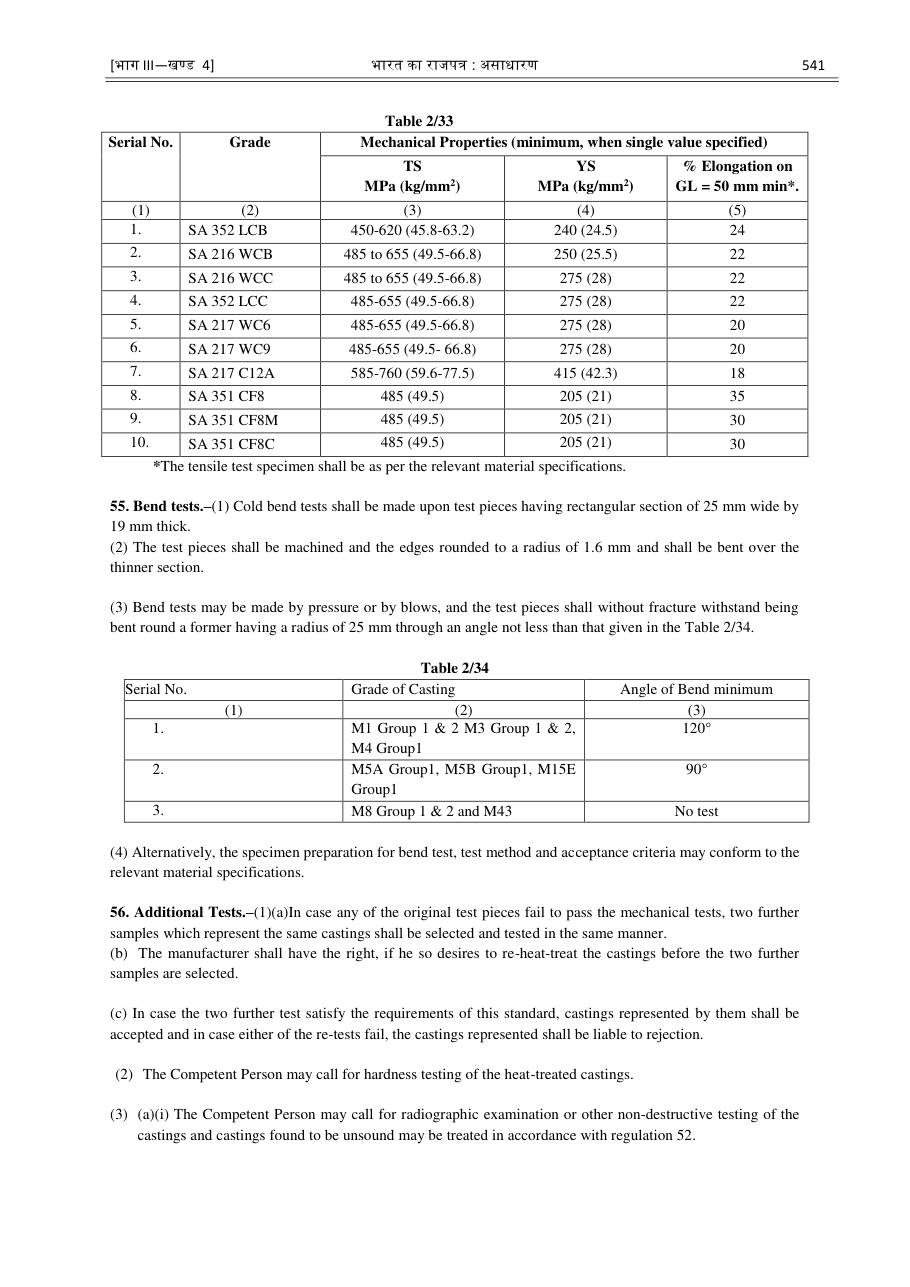
56. Additional Tests.–(1)(a)In case any of the original test pieces fail to pass the mechanical tests, two further samples which represent the same castings shall be selected and tested in the same manner.
(b)The manufacturer shall have the right, if he so desires to re-heat-treat the castings before the two further samples are selected.
(c)In case the two further test satisfy the requirements of this standard, castings represented by them shall be accepted and in case either of the re-tests fail, the castings represented shall be liable to rejection.
(2)The Competent Person may call for hardness testing of the heat-treated castings.
(3)(a)(i) The Competent Person may call for radiographic examination or other non-destructive testing of the castings and castings found to be unsound may be treated in accordance with regulation 52.
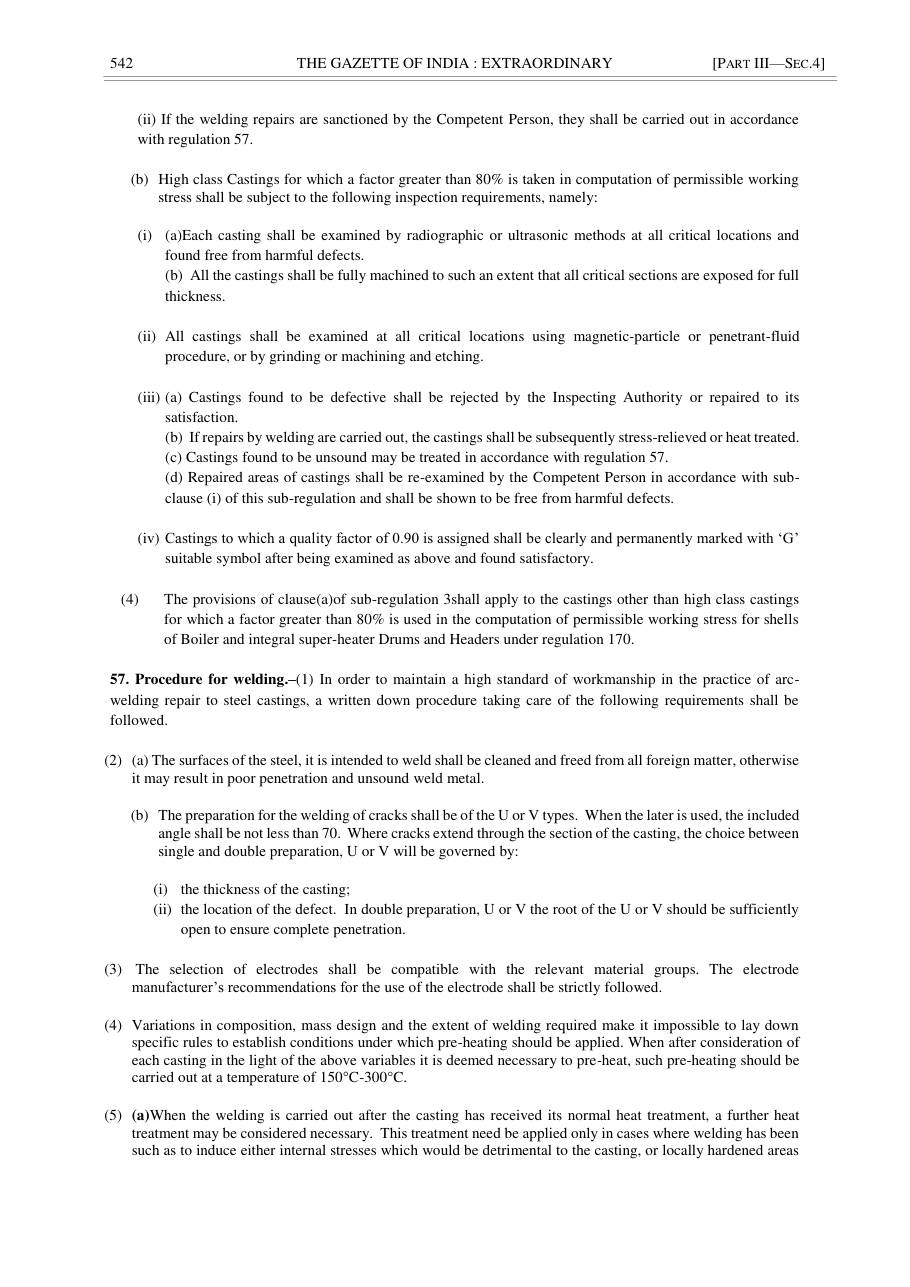
(ii)If the welding repairs are sanctioned by the Competent Person, they shall be carried out in accordance with regulation 57.
(b)High class Castings for which a factor greater than 80% is taken in computation of permissible working stress shall be subject to the following inspection requirements, namely:
(i)(a)Each casting shall be examined by radiographic or ultrasonic methods at all critical locations and found free from harmful defects.
(b)All the castings shall be fully machined to such an extent that all critical sections are exposed for full thickness.
(ii)All castings shall be examined at all critical locations using magnetic-particle or penetrant-fluid procedure, or by grinding or machining and etching.
(iii)(a) Castings found to be defective shall be rejected by the Inspecting Authority or repaired to its satisfaction.
(b)If repairs by welding are carried out, the castings shall be subsequently stress-relieved or heat treated.
(c)Castings found to be unsound may be treated in accordance with regulation 57.
(d)Repaired areas of castings shall be re-examined by the Competent Person in accordance with sub-clause (i) of this sub-regulation and shall be shown to be free from harmful defects.
(iv)Castings to which a quality factor of 0.90 is assigned shall be clearly and permanently marked with ‘G’ suitable symbol after being examined as above and found satisfactory.
(4)The provisions of clause(a)of sub-regulation 3shall apply to the castings other than high class castings for which a factor greater than 80% is used in the computation of permissible working stress for shells of Boiler and integral super-heater Drums and Headers under regulation 170.
In short
Regulation 56 covers retests, hardness tests and NDT for castings, and extra inspection for high class castings.
Key points
- (1) If an original test piece fails a mechanical test, two further samples representing the same castings are tested. The manufacturer may re-heat-treat the castings first. If both pass, the castings are accepted; if either fails, they are liable to rejection.
- (2) The Competent Person may call for hardness testing of heat-treated castings.
- (3)(a) The Competent Person may call for radiography or other NDT. Unsound castings may be treated under regulation 52, and sanctioned weld repairs follow regulation 57.
- (3)(b) High class castings, where a factor greater than 80% is used in computing permissible working stress, must be radiographed or ultrasonically examined at all critical locations, fully machined to expose critical sections, and examined by magnetic-particle, penetrant or etching methods.
Watch out
- Defective high class castings are rejected or repaired to the Inspecting Authority's satisfaction. Weld-repaired castings must be stress-relieved or heat treated, and repaired areas re-examined and shown free from harmful defects.
- Castings assigned a quality factor of 0.90 must be clearly and permanently marked with 'G' after satisfactory examination.
- (4) links these provisions to the computation of permissible working stress for drum and header shells under regulation 170.
Written by IBRsource editors · last edited 2026-11-20. Explanations simplify and are not a design method, testing procedure or authorisation. Requirements come from the complete regulations, the Gazette and approved documentation.
Comparison pending: the IBR 1950 text in force on 30 September 2026 is not yet established for this provision, so no change is claimed (how this works).
Orientation hints (unverified)
These candidates come from automated heading matching against DPIIT's scanned historical print edition of IBR 1950. That edition uses imperial units and riveted-construction provisions, so it is not the operative 2026 predecessor text. Regulation numbers alone never prove equivalence.
| Historical 1950-edition reg. | Heading as OCR'd | Heading similarity | Source image |
|---|---|---|---|
| 55 | Additional tests before rejection | 100% | Chapter II (DPIIT scan), image 10 |
| 66 | Additional Tests | 100% | Chapter II (DPIIT scan), image 13 |
Amendment history of the candidate IBR 1950 regulations: Reg. 55 (1 amendment)
IBR 1950 regulation 55 as last published in the DPIIT web edition (archived 2022)
Unofficial archived copy, not verified; see the regulation 55 page for its amendments.
| Reg. 55 MATERIALS OF CONSTRUCTION SEAMLESS FERRITIC PIPES FOR HIGH TEMPERATURE SERVICE Additional tests before rejection |
| (i)If any one or more tests specified in these regulations fail, two further tests of the same kind may be made on two other pipes of the same batch. If any of these tests fails, the batch of the pipes represented may be given a further heat treatment and entire set of tests shall be repeated. (ii) If the repeat tests are satisfactory, the pipes shall be accepted. If any failure in the tests should occur the entire batch of the pipes shall be rejected. |
Images of the official Gazette pages that contain this regulation. Click to zoom. Compare word by word before relying on the extracted text.
Indian Boiler Regulations, 2026, reg. 56, Regulation 56, Gazette of India, Extraordinary, Part III—Section 4, No. 596, 1 October 2026, printed p.541–542. https://egazette.gov.in/WriteReadData/2026/276813.pdf (text consulted via IBRsource, 2026-11-23).
The citation refers to the government publication. Cite the Gazette, not this website.