BETAIndependent engineering reference. Source-text verification is ongoing.Verification ongoing.Verification status →
IBRsourceIndian Boiler Regulations, made clear

Indian Boiler Regulations, 2026 · Chapter 2 · Materials of Construction

Regulation 57. Procedure for welding

Official text — not yet verifiedGazette 1 Oct 2026 · printed pp. 542–544

Not yet checked against the official Gazette; verify before relying on it.

Reproduced from the Gazette of India · verification status above

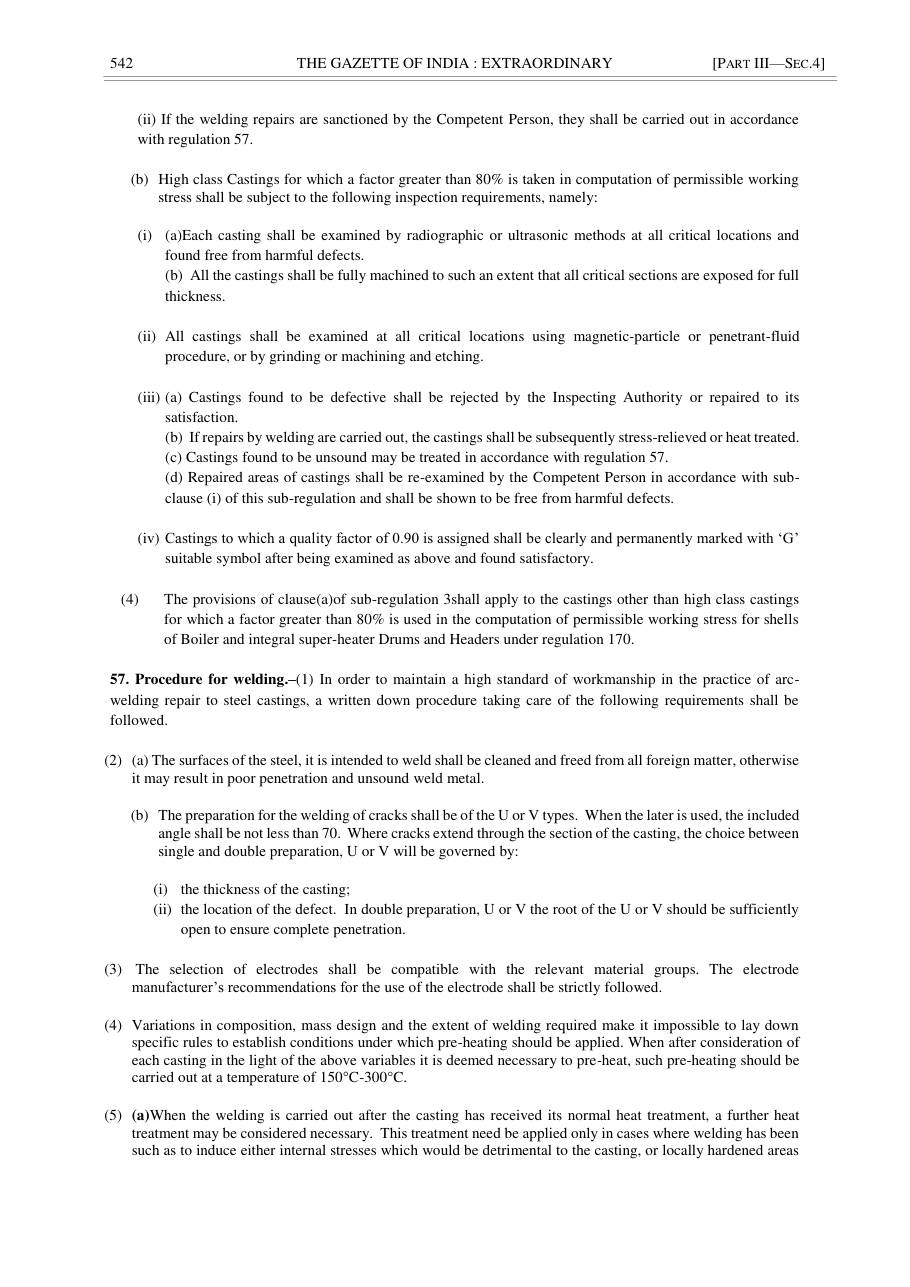
57. Procedure for welding.–(1) In order to maintain a high standard of workmanship in the practice of arc-welding repair to steel castings, a written down procedure taking care of the following requirements shall be followed.

(2)(a) The surfaces of the steel, it is intended to weld shall be cleaned and freed from all foreign matter, otherwise it may result in poor penetration and unsound weld metal.

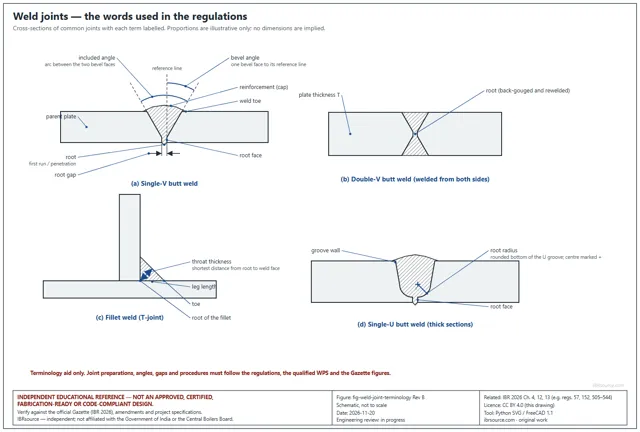
(b)The preparation for the welding of cracks shall be of the U or V types. When the later is used, the included angle shall be not less than 70. Where cracks extend through the section of the casting, the choice between single and double preparation, U or V will be governed by:

(i)the thickness of the casting;

(ii)the location of the defect. In double preparation, U or V the root of the U or V should be sufficiently open to ensure complete penetration.

(3)The selection of electrodes shall be compatible with the relevant material groups. The electrode manufacturer’s recommendations for the use of the electrode shall be strictly followed.

(4)Variations in composition, mass design and the extent of welding required make it impossible to lay down specific rules to establish conditions under which pre-heating should be applied. When after consideration of each casting in the light of the above variables it is deemed necessary to pre-heat, such pre-heating should be carried out at a temperature of 150°C-300°C.

(5)(a)When the welding is carried out after the casting has received its normal heat treatment, a further heat treatment may be considered necessary. This treatment need be applied only in cases where welding has been such as to induce either internal stresses which would be detrimental to the casting, or locally hardened areas which would cause difficulty in machining. Where this further beat treatment is applied, the casting, where possible, should not be allowed to go cold after welding, but should be charged into a warm furnace and re-heated to a suitable tempering temperature which in general should be not less than 550°C.

(b)When considering the advisability of applying this further treatment, its effect on the physical properties of the castings shall be borne in mind. If the treatment, or the welding itself is such that the physical properties will be adversely affected, the full heat treatment required to produce satisfactory qualities shall be substituted.

Independent explanation — not the law · draft · engineer review in progress

In short

Regulation 57 sets a written procedure for arc-welding repair of steel castings.

Key points

  • (2)(a) Surfaces to be welded must be cleaned of all foreign matter, to avoid poor penetration and unsound weld metal.
  • (2)(b) Cracks are prepared with U or V types. For V preparation, the included angle is not less than 70 (degrees; the Gazette prints the number without a unit). For through-thickness cracks, the choice of single or double U or V depends on casting thickness and defect location; the root must be open enough for complete penetration.
  • (3) Electrodes must suit the material group, and the electrode manufacturer's recommendations must be strictly followed.
  • (4) Where pre-heating is deemed necessary for a casting, it is carried out at 150°C-300°C.
  • (5)(a) If welding follows the casting's normal heat treatment, a further heat treatment may be needed where welding induces harmful internal stresses or hard areas. Where possible, the casting should go into a warm furnace without cooling and be reheated to a tempering temperature generally not less than 550°C.

Watch out

  • (5)(b) If the further treatment or the welding would adversely affect physical properties, the full heat treatment must be applied instead.

Written by IBRsource editors · last edited 2026-11-20. Explanations simplify and are not a design method, testing procedure or authorisation. Requirements come from the complete regulations, the Gazette and approved documentation.

Original drawings for this regulation
Comparison pending: the IBR 1950 text in force on 30 September 2026 is not yet established for this provision, so no change is claimed (how this works).

Orientation hints (unverified)

These candidates come from automated heading matching against DPIIT's scanned historical print edition of IBR 1950. That edition uses imperial units and riveted-construction provisions, so it is not the operative 2026 predecessor text. Regulation numbers alone never prove equivalence.

Historical 1950-edition reg.Heading as OCR'dHeading similaritySource image
8Welding100%Chapter I (DPIIT scan), image 3
381Procedure for registration76%Chapter IX (DPIIT scan), image 2
525Procedure for Registration76%Chapter XI (DPIIT scan), image 7

Amendment history of the candidate IBR 1950 regulations: Reg. 8 (2 amendments) · Reg. 381 (2 amendments) · Reg. 525 (1 amendment)

IBR 1950 regulation 8 as last published in the DPIIT web edition (archived 2022)

Unofficial archived copy, not verified; see the regulation 8 page for its amendments.

Reg. 8
Welding:-

(a) The use of welding in the construction of boilers shall be permitted only where specifically provided for in the standard conditions.

IBR 1950 regulation 381 as last published in the DPIIT web edition (archived 2022)

Unofficial archived copy, not verified; see the regulation 381 page for its amendments.

Reg. 381

Procedure for registration

a) On receipt of an application for registration under Section 7(1) of the Act, the Inspector shall, when the boiler has been properly prepared for examination proceed to measure in complete detail all its parts, ascertain the working pressure allowed by the Regulations by making a series of calculations of the strength of the various parts, such calculations being based on his measurement and if he is satisfied with the correctness of the maker’s certificate, on the dimensions and other particulars relating to the material and construction as stated therein [vide Section 14(1)(c) of the Act and Regulation]. In making his calculations he shall after examination of the material, take due account of the workmanship and details of the construction of each part. In his examination the Inspector may, if he deems necessary bore the plates or other parts to ascertain their thickness and in making his calculations he shall be guided by the requirements of the Regulations.
b) If no formulae or co-efficient applicable to any part is contained in the Regulations, the Chief Inspector shall in his discretion determine the fitness of such part.
c) The strength of the weakest part so calculated or determined, subject to any discretionary power exercised by the Chief Inspector, shall determine the permissible working pressure of the boiler. After inspecting the boiler and ascertaining by the prescribed calculations the maximum pressure at which the boiler may be worked, the Inspector shall hydraulically test and steam-test it in accordance with requirements of Regulations 379 and 380 and a provisional order under Section 9 of the Act in Form V may be issued after the hydraulic test.
d) The Inspector shall enter the above particulars and dimensions of the boiler and calculations of strength of the various parts, together with details of the hydraulic and of the steam tests, in a “Memorandum of Inspection” Book (vide Regulation 386) which, together with all the maker’s papers for the boiler, shall be submitted to the Chief Inspector with the Inspector’s report under sub-section (3) of Section 7 of the Act in Form I.
e) Where a certificate in Form II and a Memorandum of Inspection Book in Form I are furnished by an Inspecting Authority in accordance with sub-regulation (c) of Regulation 4, the Inspector shall, on receipt of an application for registration under sub-section (1) of Section 7 of the Act, proceed to make such examination and measurement of boiler as will satisfy him that the boiler is the one certified by the Inspecting Authority and carry out a thorough examination and check the measurements to ensure the correctness of the Inspecting Authority’s certificate and that no damage has been caused in transit.

The Inspector shall, if he is satisfied with the condition of the boiler, the correctness of the particulars and approved working pressure entered in Form I by the Inspecting authority, subject the boiler to hydraulic test in accordance with Regulation 379.

When the Inspector is satisfied that the boiler has satisfactorily withstood the test, he shall issue a provisional order to enable the boilers to the worked.
IBR 1950 regulation 525 as last published in the DPIIT web edition (archived 2022)

Unofficial archived copy, not verified; see the regulation 525 page for its amendments.

Reg. 524, Reg. 525
STANDARD CONDITIONS FOR THE DESIGN AND CONSTRUCTION OF ECONOMISER, FEED PIPES, FEED HEATERS AND OTHER SIMILAR VESSELS

REGULATIONS FOR REGISTRATION AND INSPECTION OF ECONOMISERS AND FEED PIPES

Preparation for inspection

a)

At each inspection the economiser shall be emptied and thoroughly cleaned internally and externally and in the flues. All mountings shall be opened up and all caps, doors and blank flanges removed to permit adequate inspection.
b) The owner of an economiser to which this Regulation is applicable shall obtain the approval of the Chief Inspector in writing to the method of disconnection which he proposes to use and shall be responsible for ensuring that the method so approved is followed in practice.


Reg. 525

STANDARD CONDITIONS FOR THE DESIGN AND CONSTRUCTION OF ECONOMISER, FEED PIPES, FEED HEATERS AND OTHER SIMILAR VESSELS

REGULATIONS FOR REGISTRATION AND INSPECTION OF ECONOMISERS AND FEED PIPES

Procedure for Registration
a) On receipt of an application for registration the Inspector shall, after the economiser has been prepared for examination, take full particulars of the design and ascertain the working pressure allowed by the Regulations.
b)

The fitness of the economiser parts shall be determined as per the following formulae:-

(i)

Cast Iron Smooth Tube Economisers with Pressed Socket Joints.

WP = AZ + 225N Eqn.(124)
70a n

Where,

WP=Design pressure in pounds per square inch (gauge).
A= Area of contact surface of a single socket, square inches.
a= Cross sectional area measured on the mean diameter of a socket hole, in square inches.
Z=Breakdown load of an unreinforced socket joint in pounds.
N=Number of stays per header.
n=Number of sockets per header.

For existing standard designs the breakdown load of an unreinforced socket joint shall be taken as not greater than 13,500 lbs. For designs not already in use before the date of this standard the corresponding figure shall be taken as not greater than 75 per cent of the load as determined by experiment.
(ii) Headers of approximately rectangular cross section.

WP = C(t-2) Eqn.(125)
b²
Where,

t = Thickness in thirty-second of an inch.
b = Distance between the sides of header supporting the surface, in inches.
WP= Design pressure, in pounds per square inch (gauge)
C = 11 where the water side surface is flat

= 22 where the water side surface is curved, provided that the curvature is continued without interruption and the thickness at each end of the side is not less than that determined with C=11.

In no case, however, shall the thickness of the side of a header be less than 16 thirty-seconds of an inch at any part.
Next >>>

Images of the official Gazette pages that contain this regulation. Click to zoom. Compare word by word before relying on the extracted text.

Instrument
Indian Boiler Regulations, 2026 (made by the Central Boilers Board under s.40 of the Boilers Act, 2025)
Notification
F.No. P-30014/3/2021-Boiler dated 7 Aug 2026
Published
Gazette of India, Extraordinary, Part III Sec. 4, No. 596, 1 Oct 2026 (CG-DL-E-06102026-276813)
In force
1 Oct 2026 (reg. 1(3): date of publication in the Official Gazette)
Printed Gazette page
542–544
PDF page index
542–544 · open official e-Gazette PDF
Extraction
pdftotext layout mode, sequential regulation detector · text hash 33b55a1a9307e59e
Verification
Official text — not yet verified
Amendments checked
None known after 1 Oct 2026 as of build date (not a guarantee). Amendment log
How to cite

Indian Boiler Regulations, 2026, reg. 57, Regulation 57, Gazette of India, Extraordinary, Part III—Section 4, No. 596, 1 October 2026, printed p.542–544. https://egazette.gov.in/WriteReadData/2026/276813.pdf (text consulted via IBRsource, 2026-11-23).

The citation refers to the government publication. Cite the Gazette, not this website.

Help improve this page

Engineers like you keep IBRsource accurate. Every checked correction or tip helps the next reader.