
Indian Boiler Regulations, 2026 · Chapter 2 · Materials of Construction
Regulation 37. Tensile test
Not yet checked against the official Gazette; verify before relying on it.
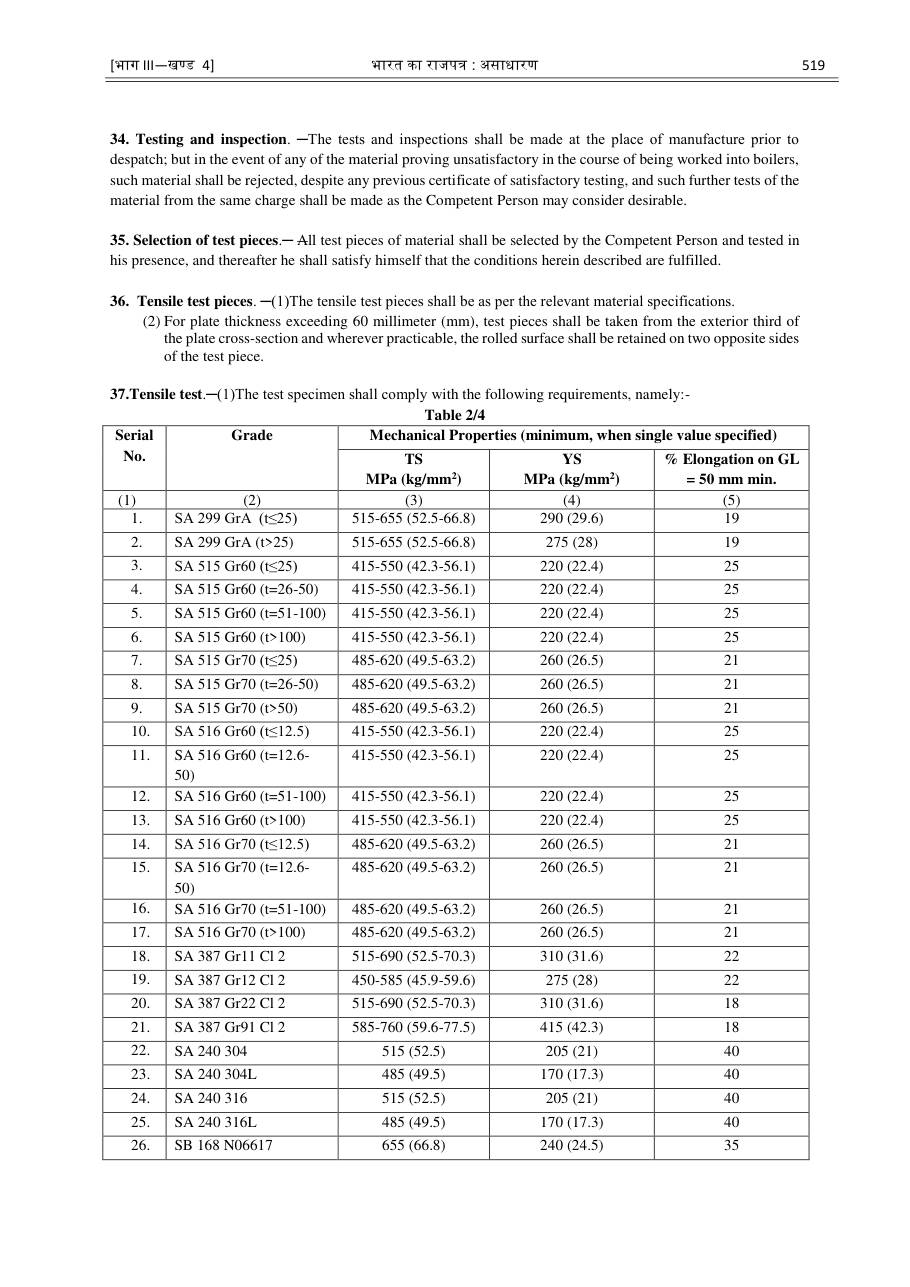
37.Tensile test.─(1)The test specimen shall comply with the following requirements, namely:-
Table 2/4
| Serial No. | Grade | Mechanical Properties (minimum, when single value specified) | ||
|---|---|---|---|---|
| TS MPa (kg/mm2) | YS MPa (kg/mm2) | % Elongation on GL = 50 mm min. | ||
| (1) | (2) | (3) | (4) | (5) |
| 1. | SA 299 GrA (t≤25) | 515-655 (52.5-66.8) | 290 (29.6) | 19 |
| 2. | SA 299 GrA (t>25) | 515-655 (52.5-66.8) | 275 (28) | 19 |
| 3. | SA 515 Gr60 (t≤25) | 415-550 (42.3-56.1) | 220 (22.4) | 25 |
| 4. | SA 515 Gr60 (t=26-50) | 415-550 (42.3-56.1) | 220 (22.4) | 25 |
| 5. | SA 515 Gr60 (t=51-100) | 415-550 (42.3-56.1) | 220 (22.4) | 25 |
| 6. | SA 515 Gr60 (t>100) | 415-550 (42.3-56.1) | 220 (22.4) | 25 |
| 7. | SA 515 Gr70 (t≤25) | 485-620 (49.5-63.2) | 260 (26.5) | 21 |
| 8. | SA 515 Gr70 (t=26-50) | 485-620 (49.5-63.2) | 260 (26.5) | 21 |
| 9. | SA 515 Gr70 (t>50) | 485-620 (49.5-63.2) | 260 (26.5) | 21 |
| 10. | SA 516 Gr60 (t≤12.5) | 415-550 (42.3-56.1) | 220 (22.4) | 25 |
| 11. | SA 516 Gr60 (t=12.6- 50) | 415-550 (42.3-56.1) | 220 (22.4) | 25 |
| 12. | SA 516 Gr60 (t=51-100) | 415-550 (42.3-56.1) | 220 (22.4) | 25 |
| 13. | SA 516 Gr60 (t>100) | 415-550 (42.3-56.1) | 220 (22.4) | 25 |
| 14. | SA 516 Gr70 (t≤12.5) | 485-620 (49.5-63.2) | 260 (26.5) | 21 |
| 15. | SA 516 Gr70 (t=12.6- 50) | 485-620 (49.5-63.2) | 260 (26.5) | 21 |
| 16. | SA 516 Gr70 (t=51-100) | 485-620 (49.5-63.2) | 260 (26.5) | 21 |
| 17. | SA 516 Gr70 (t>100) | 485-620 (49.5-63.2) | 260 (26.5) | 21 |
| 18. | SA 387 Gr11 Cl 2 | 515-690 (52.5-70.3) | 310 (31.6) | 22 |
| 19. | SA 387 Gr12 Cl 2 | 450-585 (45.9-59.6) | 275 (28) | 22 |
| 20. | SA 387 Gr22 Cl 2 | 515-690 (52.5-70.3) | 310 (31.6) | 18 |
| 21. | SA 387 Gr91 Cl 2 | 585-760 (59.6-77.5) | 415 (42.3) | 18 |
| 22. | SA 240 304 | 515 (52.5) | 205 (21) | 40 |
| 23. | SA 240 304L | 485 (49.5) | 170 (17.3) | 40 |
| 24. | SA 240 316 | 515 (52.5) | 205 (21) | 40 |
| 25. | SA 240 316L | 485 (49.5) | 170 (17.3) | 40 |
| 26. | SB 168 N06617 | 655 (66.8) | 240 (24.5) | 35 |
Table structure read from the Gazette PDF, page 519. Verification status as for the text above.
Show original extracted text (diagnostic, not authoritative)
Serial             Grade  Mechanical Properties (minimum, when single value specified)
 No.
                                    TS                 YS        % Elongation on GL
(1)                (2)      MPa (kg/mm2)        MPa (kg/mm2)         = 50 mm min.
                                                                            (5)
1. SA 299 GrA (t≤25)                (3)                (4)                   19
                          515-655 (52.5-66.8)      290 (29.6)

2. SA 299 GrA (t>25)      515-655 (52.5-66.8)        275 (28)                                 19

3. SA 515 Gr60 (t≤25)     415-550 (42.3-56.1)        220 (22.4)                               25

4. SA 515 Gr60 (t=26-50) 415-550 (42.3-56.1)         220 (22.4)                               25

5. SA 515 Gr60 (t=51-100) 415-550 (42.3-56.1)        220 (22.4)                               25

6. SA 515 Gr60 (t>100)    415-550 (42.3-56.1)        220 (22.4)                               25

7. SA 515 Gr70 (t≤25)     485-620 (49.5-63.2)        260 (26.5)                               21

8. SA 515 Gr70 (t=26-50) 485-620 (49.5-63.2)         260 (26.5)                               21

9. SA 515 Gr70 (t>50)     485-620 (49.5-63.2)        260 (26.5)                               21

10. SA 516 Gr60 (t≤12.5)  415-550 (42.3-56.1)        220 (22.4)                               25

11. SA 516 Gr60 (t=12.6-  415-550 (42.3-56.1)        220 (22.4)                               25

        50)

12. SA 516 Gr60 (t=51-100) 415-550 (42.3-56.1)       220 (22.4)                               25

13. SA 516 Gr60 (t>100)   415-550 (42.3-56.1)        220 (22.4)                               25

14. SA 516 Gr70 (t≤12.5)  485-620 (49.5-63.2)        260 (26.5)                               21

15. SA 516 Gr70 (t=12.6-  485-620 (49.5-63.2)        260 (26.5)                               21

        50)

16. SA 516 Gr70 (t=51-100) 485-620 (49.5-63.2)       260 (26.5)                               21

17. SA 516 Gr70 (t>100)   485-620 (49.5-63.2)        260 (26.5)                               21

18. SA 387 Gr11 Cl 2      515-690 (52.5-70.3)        310 (31.6)                               22

19. SA 387 Gr12 Cl 2      450-585 (45.9-59.6)        275 (28)                                 22

20. SA 387 Gr22 Cl 2      515-690 (52.5-70.3)        310 (31.6)                               18

21. SA 387 Gr91 Cl 2      585-760 (59.6-77.5)        415 (42.3)                               18

22. SA 240 304            515 (52.5)                 205 (21)                                 40

23. SA 240 304L           485 (49.5)                 170 (17.3)                               40

24. SA 240 316            515 (52.5)                 205 (21)                                 40

25. SA 240 316L           485 (49.5)                 170 (17.3)                               40

26. SB 168 N06617 655 (66.8) 240 (24.5) 35(2)In case of Carbon Steel,─ (i) The upper yield point at room temperature shall not be less than 50% of the specified minimum tensile strength at room temperature.
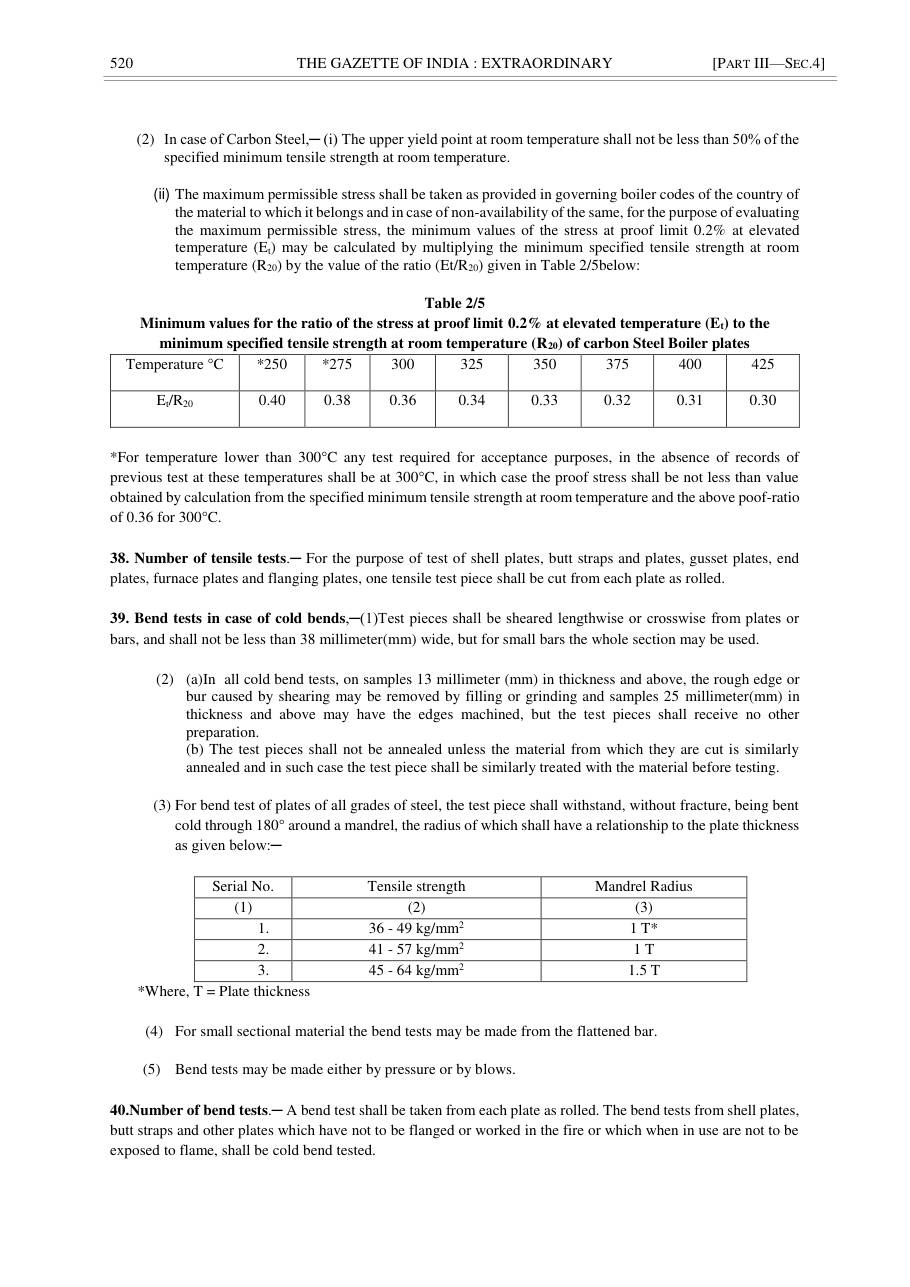
(ii)The maximum permissible stress shall be taken as provided in governing boiler codes of the country of the material to which it belongs and in case of non-availability of the same, for the purpose of evaluating the maximum permissible stress, the minimum values of the stress at proof limit 0.2% at elevated temperature (Et) may be calculated by multiplying the minimum specified tensile strength at room temperature (R20) by the value of the ratio (Et/R20) given in Table 2/5below:
Table 2/5
Minimum values for the ratio of the stress at proof limit 0.2% at elevated temperature (Et) to the minimum specified tensile strength at room temperature (R20) of carbon Steel Boiler plates
| Temperature °C | *250 | *275 | 300 | 325 | 350 | 375 | 400 | 425 |
| Et/R20 | 0.40 | 0.38 | 0.36 | 0.34 | 0.33 | 0.32 | 0.31 | 0.30 |
Table structure read from the Gazette PDF, page 520. Verification status as for the text above.
Show original extracted text (diagnostic, not authoritative)
Temperature °C *250 *275                300   325         350   375                       400    425

     Et/R20  0.40                 0.38  0.36  0.34        0.33  0.32                      0.31  0.30
*For temperature lower than 300°C any test required for acceptance purposes, in the absence of records of previous test at these temperatures shall be at 300°C, in which case the proof stress shall be not less than value obtained by calculation from the specified minimum tensile strength at room temperature and the above poof-ratio of 0.36 for 300°C.
Tables and formulae are shown in their extracted layout. Alignment, superscripts and subscripts may be lost. The Gazette page image is authoritative.
In short
Regulation 37 sets the minimum tensile properties for plate grades and, for carbon steel, how elevated-temperature proof stress is evaluated.
Key points
- (1) Table 2/4 gives, for each plate grade, the tensile strength (TS), yield strength (YS), both in MPa (kg/mm2), and the minimum % elongation on a 50 mm gauge length. See the Official text tab for the values.
- (2)(i) For carbon steel, the upper yield point at room temperature must be at least 50% of the specified minimum tensile strength at room temperature.
- (2)(ii) The maximum permissible stress is taken from the governing boiler code of the material's country. If that is not available, the minimum 0.2% proof stress at elevated temperature (Et) may be calculated by multiplying the minimum specified room-temperature tensile strength (R20) by the Et/R20 ratio in Table 2/5 for the temperature concerned.
Watch out
- For temperatures lower than 300°C, any acceptance test, if there are no records of previous tests at those temperatures, is made at 300°C. The proof stress must then be at least the value calculated with the ratio of 0.36 for 300°C.
Written by IBRsource editors · last edited 2026-11-20. Explanations simplify and are not a design method, testing procedure or authorisation. Requirements come from the complete regulations, the Gazette and approved documentation.
Comparison pending: the IBR 1950 text in force on 30 September 2026 is not yet established for this provision, so no change is claimed (how this works).
Orientation hints (unverified)
These candidates come from automated heading matching against DPIIT's scanned historical print edition of IBR 1950. That edition uses imperial units and riveted-construction provisions, so it is not the operative 2026 predecessor text. Regulation numbers alone never prove equivalence.
| Historical 1950-edition reg. | Heading as OCR'd | Heading similarity | Source image |
|---|---|---|---|
| 91 | Tensile test | 100% | Chapter II (DPIIT scan), image 18 |
| 1 | Tensile test for joint | 100% | Chapter V (DPIIT scan), image 5 |
| 2 | Tensile test for all | 100% | Chapter V (DPIIT scan), image 5 |
Amendment history of the candidate IBR 1950 regulations: Reg. 1 (1 amendment) · Reg. 2 (8 amendments)
IBR 1950 regulation 91 as last published in the DPIIT web edition (archived 2022)
Unofficial archived copy, not verified; see the regulation 91 page for its amendments.
| Reg. 91 MATERIALS OF CONSTRUCTION GENERAL GREY IRON CASTINGS (GRADE A) Tensile test |
| A tensile test bar machined to the dimensions shown in Regulation 88(b) and tested with either plain or screwed ends must show a breaking strength of not less than that shown in the following table:-
|
IBR 1950 regulation 1 as last published in the DPIIT web edition (archived 2022)
Unofficial archived copy, not verified; see the regulation 1 page for its amendments.
| Reg. 1 Short Title, Extent, Application and Commencement: |
|
IBR 1950 regulation 2 as last published in the DPIIT web edition (archived 2022)
Unofficial archived copy, not verified; see the regulation 2 page for its amendments.
| Reg. 2 Definitions |
In these Regulations, unless the context otherwise requires
|
Images of the official Gazette pages that contain this regulation. Click to zoom. Compare word by word before relying on the extracted text.
Indian Boiler Regulations, 2026, reg. 37, Regulation 37, Gazette of India, Extraordinary, Part III—Section 4, No. 596, 1 October 2026, printed p.519–520. https://egazette.gov.in/WriteReadData/2026/276813.pdf (text consulted via IBRsource, 2026-11-23).
The citation refers to the government publication. Cite the Gazette, not this website.