
Indian Boiler Regulations, 2026 · Chapter 2 · Materials of Construction
Regulation 61. Bend tests
Not yet checked against the official Gazette; verify before relying on it.
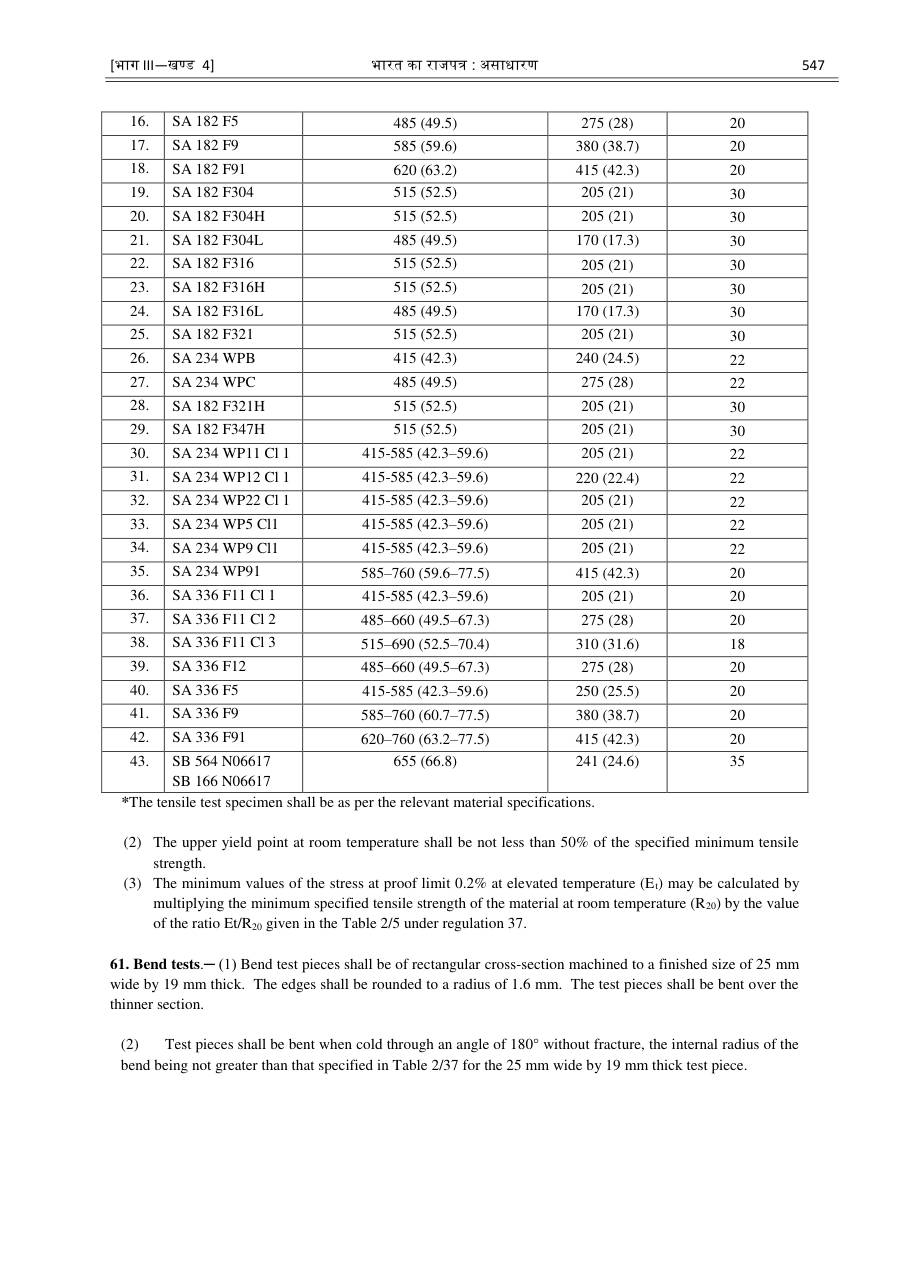
61. Bend tests.─ (1) Bend test pieces shall be of rectangular cross-section machined to a finished size of 25 mm wide by 19 mm thick. The edges shall be rounded to a radius of 1.6 mm. The test pieces shall be bent over the thinner section.
(2)Test pieces shall be bent when cold through an angle of 180° without fracture, the internal radius of the bend being not greater than that specified in Table 2/37 for the 25 mm wide by 19 mm thick test piece.
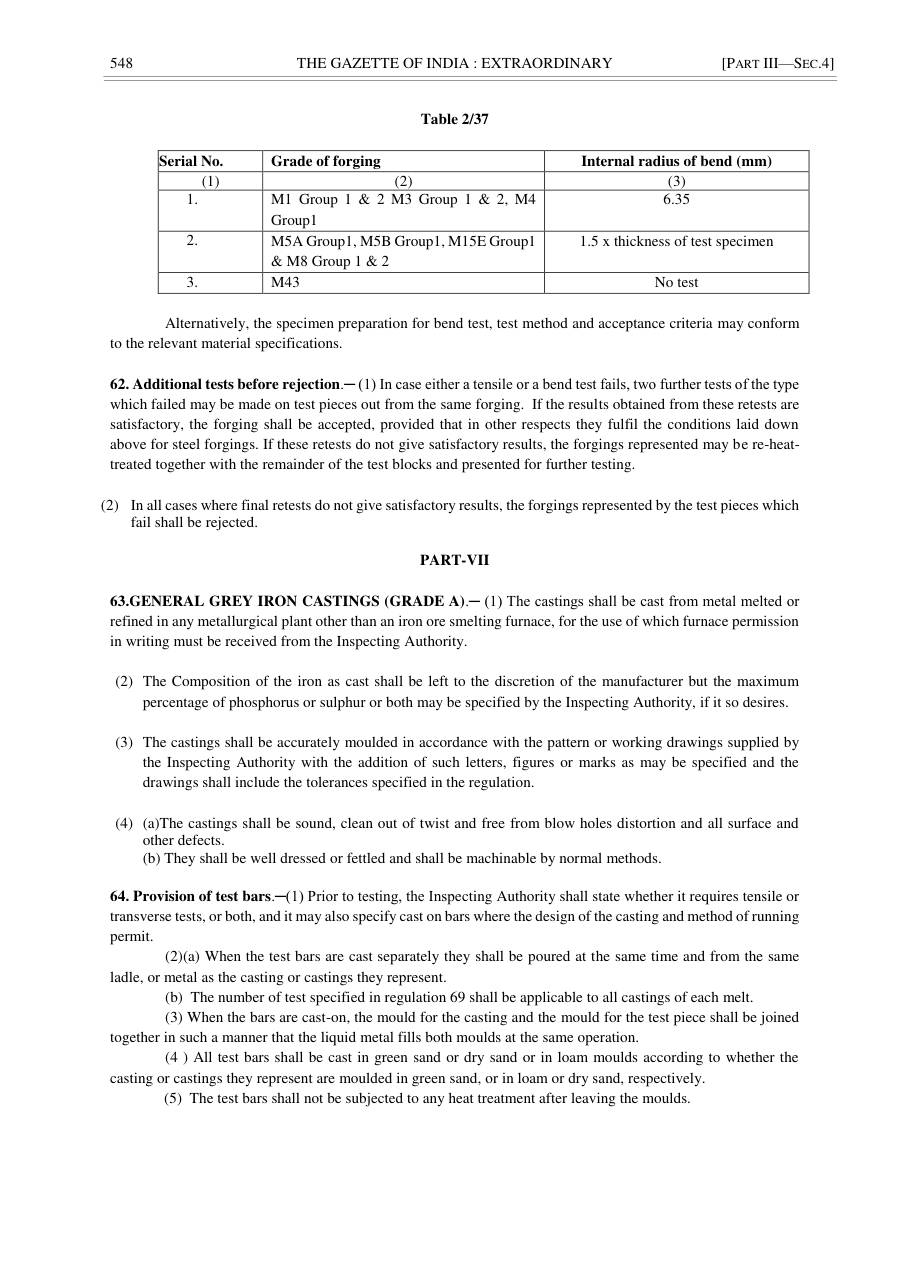
Table 2/37
| Serial No. | Grade of forging | Internal radius of bend (mm) |
|---|---|---|
| (1) | (2) | (3) |
| 1. | M1 Group 1 & 2 M3 Group 1 & 2, M4 Group1 | 6.35 |
| 2. | M5A Group1, M5B Group1, M15E Group1 & M8 Group 1 & 2 | 1.5 x thickness of test specimen |
| 3. | M43 | No test |
Table structure read from the Gazette PDF, page 548. Verification status as for the text above.
Show original extracted text (diagnostic, not authoritative)
Serial No.   Grade of forging                     Internal radius of bend (mm)
        (1)                          (2)                           (3)
                                                                  6.35
     1.      M1 Group 1 & 2 M3 Group 1 & 2, M4
             Group1                               1.5 x thickness of test specimen
     2.      M5A Group1, M5B Group1, M15E Group1
             & M8 Group 1 & 2                                    No test
     3.      M43
Alternatively, the specimen preparation for bend test, test method and acceptance criteria may conform to the relevant material specifications.
Parts of this extracted text look garbled; read the Gazette page before using any value.
Tables and formulae are shown in their extracted layout. Alignment, superscripts and subscripts may be lost. The Gazette page image is authoritative.
In short
Regulation 61 sets the bend test for steel forgings: the size of the test piece, how it is bent and the maximum internal radius of the bend for each forging grade.
Key points
- (1) Test pieces are rectangular, machined to 25 mm wide by 19 mm thick, with edges rounded to a radius of 1.6 mm. They are bent over the thinner section.
- (2) Where a bend test applies (Table 2/37 marks some groups "No test"), the piece is bent cold through 180° without fracture. The internal radius of the bend must not exceed the value in Table 2/37 for the grade of forging.
- Table 2/37 groups the forging grades (M1, M3, M4, M5A, M5B, M15E, M8 and M43) against a bend radius, a multiple of specimen thickness, or "No test". The extracted table layout is broken, so check the Gazette page for which value belongs to which grade.
- As an alternative, the specimen preparation, test method and acceptance criteria may follow the relevant material specification.
Watch out
- The test is done cold, and any fracture during the 180° bend is a failure.
Written by IBRsource editors · last edited 2026-11-20. Explanations simplify and are not a design method, testing procedure or authorisation. Requirements come from the complete regulations, the Gazette and approved documentation.
Comparison pending: the IBR 1950 text in force on 30 September 2026 is not yet established for this provision, so no change is claimed (how this works).
Orientation hints (unverified)
These candidates come from automated heading matching against DPIIT's scanned historical print edition of IBR 1950. That edition uses imperial units and riveted-construction provisions, so it is not the operative 2026 predecessor text. Regulation numbers alone never prove equivalence.
| Historical 1950-edition reg. | Heading as OCR'd | Heading similarity | Source image |
|---|---|---|---|
| 20 | Number of Bend Tests | 100% | Chapter II (DPIIT scan), image 2 |
| 19 | Bend Tests | 100% | Chapter II (DPIIT scan), image 2 |
| 84 | Bend Tests | 100% | Chapter II (DPIIT scan), image 16 |
Amendment history of the candidate IBR 1950 regulations: Reg. 20 (2 amendments) · Reg. 19 (1 amendment)
IBR 1950 regulation 20 as last published in the DPIIT web edition (archived 2022)
Unofficial archived copy, not verified; see the regulation 20 page for its amendments.
| Reg. 20 MATERIALS OF CONSTRUCTION STEEL PLATES, RIVETS, SECTION AND BARS IN CARBON STEEL |
| (a) Plates.- A bend test shall be taken from each plate as rolled. The bend test from shell plates, butt straps and other plates which have not to be flanged or worked in the fire or which when in use are not to be exposed to flame shall be cold bend test. (b) Angle Bars.- A cold bend test shall be made from each angle bar rolled, provided that the cold bend test need not be carried out if basic material specification does not call for it. (c) Stay Bars.- A cold bend test shall be made from every 15 stay bars as rolled from each charge. |
IBR 1950 regulation 19 as last published in the DPIIT web edition (archived 2022)
Unofficial archived copy, not verified; see the regulation 19 page for its amendments.
| Reg. 19 MATERIALS OF CONSTRUCTION STEEL PLATES, RIVETS, SECTION AND BARS IN CARBON STEEL |
| Cold Bends.-(a) Test pieces shall be sheared lengthwise or crosswise from plates or bars, and shall not be less than 1½ inches wide, but for small bars the whole section may be used. For rivet bars bend tests are not required. b) In all cold bend tests, on samples 0.5 inch in thickness and above, the rough edge or arris caused by shearing may be removed by filing or grinding, and samples 1 inch in thickness and above may have the edges machined, but the test pieces shall receive no other preparation. The test pieces shall not be annealed unless the material from which they are cut is similarly annealed in which case the test piece shall be similarly and simultaneously treated with the material before testing. (c) (i) For bend test of plates of all grades of steel, the test piece shall withstands, without fracture, being bent cold through 180o around a mandrel, the radius of which shall have a relationship to the plate thickness as given below: Tensile strength Mandrel Radius 36 - 49 kg./mm2 1 T 41 - 57 kg./mm2 1 T 45 - 64 kg./mm2 1.5 T where T = Plate thickness (ii) For cold bend test of sections and bars, the test piece shall withstand, without fracture, being doubled over until the internal radius is equal to that shown in Table under regulation 16 and the limbs are parallel. (d) For small sectional material these bend tests may be made from the flattened bar. (e) Bend tests may be made either by pressure or by blows. |
IBR 1950 regulation 84 as last published in the DPIIT web edition (archived 2022)
Unofficial archived copy, not verified; see the regulation 84 page for its amendments.
| Reg. 84 MATERIALS OF CONSTRUCTION FORGED OR ROLLED PRESSURE PARTS OTHER THAN SEAMLESS DRUMS OF CARBON STEEL Bend Tests |
| (a) Bend test pieces shall be of rectangular cross section machined to a finished size of 1 inch wide by ¾ inch thick. In the case of headers, bend test pieces may be cut transversely 1½ T wide by T thick where T is the thickness of the header. The edges shall be rounded to a radius of 1/16 inch. The test pieces shall be bent over the thinner section. (b) Test pieces shall be bent when cold through an angle of 180° without fracture, the internal radius of the bend being not greater than that specified in table below for the 1 inch wide by ¾ inch thick test piece and not more than 1½ T for the full thickness test piece:
Bend tests may be made by pressure or by blows. |
Images of the official Gazette pages that contain this regulation. Click to zoom. Compare word by word before relying on the extracted text.
Indian Boiler Regulations, 2026, reg. 61, Regulation 61, Gazette of India, Extraordinary, Part III—Section 4, No. 596, 1 October 2026, printed p.547–548. https://egazette.gov.in/WriteReadData/2026/276813.pdf (text consulted via IBRsource, 2026-11-23).
The citation refers to the government publication. Cite the Gazette, not this website.