
Indian Boiler Regulations, 2026 · Chapter 2 · Materials of Construction
Regulation 31. Materials of construction for plates
Not yet checked against the official Gazette; verify before relying on it.
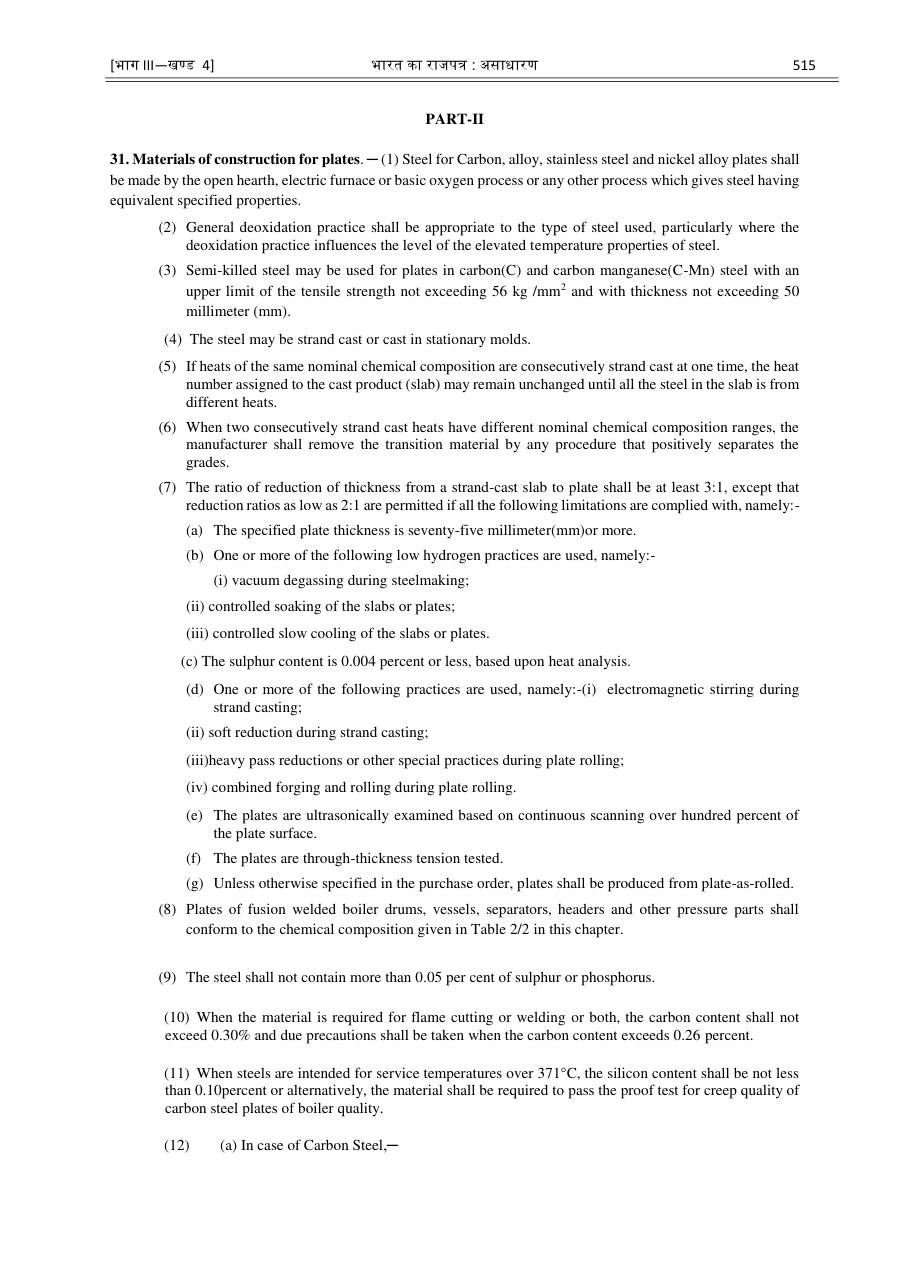
31. Materials of construction for plates. ─ (1) Steel for Carbon, alloy, stainless steel and nickel alloy plates shall be made by the open hearth, electric furnace or basic oxygen process or any other process which gives steel having equivalent specified properties.
(2)General deoxidation practice shall be appropriate to the type of steel used, particularly where the deoxidation practice influences the level of the elevated temperature properties of steel.
(3)Semi-killed steel may be used for plates in carbon(C) and carbon manganese(C-Mn) steel with an upper limit of the tensile strength not exceeding 56 kg /mm2 and with thickness not exceeding 50 millimeter (mm).
(4)The steel may be strand cast or cast in stationary molds.
(5)If heats of the same nominal chemical composition are consecutively strand cast at one time, the heat number assigned to the cast product (slab) may remain unchanged until all the steel in the slab is from different heats.
(6)When two consecutively strand cast heats have different nominal chemical composition ranges, the manufacturer shall remove the transition material by any procedure that positively separates the grades.
(7)The ratio of reduction of thickness from a strand-cast slab to plate shall be at least 3:1, except that reduction ratios as low as 2:1 are permitted if all the following limitations are complied with, namely:-
(a)The specified plate thickness is seventy-five millimeter(mm)or more.
(b)One or more of the following low hydrogen practices are used, namely:-
(i)vacuum degassing during steelmaking;
(ii)controlled soaking of the slabs or plates;
(iii)controlled slow cooling of the slabs or plates.
(c)The sulphur content is 0.004 percent or less, based upon heat analysis.
(d)One or more of the following practices are used, namely:-(i) electromagnetic stirring during strand casting;
(ii)soft reduction during strand casting;
(iii)heavy pass reductions or other special practices during plate rolling;
(iv)combined forging and rolling during plate rolling.
(e)The plates are ultrasonically examined based on continuous scanning over hundred percent of the plate surface.
(f)The plates are through-thickness tension tested.
(g)Unless otherwise specified in the purchase order, plates shall be produced from plate-as-rolled.
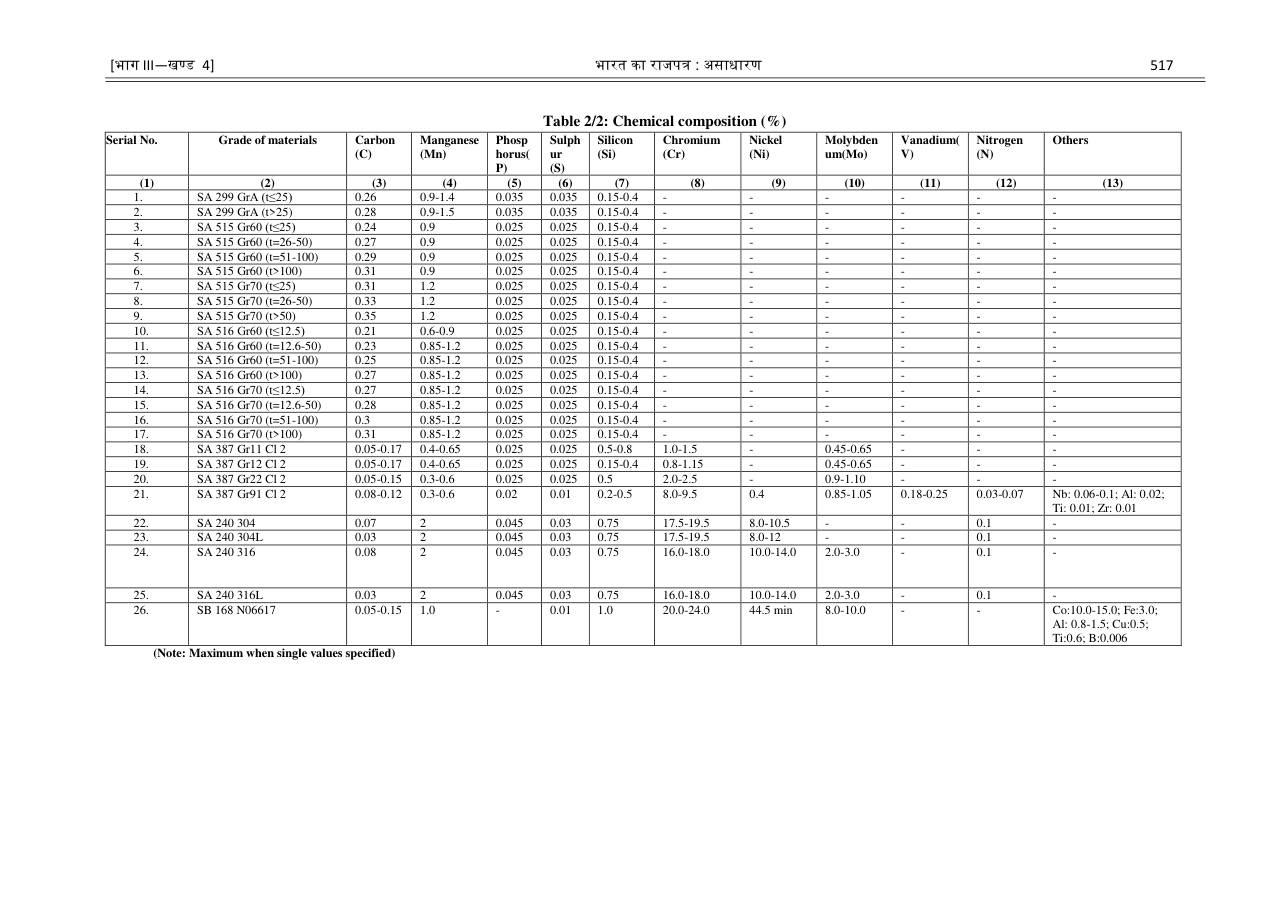
(8)Plates of fusion welded boiler drums, vessels, separators, headers and other pressure parts shall conform to the chemical composition given in Table 2/2 in this chapter.
(9)The steel shall not contain more than 0.05 per cent of sulphur or phosphorus.
(10)When the material is required for flame cutting or welding or both, the carbon content shall not exceed 0.30% and due precautions shall be taken when the carbon content exceeds 0.26 percent.
(11)When steels are intended for service temperatures over 371°C, the silicon content shall be not less than 0.10percent or alternatively, the material shall be required to pass the proof test for creep quality of carbon steel plates of boiler quality.
(12)(a) In case of Carbon Steel,─
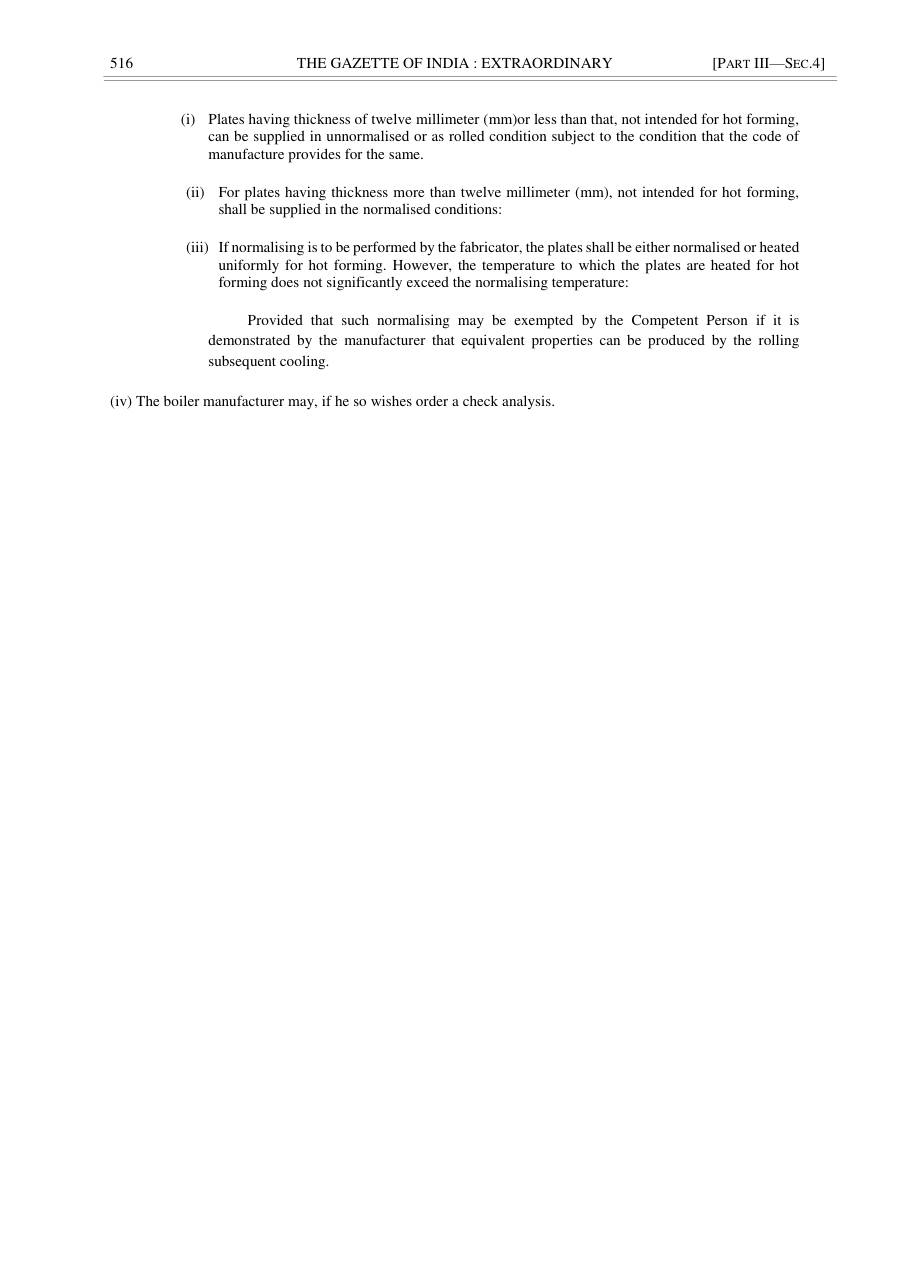
(i)Plates having thickness of twelve millimeter (mm)or less than that, not intended for hot forming, can be supplied in unnormalised or as rolled condition subject to the condition that the code of manufacture provides for the same.
(ii)For plates having thickness more than twelve millimeter (mm), not intended for hot forming, shall be supplied in the normalised conditions:
(iii)If normalising is to be performed by the fabricator, the plates shall be either normalised or heated uniformly for hot forming. However, the temperature to which the plates are heated for hot forming does not significantly exceed the normalising temperature:
Provided that such normalising may be exempted by the Competent Person if it is demonstrated by the manufacturer that equivalent properties can be produced by the rolling subsequent cooling.
(iv)The boiler manufacturer may, if he so wishes order a check analysis.
Table 2/2: Chemical composition (%)
| Serial No. | Grade of materials | Carbon (C) | Manganese (Mn) | Phosphorus( P) | Sulphur (S) | Silicon (Si) | Chromium (Cr) | Nickel (Ni) | Molybdenum(Mo) | Vanadium( V) | Nitrogen (N) | Others |
|---|---|---|---|---|---|---|---|---|---|---|---|---|
| (1) | (2) | (3) | (4) | (5) | (6) | (7) | (8) | (9) | (10) | (11) | (12) | (13) |
| 1. | SA 299 GrA (t≤25) | 0.26 | 0.9-1.4 | 0.035 | 0.035 | 0.15-0.4 | - | - | - | - | - | - |
| 2. | SA 299 GrA (t>25) | 0.28 | 0.9-1.5 | 0.035 | 0.035 | 0.15-0.4 | - | - | - | - | - | - |
| 3. | SA 515 Gr60 (t≤25) | 0.24 | 0.9 | 0.025 | 0.025 | 0.15-0.4 | - | - | - | - | - | - |
| 4. | SA 515 Gr60 (t=26-50) | 0.27 | 0.9 | 0.025 | 0.025 | 0.15-0.4 | - | - | - | - | - | - |
| 5. | SA 515 Gr60 (t=51-100) | 0.29 | 0.9 | 0.025 | 0.025 | 0.15-0.4 | - | - | - | - | - | - |
| 6. | SA 515 Gr60 (t>100) | 0.31 | 0.9 | 0.025 | 0.025 | 0.15-0.4 | - | - | - | - | - | - |
| 7. | SA 515 Gr70 (t≤25) | 0.31 | 1.2 | 0.025 | 0.025 | 0.15-0.4 | - | - | - | - | - | - |
| 8. | SA 515 Gr70 (t=26-50) | 0.33 | 1.2 | 0.025 | 0.025 | 0.15-0.4 | - | - | - | - | - | - |
| 9. | SA 515 Gr70 (t>50) | 0.35 | 1.2 | 0.025 | 0.025 | 0.15-0.4 | - | - | - | - | - | - |
| 10. | SA 516 Gr60 (t≤12.5) | 0.21 | 0.6-0.9 | 0.025 | 0.025 | 0.15-0.4 | - | - | - | - | - | - |
| 11. | SA 516 Gr60 (t=12.6-50) | 0.23 | 0.85-1.2 | 0.025 | 0.025 | 0.15-0.4 | - | - | - | - | - | - |
| 12. | SA 516 Gr60 (t=51-100) | 0.25 | 0.85-1.2 | 0.025 | 0.025 | 0.15-0.4 | - | - | - | - | - | - |
| 13. | SA 516 Gr60 (t>100) | 0.27 | 0.85-1.2 | 0.025 | 0.025 | 0.15-0.4 | - | - | - | - | - | - |
| 14. | SA 516 Gr70 (t≤12.5) | 0.27 | 0.85-1.2 | 0.025 | 0.025 | 0.15-0.4 | - | - | - | - | - | - |
| 15. | SA 516 Gr70 (t=12.6-50) | 0.28 | 0.85-1.2 | 0.025 | 0.025 | 0.15-0.4 | - | - | - | - | - | - |
| 16. | SA 516 Gr70 (t=51-100) | 0.3 | 0.85-1.2 | 0.025 | 0.025 | 0.15-0.4 | - | - | - | - | - | - |
| 17. | SA 516 Gr70 (t>100) | 0.31 | 0.85-1.2 | 0.025 | 0.025 | 0.15-0.4 | - | - | - | - | - | - |
| 18. | SA 387 Gr11 Cl 2 | 0.05-0.17 | 0.4-0.65 | 0.025 | 0.025 | 0.5-0.8 | 1.0-1.5 | - | 0.45-0.65 | - | - | - |
| 19. | SA 387 Gr12 Cl 2 | 0.05-0.17 | 0.4-0.65 | 0.025 | 0.025 | 0.15-0.4 | 0.8-1.15 | - | 0.45-0.65 | - | - | - |
| 20. | SA 387 Gr22 Cl 2 | 0.05-0.15 | 0.3-0.6 | 0.025 | 0.025 | 0.5 | 2.0-2.5 | - | 0.9-1.10 | - | - | - |
| 21. | SA 387 Gr91 Cl 2 | 0.08-0.12 | 0.3-0.6 | 0.02 | 0.01 | 0.2-0.5 | 8.0-9.5 | 0.4 | 0.85-1.05 | 0.18-0.25 | 0.03-0.07 | Nb: 0.06-0.1; Al: 0.02; Ti: 0.01; Zr: 0.01 |
| 22. | SA 240 304 | 0.07 | 2 | 0.045 | 0.03 | 0.75 | 17.5-19.5 | 8.0-10.5 | - | - | 0.1 | - |
| 23. | SA 240 304L | 0.03 | 2 | 0.045 | 0.03 | 0.75 | 17.5-19.5 | 8.0-12 | - | - | 0.1 | - |
| 24. | SA 240 316 | 0.08 | 2 | 0.045 | 0.03 | 0.75 | 16.0-18.0 | 10.0-14.0 | 2.0-3.0 | - | 0.1 | - |
| 25. | SA 240 316L | 0.03 | 2 | 0.045 | 0.03 | 0.75 | 16.0-18.0 | 10.0-14.0 | 2.0-3.0 | - | 0.1 | - |
| 26. | SB 168 N06617 | 0.05-0.15 | 1.0 | - | 0.01 | 1.0 | 20.0-24.0 | 44.5 min | 8.0-10.0 | - | - | Co:10.0-15.0; Fe:3.0; Al: 0.8-1.5; Cu:0.5; Ti:0.6; B:0.006 |
Table structure read from the Gazette PDF, page 517. Verification status as for the text above.
Show original extracted text (diagnostic, not authoritative)
Serial No.        Grade of materials  Carbon       Manganese  Phosp   Sulph  Silicon  Chromium   Nickel      Molybden   Vanadium( Nitrogen    Others
                                      (C)          (Mn)       horus(  ur     (Si)     (Cr)       (Ni)        um(Mo)
        (1)                 (2)                               P)      (S)                                               V)         (N)                    (13)
      1.     SA 299 GrA (t≤25)            (3)           (4)                                                      (10)                         -
      2.     SA 299 GrA (t>25)        0.26         0.9-1.4      (5)   (6)        (7)    (8)             (9)  -              (11)       (12)   -
      3.     SA 515 Gr60 (t≤25)       0.28         0.9-1.5    0.035                                          -          -          -          -
      4.     SA 515 Gr60 (t=26-50)    0.24         0.9        0.035   0.035 0.15-0.4 -           -           -          -          -          -
      5.     SA 515 Gr60 (t=51-100)   0.27         0.9        0.025                                          -          -          -          -
      6.     SA 515 Gr60 (t>100)      0.29         0.9        0.025   0.035 0.15-0.4 -           -           -          -          -          -
      7.     SA 515 Gr70 (t≤25)       0.31         0.9        0.025                                          -          -          -          -
      8.     SA 515 Gr70 (t=26-50)    0.31         1.2        0.025   0.025 0.15-0.4 -           -           -          -          -          -
      9.     SA 515 Gr70 (t>50)       0.33         1.2        0.025                                          -          -          -          -
      10.    SA 516 Gr60 (t≤12.5)     0.35         1.2        0.025   0.025 0.15-0.4 -           -           -          -          -          -
      11.    SA 516 Gr60 (t=12.6-50)  0.21         0.6-0.9    0.025                                          -          -          -          -
      12.    SA 516 Gr60 (t=51-100)   0.23         0.85-1.2   0.025   0.025 0.15-0.4 -           -           -          -          -          -
      13.    SA 516 Gr60 (t>100)      0.25         0.85-1.2   0.025                                          -          -          -          -
      14.    SA 516 Gr70 (t≤12.5)     0.27         0.85-1.2   0.025   0.025 0.15-0.4 -           -           -          -          -          -
      15.    SA 516 Gr70 (t=12.6-50)  0.27         0.85-1.2   0.025                                          -          -          -          -
      16.    SA 516 Gr70 (t=51-100)   0.28         0.85-1.2   0.025   0.025 0.15-0.4 -           -           -          -          -          -
      17.    SA 516 Gr70 (t>100)      0.3          0.85-1.2   0.025                                          -          -          -          -
      18.    SA 387 Gr11 Cl 2         0.31         0.85-1.2   0.025   0.025 0.15-0.4 -           -           -          -          -          -
      19.    SA 387 Gr12 Cl 2         0.05-0.17    0.4-0.65   0.025                                          0.45-0.65  -          -          -
      20.    SA 387 Gr22 Cl 2         0.05-0.17    0.4-0.65   0.025   0.025 0.15-0.4 -           -           0.45-0.65  -          -          -
      21.    SA 387 Gr91 Cl 2         0.05-0.15    0.3-0.6    0.025                                          0.9-1.10   -          -          Nb: 0.06-0.1; Al: 0.02;
                                      0.08-0.12    0.3-0.6    0.025   0.025 0.15-0.4 -           -           0.85-1.05  -          -          Ti: 0.01; Zr: 0.01
      22.    SA 240 304                                       0.02                                                      0.18-0.25  0.03-0.07  -
      23.    SA 240 304L              0.07         2                  0.025 0.15-0.4 -           -           -                                -
      24.    SA 240 316               0.03         2                                                         -                                -
                                      0.08         2                  0.025 0.15-0.4 -           -           2.0-3.0

                                                                      0.025 0.15-0.4 -           -

                                                                      0.025 0.15-0.4 -           -

                                                                      0.025 0.15-0.4 -           -

                                                                      0.025 0.15-0.4 -           -

                                                                      0.025 0.15-0.4 -           -

                                                                      0.025 0.5-0.8 1.0-1.5      -

                                                                      0.025 0.15-0.4 0.8-1.15    -

                                                                      0.025 0.5       2.0-2.5    -

                                                                      0.01 0.2-0.5 8.0-9.5       0.4

                                                              0.045 0.03 0.75         17.5-19.5  8.0-10.5               -          0.1
                                                              0.045 0.03 0.75         17.5-19.5  8.0-12
                                                              0.045 0.03 0.75         16.0-18.0  10.0-14.0              -          0.1

                                                                                                                        -          0.1

25.          SA 240 316L              0.03         2          0.045 0.03 0.75         16.0-18.0  10.0-14.0 2.0-3.0      -          0.1        -
                                                                                      20.0-24.0
26.          SB 168 N06617            0.05-0.15 1.0           -       0.01 1.0                   44.5 min    8.0-10.0   -          -          Co:10.0-15.0; Fe:3.0;

                                                                                                                                              Al: 0.8-1.5; Cu:0.5;

                                                                                                                                              Ti:0.6; B:0.006
(Note: Maximum when single values specified)
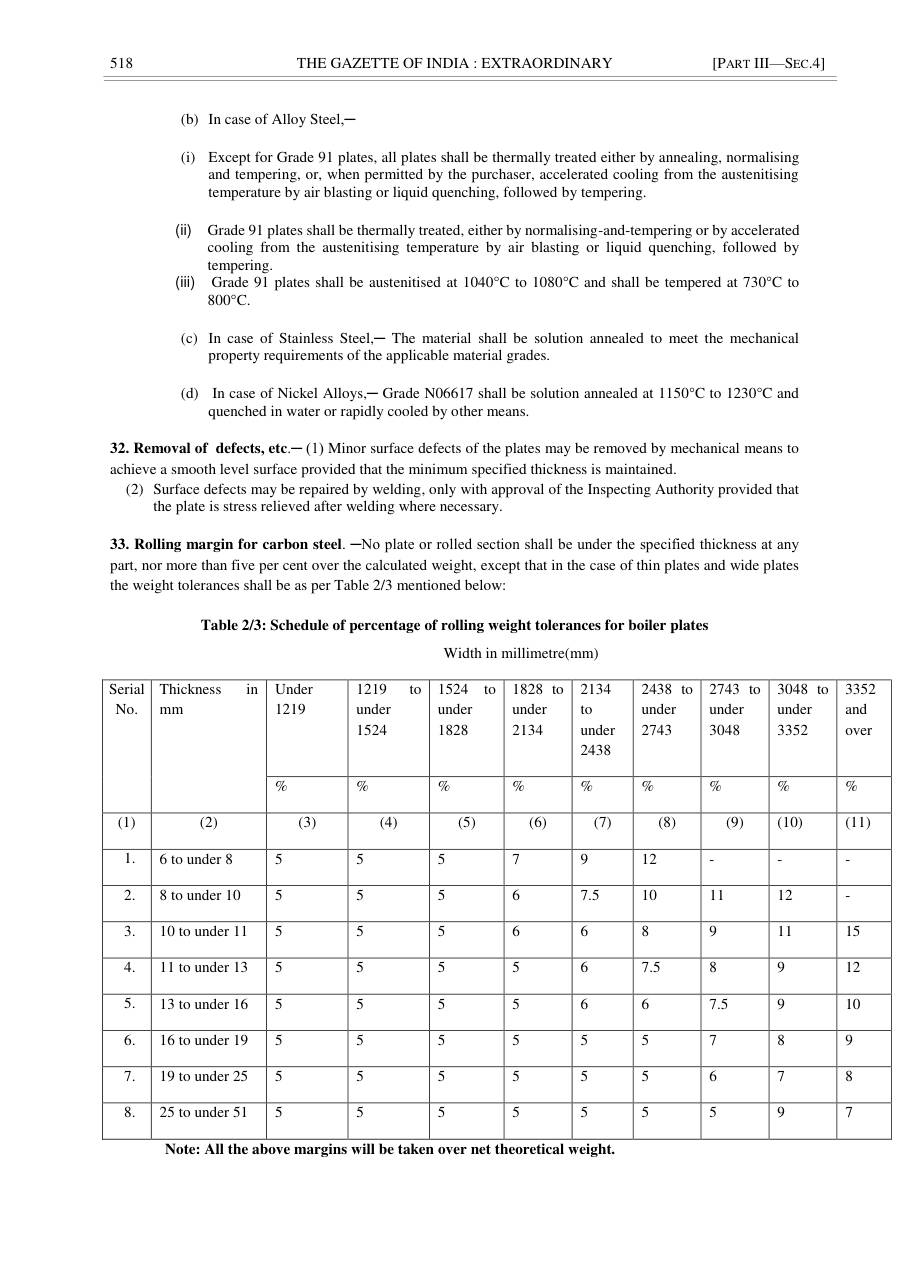
(b)In case of Alloy Steel,─
(i)Except for Grade 91 plates, all plates shall be thermally treated either by annealing, normalising and tempering, or, when permitted by the purchaser, accelerated cooling from the austenitising temperature by air blasting or liquid quenching, followed by tempering.
(ii)Grade 91 plates shall be thermally treated, either by normalising-and-tempering or by accelerated cooling from the austenitising temperature by air blasting or liquid quenching, followed by tempering.
(iii)Grade 91 plates shall be austenitised at 1040°C to 1080°C and shall be tempered at 730°C to 800°C.
(c)In case of Stainless Steel,─ The material shall be solution annealed to meet the mechanical property requirements of the applicable material grades.
(d)In case of Nickel Alloys,─ Grade N06617 shall be solution annealed at 1150°C to 1230°C and quenched in water or rapidly cooled by other means.
Parts of this extracted text look garbled; read the Gazette page before using any value.
Tables and formulae are shown in their extracted layout. Alignment, superscripts and subscripts may be lost. The Gazette page image is authoritative.
In short
Regulation 31 sets steelmaking, casting, chemistry and heat treatment requirements for carbon, alloy, stainless steel and nickel alloy plates.
Key points
- (1)–(2) Steel is made by open hearth, electric furnace, basic oxygen or an equivalent process, with deoxidation suited to the steel type.
- (3) Semi-killed steel is allowed for C and C-Mn plates only up to a tensile strength of 56 kg/mm2 and a thickness of 50 mm.
- (4)–(6) Steel may be strand cast or cast in stationary molds. Transition material between strand cast heats of different composition must be removed.
- (7) The reduction ratio from strand-cast slab to plate must be at least 3:1. Down to 2:1 is allowed only if all the listed conditions are met, including thickness of seventy-five mm or more, low hydrogen practice, sulphur of 0.004 percent or less, special casting or rolling practice, full ultrasonic examination and through-thickness tension testing.
- (8) Plates for fusion welded drums, vessels, separators, headers and other pressure parts follow the chemistry in Table 2/2.
- (9) Sulphur or phosphorus must not exceed 0.05 per cent.
- (10) For flame cutting or welding, carbon must not exceed 0.30%; take due precautions above 0.26 percent.
- (11) For service over 371°C, silicon must be at least 0.10 percent, or the material must pass the creep quality proof test.
- (12)(a) Carbon steel: plates of twelve mm or less not for hot forming may be supplied as rolled if the code of manufacture allows. Thicker plates are supplied normalised. The Competent Person may exempt normalising if equivalent properties are shown through rolling and subsequent cooling.
- (12)(b)–(d) Alloy steel plates are thermally treated as described. Grade 91 is austenitised at 1040°C to 1080°C and tempered at 730°C to 800°C. Stainless steel is solution annealed. Nickel alloy N06617 is solution annealed at 1150°C to 1230°C and quenched in water or rapidly cooled.
Watch out
- Table 2/2 is garbled in the extracted text. Check the Gazette page for the exact chemical limits before selecting, accepting or certifying material, and treat the values summarised here as subject to that check.
Written by IBRsource editors · last edited 2026-11-20. Explanations simplify and are not a design method, testing procedure or authorisation. Requirements come from the complete regulations, the Gazette and approved documentation.
Comparison pending: the IBR 1950 text in force on 30 September 2026 is not yet established for this provision, so no change is claimed (how this works).
Orientation hints (unverified)
These candidates come from automated heading matching against DPIIT's scanned historical print edition of IBR 1950. That edition uses imperial units and riveted-construction provisions, so it is not the operative 2026 predecessor text. Regulation numbers alone never prove equivalence.
| Historical 1950-edition reg. | Heading as OCR'd | Heading similarity | Source image |
|---|---|---|---|
| 33 | Plates | 100% | Chapter II (DPIIT scan), image 3 |
| 626 | Materials | 100% | Chapter XV (DPIIT scan), image 1 |
| 118 | Tube Plates | 71% | Chapter III (DPIIT scan), image 2 |
Amendment history of the candidate IBR 1950 regulations: Reg. 626 (1 amendment)
IBR 1950 regulation 33 as last published in the DPIIT web edition (archived 2022)
Unofficial archived copy, not verified; see the regulation 33 page for its amendments.
| Reg. 33 MATERIALS OF CONSTRUCTION COPPER PLATES, STAY AND RIVET BARS |
| (a) Process.- The copper shall be fire-refined or electrolytic and hot-rolled from suitable cakes. (b) Chemical Composition.- The chemical composition of the plates shall be as follows:-
(c) Freedom from defects.- The plates shall be clean, smooth and free from defects and shall have a workmanlike finish. They shall be thoroughly annealed. (d) Rolling Margin.- No plate shall be under the specified thickness at any part, not more than 5% over the calculated weight. The scrap margin, partly sheared and left attached, shall be not less than 3 inches at the ends and 1½ inches at each side. (e) Tensile Tests.- One tensile test shall be taken from each plate as rolled. The tensile breaking strength, from Standard Test Piece A, shall not be less than 14 tons per sq. inch with an elongation of not less than 35%. (f) Hot and Cold Bend tests.- One hot (temperature between 1200°F and 1400°F) and one cold bend test shall be taken from each plate as rolled. For either hot or cold bend tests, the test piece shall withstand being doubled over without fracture until the sides are touching and parallel. |
IBR 1950 regulation 626 as last published in the DPIIT web edition (archived 2022)
Unofficial archived copy, not verified; see the regulation 626 page for its amendments.
| Reg. 626 FEED WATER FOR BOILER | |||||||||||||||||||||||||||||||||||||||||||||||||||||||||||||||||||||||||||||||||||||||||||||||||||||||||||||||||||||||||||||||||||||||||||||||||||||||||||||||||||||||||||||||||||||||||||||||||||||||||
Tests shall be carried out as prescribed in the appropriate clauses of IS : 3025-1964* and IS : 3550-1965! as indicated against the characteristics in Table 1.
| |||||||||||||||||||||||||||||||||||||||||||||||||||||||||||||||||||||||||||||||||||||||||||||||||||||||||||||||||||||||||||||||||||||||||||||||||||||||||||||||||||||||||||||||||||||||||||||||||||||||||
IBR 1950 regulation 118 as last published in the DPIIT web edition (archived 2022)
Unofficial archived copy, not verified; see the regulation 118 page for its amendments.
| Reg. 118, Reg. 119, Reg. 120 END PLATES
Tube Plates Parts of flat tube plates within the tube nests
Reg. 120 END PLATES Flanging of End Plates All flanges shall be a good fit to the shell and flues. Flogging and/or hammering in the fitting of these parts is prohibited. The caulking edges of all flanged plates shall be machined or machine gas cut. |
Images of the official Gazette pages that contain this regulation. Click to zoom. Compare word by word before relying on the extracted text.
Indian Boiler Regulations, 2026, reg. 31, Regulation 31, Gazette of India, Extraordinary, Part III—Section 4, No. 596, 1 October 2026, printed p.515–518. https://egazette.gov.in/WriteReadData/2026/276813.pdf (text consulted via IBRsource, 2026-11-23).
The citation refers to the government publication. Cite the Gazette, not this website.