BETAIndependent engineering reference. Source-text verification is ongoing.Verification ongoing.Verification status →
IBRsourceIndian Boiler Regulations, made clear

Indian Boiler Regulations, 2026 · Chapter 2 · Materials of Construction

Regulation 50. Castings of carbon, alloy and stainless steel

Official text — not yet verifiedGazette 1 Oct 2026 · printed pp. 537–538

Not yet checked against the official Gazette; verify before relying on it.

Reproduced from the Gazette of India · verification status above

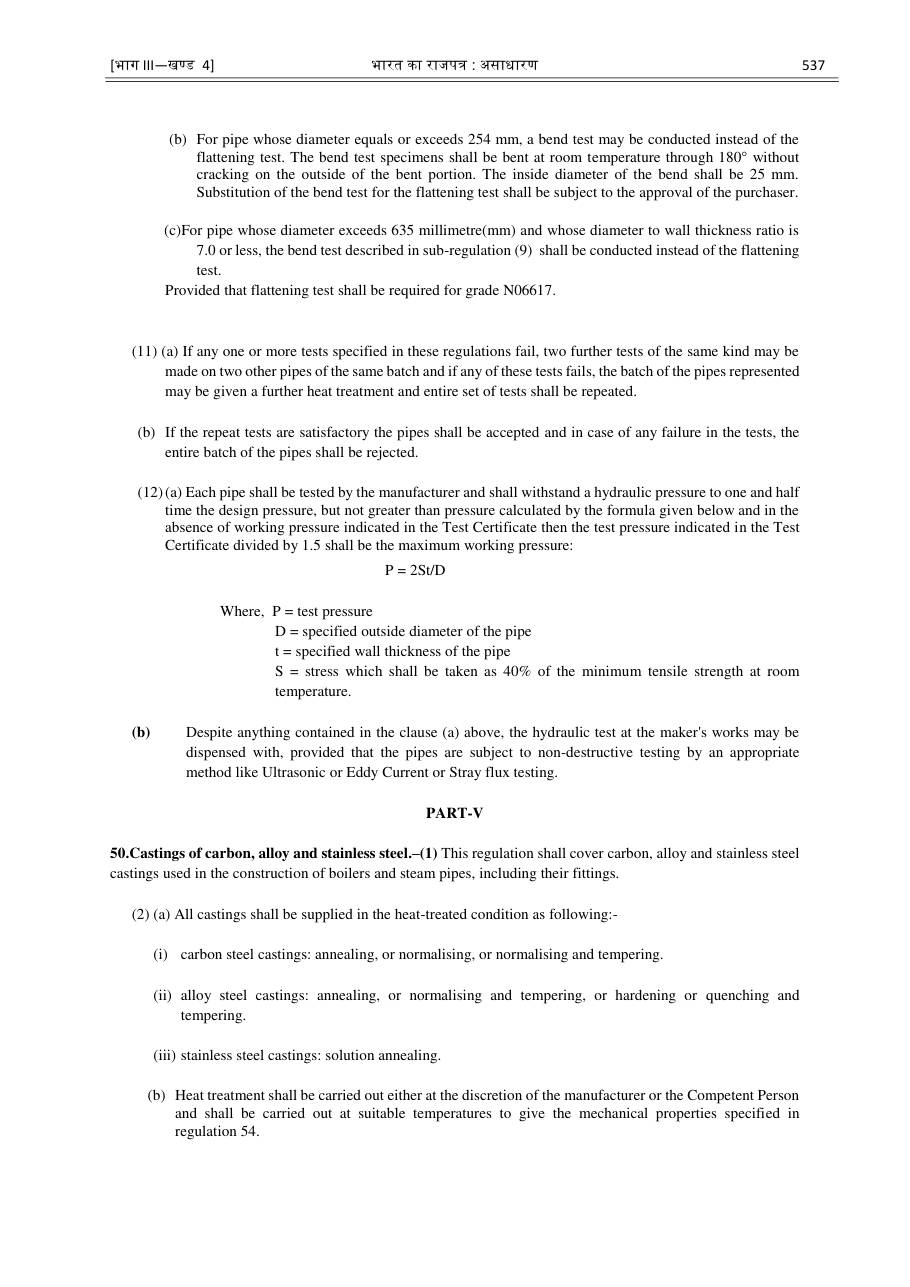
50.Castings of carbon, alloy and stainless steel.–(1) This regulation shall cover carbon, alloy and stainless steel castings used in the construction of boilers and steam pipes, including their fittings.

(2)(a) All castings shall be supplied in the heat-treated condition as following:-

(i)carbon steel castings: annealing, or normalising, or normalising and tempering.

(ii)alloy steel castings: annealing, or normalising and tempering, or hardening or quenching and tempering.

(iii)stainless steel castings: solution annealing.

(b)Heat treatment shall be carried out either at the discretion of the manufacturer or the Competent Person and shall be carried out at suitable temperatures to give the mechanical properties specified in regulation 54.

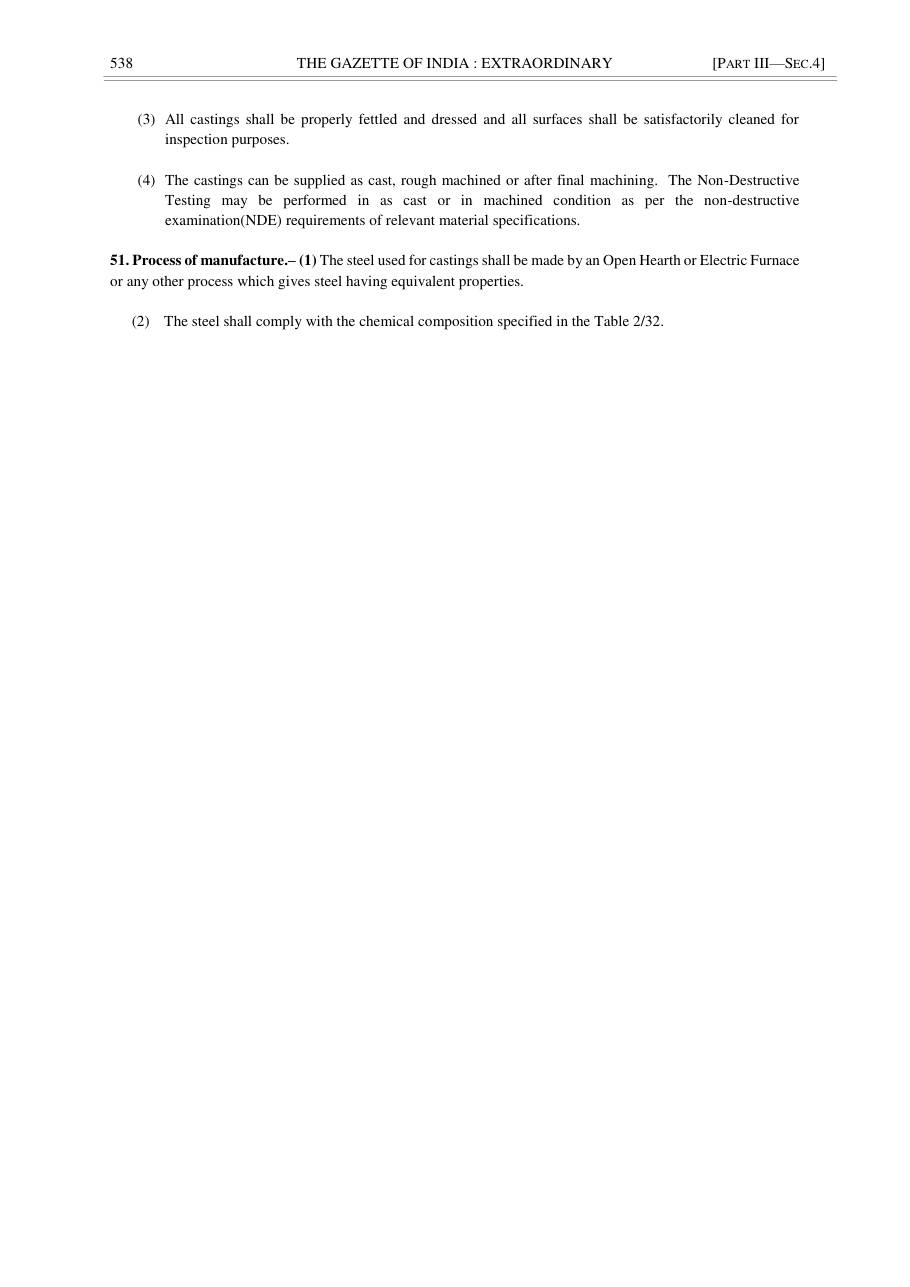
(3)All castings shall be properly fettled and dressed and all surfaces shall be satisfactorily cleaned for inspection purposes.

(4)The castings can be supplied as cast, rough machined or after final machining. The Non-Destructive Testing may be performed in as cast or in machined condition as per the non-destructive examination(NDE) requirements of relevant material specifications.

Referenced provisions

Reg. 54

Independent explanation — not the law · draft · engineer review in progress

In short

Regulation 50 covers carbon, alloy and stainless steel castings used in boilers and steam pipes, including their fittings.

Key points

  • (2)(a) All castings are supplied heat treated: carbon steel by annealing, normalising, or normalising and tempering; alloy steel by annealing, normalising and tempering, or hardening or quenching and tempering; stainless steel by solution annealing.
  • (2)(b) Heat treatment itself is required; the manufacturer or the Competent Person chooses how it is carried out, at temperatures that give the properties in regulation 54.
  • (3) Castings must be properly fettled and dressed, with surfaces cleaned for inspection.
  • (4) Castings may be supplied as cast, rough machined or finally machined. NDT may be done in either cast or machined condition, as the relevant material specification's NDE requirements provide.

Written by IBRsource editors · last edited 2026-11-20. Explanations simplify and are not a design method, testing procedure or authorisation. Requirements come from the complete regulations, the Gazette and approved documentation.

Comparison pending: the IBR 1950 text in force on 30 September 2026 is not yet established for this provision, so no change is claimed (how this works).

Orientation hints (unverified)

These candidates come from automated heading matching against DPIIT's scanned historical print edition of IBR 1950. That edition uses imperial units and riveted-construction provisions, so it is not the operative 2026 predecessor text. Regulation numbers alone never prove equivalence.

Historical 1950-edition reg.Heading as OCR'dHeading similaritySource image
246Steel Castings100%Chapter V (DPIIT scan), image 3
IBR 1950 regulation 246 as last published in the DPIIT web edition (archived 2022)

Unofficial archived copy, not verified; see the regulation 246 page for its amendments.


Reg. 246
, Reg. 247, Reg. 248, Reg. 249

Steel Castings

Steel castings for pressure parts shall comply with Regulations 73 to 80 (28 to 35 tons per sq. in).


Reg. 247
FUSION WELDED DRUMS

Definition of term ‘Fusion Weld'

The term ‘Fusion Weld’ is, for the purpose of this Chapter, applicable to all welded joints made by the metal arc process with covered electrodes or other electric arc process in which the arc stream and the deposited weld metal are shielded from atmospheric contamination.

It is intended that this Chapter shall apply to the single run or heavy run welding process and that welded boiler drums manufactured by that process shall conform with all Regulations of this Chapter, excepting those in which divergence is necessary solely because of special requirements essential for the most efficient utilization of that process. Thus all Regulations governing quality of material, construction workmanship and testing (both non-destructive and otherwise) are applicable.

When welded drums ordered to this chapter are made by this single run or heavy run process it will be understood that Regulations 252 and 267 do not apply in their entirety.


Reg. 248

Equipment of Workshop

a)

The welding plant and equipment are to be of good quality and maintained in an efficient working condition. The welding apparatus is be installed under cover and arranged so that the welding work may be carried out in positions free from draughts and adverse weather conditions. The procedure is to be such that there is regular and systematic supervision of the welding works, and the welding operators are to be subjected by the works officials to periodic tests for quality of workmanship. Records of these tests are to be kept and are to be available to the Inspecting Officers for scrutiny.
b) The Works should be equipped with an efficient testing laboratory which should include apparatus suitable for carrying out tensile, bend and impact test micro-examination of specimens and X-ray examination of the actual joints in pressure vessels. The Works should also be equipped with a suitable heat treating furnace having satisfactory means for temperature control, but as an alternative arrangements may be made whereby the drums can be heat-treated elsewhere.


Reg. 249

Constructional details and preparation for welding

The manufacturer shall supply the Inspecting Authority with a fully dimensioned sectional drawing showing in full details the construction of the drum(s) for approval before putting the work in hand.

Fully dimensioned drawings of the proposed welds preparations of the main seams drawn to a scale which clearly shows all the relevant details shall be furnished.

Sketches showing details of the welds preparations for the attachment of the stand pipes, branch pipes and seatings and their locations relative to the longitudinal and circumferential seams and to other openings shall be furnished.

Images of the official Gazette pages that contain this regulation. Click to zoom. Compare word by word before relying on the extracted text.
Instrument
Indian Boiler Regulations, 2026 (made by the Central Boilers Board under s.40 of the Boilers Act, 2025)
Notification
F.No. P-30014/3/2021-Boiler dated 7 Aug 2026
Published
Gazette of India, Extraordinary, Part III Sec. 4, No. 596, 1 Oct 2026 (CG-DL-E-06102026-276813)
In force
1 Oct 2026 (reg. 1(3): date of publication in the Official Gazette)
Printed Gazette page
537–538
PDF page index
537–538 · open official e-Gazette PDF
Extraction
pdftotext layout mode, sequential regulation detector · text hash 2a24080b85c91fc2
Verification
Official text — not yet verified
Amendments checked
None known after 1 Oct 2026 as of build date (not a guarantee). Amendment log
How to cite

Indian Boiler Regulations, 2026, reg. 50, Regulation 50, Gazette of India, Extraordinary, Part III—Section 4, No. 596, 1 October 2026, printed p.537–538. https://egazette.gov.in/WriteReadData/2026/276813.pdf (text consulted via IBRsource, 2026-11-23).

The citation refers to the government publication. Cite the Gazette, not this website.

Help improve this page

Engineers like you keep IBRsource accurate. Every checked correction or tip helps the next reader.