
Indian Boiler Regulations, 2026 · Chapter 11 · Standard Conditions for the Design and Construction of Economisers, Feed Pipes, Feed Heaters and Other Similar Vessels
Regulation 382. Procedure at subsequent Inspection
Not yet checked against the official Gazette; verify before relying on it.
382. Procedure at subsequent Inspection.─ (1) (a)After economiser has been cleaned, the Competent Person shall make a thorough examination so far as its construction permits.
(b)The external condition of the tubes shall be carefully noted for wasting especially at the feed inlet end and all accessible tubes shall be calibered.
(c)The internal surfaces of cast iron tubes shall be closely observed for graphitic wasting as far as it is possible and in the event of any tube failure, these shall be broken up for scrutiny so that the general internal condition of the other tubes may be estimated.
(2)Where tubes or other parts are wasted, the strength shall be re-calculated.
(3)The scraper gear shall be examined to note if any parts are missing, if the length of travel is adequate and if the scrapers are correctly adjusted.
(4)All cap bolts shall be inspected and also the condition and position of the dampers and baffles.
(5)The record of each inspection and calculations shall be entered in the Memorandum of Inspection Book.
In short
Regulation 382 sets what the Competent Person checks at each subsequent inspection of an economiser.
Key points
- (1)(a) After cleaning, make a thorough examination as far as the construction permits.
- (1)(b) Note external wasting of tubes, especially at the feed inlet end, and caliper all accessible tubes.
- (1)(c) Watch the inside of cast iron tubes for graphitic wasting. If a tube fails, break it up to judge the internal condition of the other tubes.
- (2) Where tubes or other parts are wasted, re-calculate the strength.
- (3) Check the scraper gear for missing parts, adequate travel and correct adjustment.
- (4) Inspect all cap bolts and the condition and position of dampers and baffles.
- (5) Enter the record and calculations in the Memorandum of Inspection Book.
Written by IBRsource editors · last edited 2026-11-20. Explanations simplify and are not a design method, testing procedure or authorisation. Requirements come from the complete regulations, the Gazette and approved documentation.
Comparison pending: the IBR 1950 text in force on 30 September 2026 is not yet established for this provision, so no change is claimed (how this works).
Orientation hints (unverified)
These candidates come from automated heading matching against DPIIT's scanned historical print edition of IBR 1950. That edition uses imperial units and riveted-construction provisions, so it is not the operative 2026 predecessor text. Regulation numbers alone never prove equivalence.
| Historical 1950-edition reg. | Heading as OCR'd | Heading similarity | Source image |
|---|---|---|---|
| 526 | Procedure at subsequent inspection | 100% | Chapter XI (DPIIT scan), image 8 |
Amendment history of the candidate IBR 1950 regulation: Reg. 526 (1 amendment)
IBR 1950 regulation 526 as last published in the DPIIT web edition (archived 2022)
Unofficial archived copy, not verified; see the regulation 526 page for its amendments.
|
REGULATIONS FOR REGISTRATION AND INSPECTION OF ECONOMISERS AND FEED PIPES | ||||||||||
| ||||||||||
|
REGULATIONS FOR REGISTRATION AND INSPECTION OF ECONOMISERS AND FEED PIPES | ||||||||||
| ||||||||||
|
REGULATIONS FOR REGISTRATION AND INSPECTION OF ECONOMISERS AND FEED PIPES | ||||||||||
|
Images of the official Gazette pages that contain this regulation. Click to zoom. Compare word by word before relying on the extracted text.
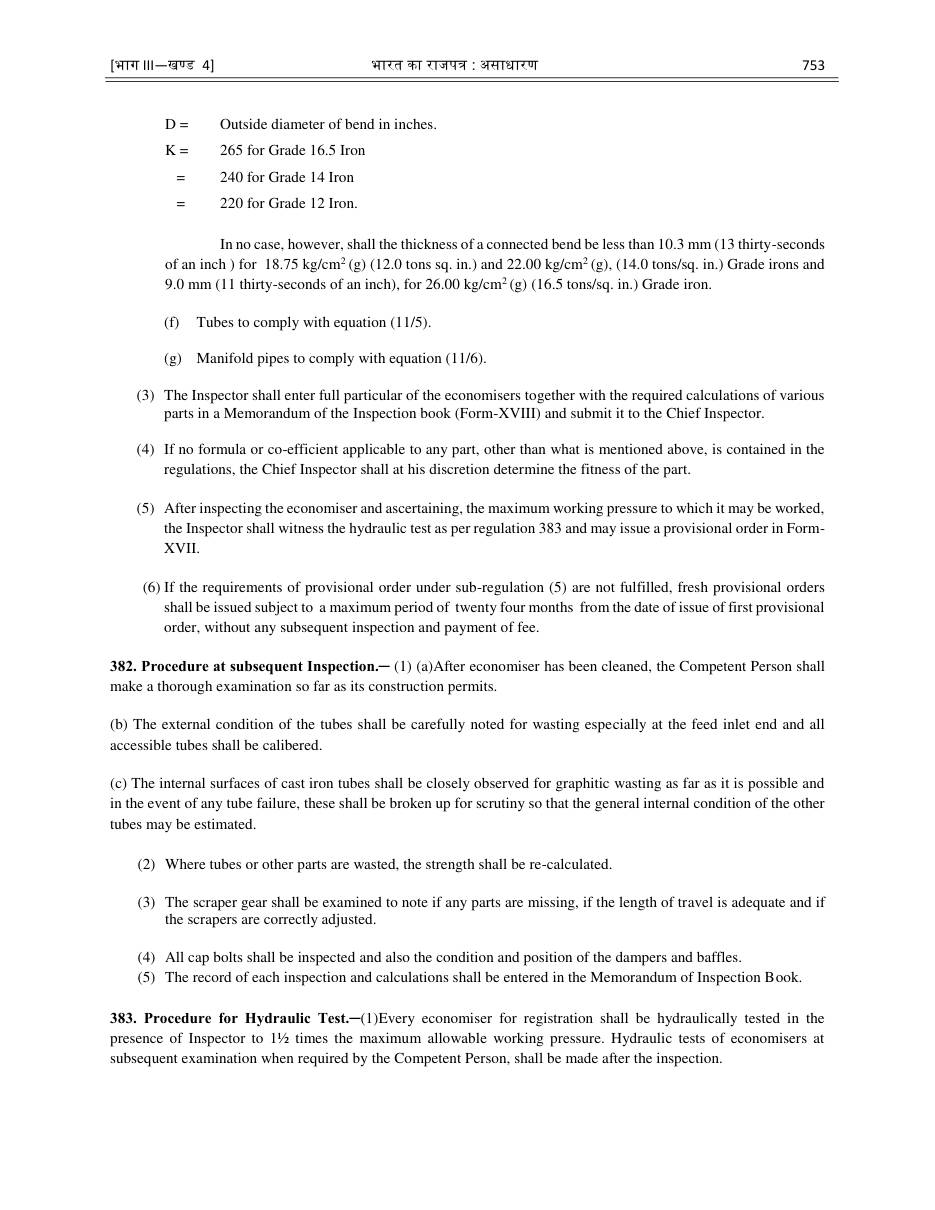
Indian Boiler Regulations, 2026, reg. 382, Regulation 382, Gazette of India, Extraordinary, Part III—Section 4, No. 596, 1 October 2026, printed p.753. https://egazette.gov.in/WriteReadData/2026/276813.pdf (text consulted via IBRsource, 2026-11-23).
The citation refers to the government publication. Cite the Gazette, not this website.