
Indian Boiler Regulations, 2026 · Chapter 11 · Standard Conditions for the Design and Construction of Economisers, Feed Pipes, Feed Heaters and Other Similar Vessels
Regulation 363. Process of manufacture
Not yet checked against the official Gazette; verify before relying on it.
363. Process of manufacture.─(1) (a) The castings shall be cast from metal melted or refined in any suitable metallurgical plant other than an iron ore smelting furnace.
(b)The minimum test results required on test bars 30 mm in diameter shall be as per Table 11/2 given below, ─
Original extracted text of the table above, continued (diagnostic)
Serial No. Material for tubes and Table 11/2 Transverse test on span of 45.8 cm
| Serial No. | Material for tubes and other pressure parts | Minimum tensile strength in kg/mm2 | Transverse test on span of 45.8 cm | |
| (1) | (2) | (3) | (4) | (5) |
| 1. | Minimum transverse breaking load in kg | Minimum deflection in cm | ||
| 2. | Grade 16.5 | 23.2 | 1,052 | 0.434 |
| 3. | Grade 14 iron | 19.7 | 934 | 0.407 |
| 4. | Grade 12 iron | 16.9 | 839 | 0.382 |
Table structure read from the Gazette PDF, page 744. Verification status as for the text above.
Show original extracted text (diagnostic, not authoritative)
                other pressure parts    Minimum tensile
                                       strength in kg/mm2

(1)                        (2)              (3)               (4)                                 (5)

1.                                                         Minimum transverse Minimum deflection

                                                           breaking load in kg  in cm

2.             Grade 16.5                   23.2           1,052                0.434

3.             Grade 14 iron                19.7              934               0.407

4.             Grade 12 iron                16.9              839               0.382
Note: Grade 16.5, 14 and 12 iron correspond to 23.2, 19.7 and 19.9 kg /mm2 minimum tensile strength respectively.
(2)On analysis, the sulphur and phosphorus contents shall not exceed the percentages given in Table 11/3 below,─
Serial No. Components Table 11/3 Maximum Phosphorus
| Serial No. | Components | Maximum Sulphur percentage | Maximum Phosphorus percentage |
|---|---|---|---|
| (1) | (2) | (3) | (4) |
| 1. | Tubes | 0.15 | 1.00 |
| 2. | Headers | 0.15 | 1.00 |
Table structure read from the Gazette PDF, page 744. Verification status as for the text above.
Show original extracted text (diagnostic, not authoritative)
                                                                              percentage
(1)                         (2)             Maximum Sulphur                        (4)
  1.                      Tubes                  percentage                       1.00
  2.                     Headers                      (3)                         1.00
                                                     0.15
0.15(3)(a) Minimum manganese content shall be related to sulphur content by the following formula:-(% Sulphur x 1.7) + 0.3 = % Manganese.
(b)It shall be shown to be satisfied by routine quality control Laboratory analysis and in any case, the manganese shall not be less than 0.5 per cent and shall be within the range 0.50 - 0.90 percent.
(c)Phosphorous content shall be kept as low as economically possible but in no circumstances it shall exceed
1.0 per cent.
Parts of this extracted text look garbled; read the Gazette page before using any value.
Tables and formulae are shown in their extracted layout. Alignment, superscripts and subscripts may be lost. The Gazette page image is authoritative.
In short
Regulation 363 covers how cast iron for economiser pressure parts is made and the minimum test results and chemical limits it must meet.
Key points
- (1)(a) Castings must be cast from metal melted or refined in a suitable metallurgical plant, not an iron ore smelting furnace.
- (1)(b) Test bars 30 mm in diameter must meet Table 11/2: a minimum tensile strength and a transverse test on a span of 45.8 cm (minimum breaking load and minimum deflection) for Grade 16.5, Grade 14 and Grade 12 iron.
- (2) Table 11/3 caps sulphur at 0.15 per cent and phosphorus at 1.00 per cent for both tubes and headers.
- (3)(a) Minimum manganese is linked to sulphur by the formula (% Sulphur x 1.7) + 0.3 = % Manganese.
- (3)(b) This must be shown by routine quality control laboratory analysis. Manganese must not be less than 0.5 per cent and must be within 0.50 - 0.90 percent.
- (3)(c) Phosphorus is kept as low as economically possible and must never exceed 1.0 per cent.
Watch out
- The note under Table 11/2 gives a tensile strength for Grade 12 iron that differs from the table row. Check the Gazette page for the exact values.
Written by IBRsource editors · last edited 2026-11-20. Explanations simplify and are not a design method, testing procedure or authorisation. Requirements come from the complete regulations, the Gazette and approved documentation.
Comparison pending: the IBR 1950 text in force on 30 September 2026 is not yet established for this provision, so no change is claimed (how this works).
Orientation hints (unverified)
These candidates come from automated heading matching against DPIIT's scanned historical print edition of IBR 1950. That edition uses imperial units and riveted-construction provisions, so it is not the operative 2026 predecessor text. Regulation numbers alone never prove equivalence.
| Historical 1950-edition reg. | Heading as OCR'd | Heading similarity | Source image |
|---|---|---|---|
| 348 | Method of manufacture, Heat treatment and Marking | 78% | Chapter VIII (DPIIT scan), image 3 |
Amendment history of the candidate IBR 1950 regulation: Reg. 348 (1 amendment)
IBR 1950 regulation 348 as last published in the DPIIT web edition (archived 2022)
Unofficial archived copy, not verified; see the regulation 348 page for its amendments.
| Reg. 348 Method of manufacture, Heat treatment and Marking
|
Images of the official Gazette pages that contain this regulation. Click to zoom. Compare word by word before relying on the extracted text.
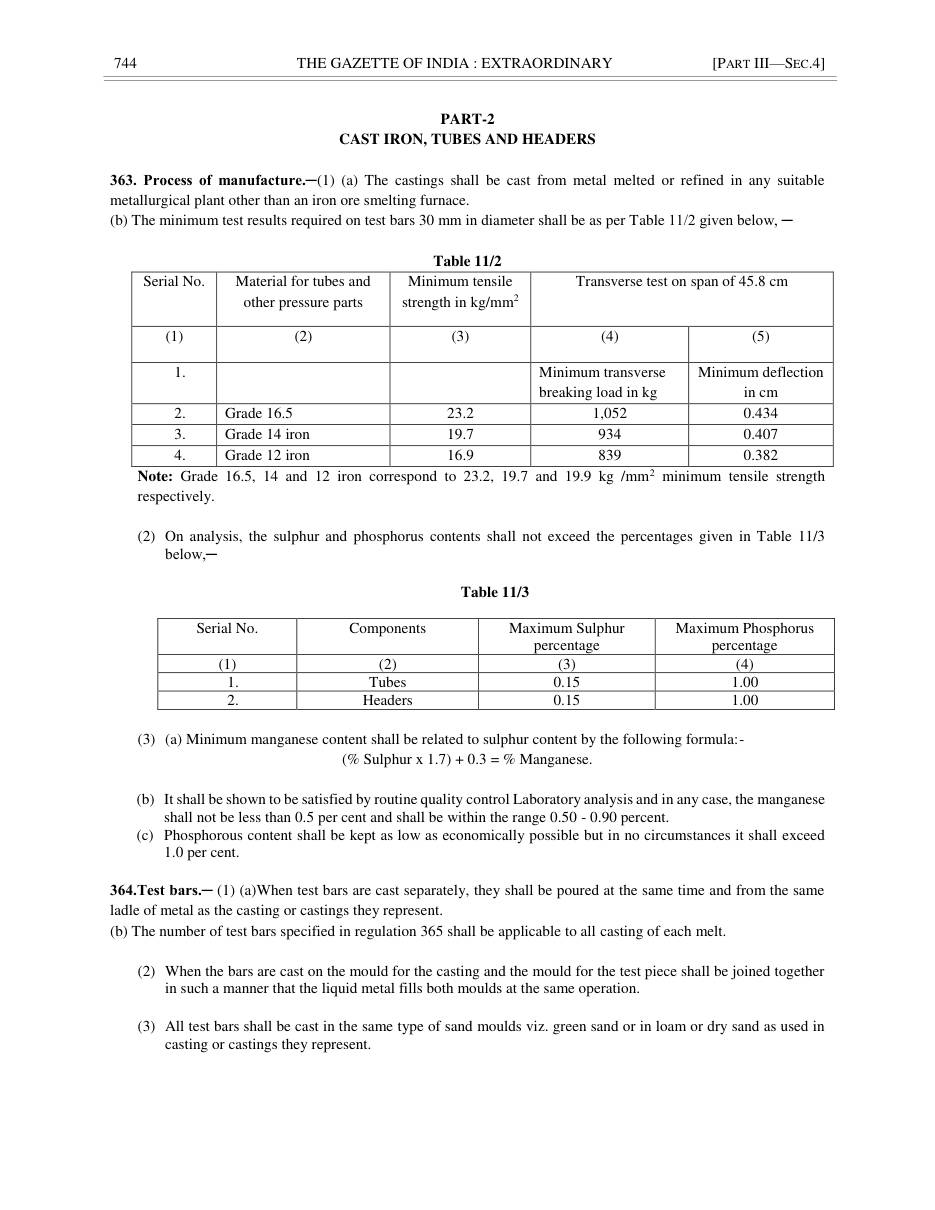
Indian Boiler Regulations, 2026, reg. 363, Regulation 363, Gazette of India, Extraordinary, Part III—Section 4, No. 596, 1 October 2026, printed p.744. https://egazette.gov.in/WriteReadData/2026/276813.pdf (text consulted via IBRsource, 2026-11-23).
The citation refers to the government publication. Cite the Gazette, not this website.