
Indian Boiler Regulations, 2026 · Chapter 11 · Standard Conditions for the Design and Construction of Economisers, Feed Pipes, Feed Heaters and Other Similar Vessels
Regulation 367. Design requirements
Not yet checked against the official Gazette; verify before relying on it.
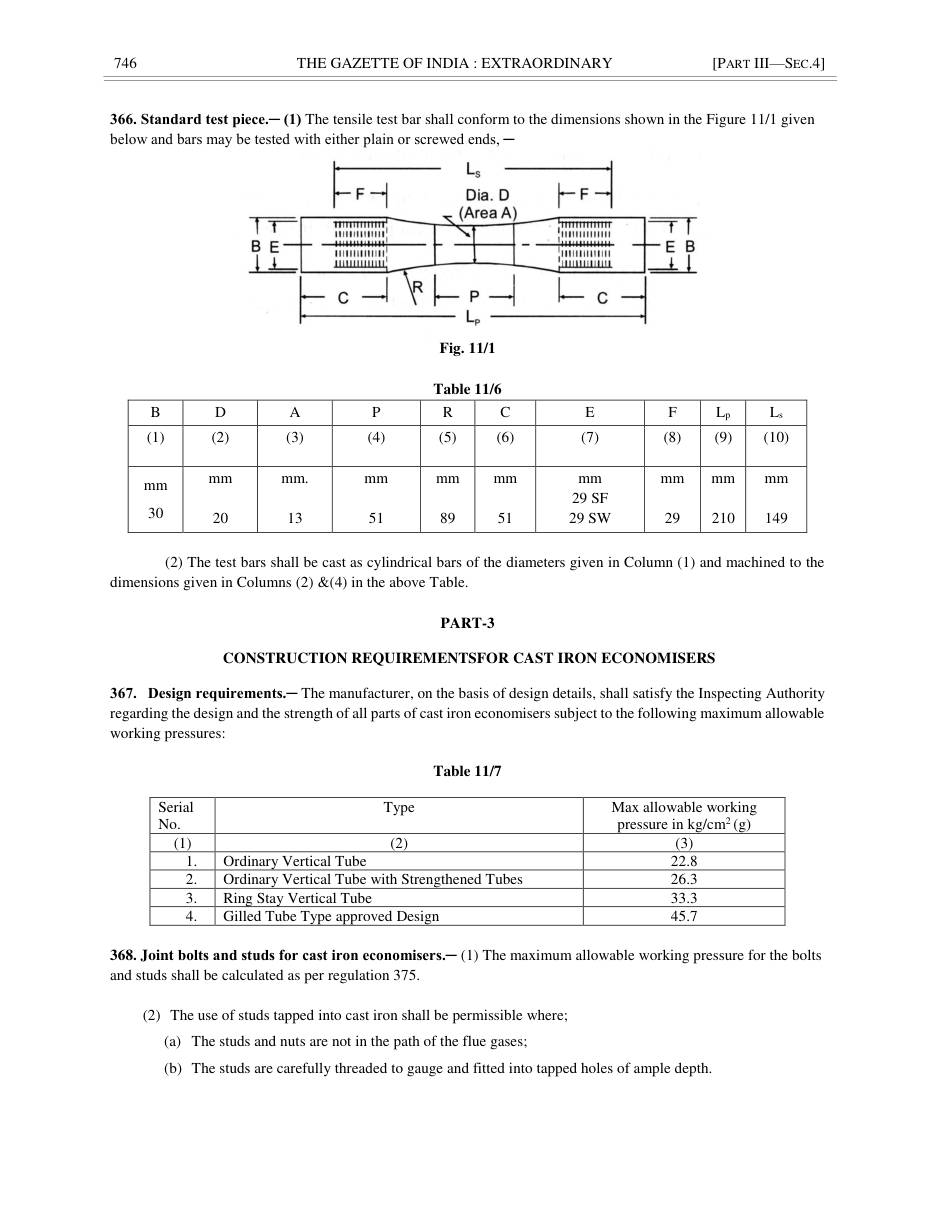
367. Design requirements.─ The manufacturer, on the basis of design details, shall satisfy the Inspecting Authority regarding the design and the strength of all parts of cast iron economisers subject to the following maximum allowable working pressures:
Serial Table 11/7 Max allowable working
| Serial No. | Type | Max allowable working pressure in kg/cm2 (g) |
|---|---|---|
| (1) | (2) | (3) |
| 1. | Ordinary Vertical Tube | 22.8 |
| 2. | Ordinary Vertical Tube with Strengthened Tubes | 26.3 |
| 3. | Ring Stay Vertical Tube | 33.3 |
| 4. | Gilled Tube Type approved Design | 45.7 |
Table structure read from the Gazette PDF, page 746. Verification status as for the text above.
Show original extracted text (diagnostic, not authoritative)
No.                                                                   pressure in kg/cm2 (g)
                                        Type
   (1)                                                                           (3)
     1.                                   (2)                                   22.8
     2.  Ordinary Vertical Tube                                                 26.3
     3.  Ordinary Vertical Tube with Strengthened Tubes                         33.3
     4.  Ring Stay Vertical Tube                                                45.7
         Gilled Tube Type approved Design
Parts of this extracted text look garbled; read the Gazette page before using any value.
Tables and formulae are shown in their extracted layout. Alignment, superscripts and subscripts may be lost. The Gazette page image is authoritative.
In short
Regulation 367 requires the manufacturer to satisfy the Inspecting Authority about the design and strength of all parts of a cast iron economiser, within fixed maximum allowable working pressures.
Key points
Table 11/7 sets the maximum allowable working pressure by type:
- Ordinary vertical tube: 22.8 kg/cm² (g).
- Ordinary vertical tube with strengthened tubes: 26.3 kg/cm² (g).
- Ring stay vertical tube: 33.3 kg/cm² (g).
- Gilled tube type of approved design: 45.7 kg/cm² (g).
Watch out
- For gilled tube economisers of approved design made from a specified iron grade, regulation 368 allows a higher limit.
- The table columns are misaligned in the extracted text; confirm the pairing on the Gazette page.
Written by IBRsource editors · last edited 2026-11-20. Explanations simplify and are not a design method, testing procedure or authorisation. Requirements come from the complete regulations, the Gazette and approved documentation.
Comparison pending: the IBR 1950 text in force on 30 September 2026 is not yet established for this provision, so no change is claimed (how this works).
Orientation hints (unverified)
These candidates come from automated heading matching against DPIIT's scanned historical print edition of IBR 1950. That edition uses imperial units and riveted-construction provisions, so it is not the operative 2026 predecessor text. Regulation numbers alone never prove equivalence.
| Historical 1950-edition reg. | Heading as OCR'd | Heading similarity | Source image |
|---|---|---|---|
| 94 | General requirements | 77% | Chapter II (DPIIT scan), image 19 |
| 96 | Requirements for Deep Penetration Butt | 77% | Chapter II (DPIIT scan), image 20 |
| 179 | Butt Straps and spacing of rivets below requirements | 77% | Chapter IV (DPIIT scan), image 2 |
IBR 1950 regulation 94 as last published in the DPIIT web edition (archived 2019)
Unofficial archived copy, not verified; see the regulation 94 page for its amendments.
| Reg. 94 MATERIALS OF CONSTRUCTION COVERED ELECTRODES FOR METAL ARC WELDING OF MILD STEEL General requirements |
| (1) Application.- The following Regulations apply to electrodes of sizes 3/32 inch (12 S.W.G.) and larger in diameter for metal arc welding of carbon steels having ultimate tensile strength not exceeding 33 tons per square inch and Sulphur and Phosphorus contents not greater than 0.06 per cent each. Electrodes less than 3/32 inch in diameter shall not be used in boilers. The electrodes shall comply with the requirements of physical tests prescribed for each class. Their characteristics and behaviour under ordinary working conditions shall be such that satisfactory weld deposits can be made by a welder of average skill and experience and that the following characteristics are also obtained:-
(2) Classification.- The electrodes shall be classified into:
(3) Manufacture.- Electrodes may be made by any method that shall yield a product conforming to the requirements of these Regulations. (4) Size of Electrodes.- The nominal size of the electrodes shall refer to the diameter of the core wire and the length shall not exceed 18 inches. Provision shall be made for end or centre gripping. The tolerances on the specified diameter of the core wire of the electrodes shall be plus or minus 0.002 inch. (5) Covering.- The flux covering shall be sufficiently robust to withstand the normal conditions of transport, storage, handling and use, without damage and shall be uniform in thickness all over so that it fuses evenly. The variation in the thickness shall not exceed 3 per cent. (6) (a) Packing and storage.- Electrodes shall be suitably packed to guard against damage during transportation. When stored, the electrodes shall be kept in their original bundles or packings in a dry store room and under such conditions, the electrodes shall for a period of at least six months be capable of giving results similar to those which they would have given on the date of their despatch from the manufacturer. (b) Marking.- Each package shall be marked with the following information:-
(7) Tests.- The electrodes shall be subjected to Initial tests, Periodic check tests and Production control to ensure that the requirements of these Regulations are fulfilled. Electrodes intended for use with more than one type of current or polarity shall be tested using each type of current and polarity. Where any test specimen fails to satisfy the requirements of any particular test, two further test specimens shall be prepared using the electrodes from the same batch and submitted to the same test. The batch of electrodes shall be accepted as having passed the test provided that the tests of both the additional specimens are satisfactory. (8) Test Certificates.- The manufacturers shall, when called upon, produce the results of the most recent Periodic check tests carried out within the preceding 12 months, on electrodes representative of the electrodes supplied. |
IBR 1950 regulation 96 as last published in the DPIIT web edition (archived 2022)
Unofficial archived copy, not verified; see the regulation 96 page for its amendments.
| Reg. 96 MATERIALS OF CONSTRUCTION COVERED ELECTRODES FOR METAL ARC WELDING OF MILD STEEL Requirements for Deep Penetration Butt-Welding Electrodes |
| Initial Test.- For electrodes recommended for deep penetration butt-welding, the following initial tests shall be carried out:- (1) Transverse Tensile Test.- Three transverse tensile test specimens, one each from test pieces shall be prepared according to Table 3 in Appendix H-2 and tested as specified in Appendix H-2. If the diameter of the largest size of electrode manufactured is less than ¼ inch only two specimens need be prepared. The ultimate tensile stress of each specimen shall be not less than 28 tons per square inch. (2) Transverse bend Test.- Six bend test specimens, two each from test pieces, prepared according to the Table 3 in Appendix H-2 shall be tested in accordance with the method specified in Appendix H-2. If the diameter of the largest size of the electrode manufactured be less than ¼ inch, only 4 specimens will be required. Of each pair of specimens, one shall be tested with the side first welded in tension and one with the other side in tension. The electrode shall be deemed to be satisfactory if on completion of the test no crack or defect at the outer surface of the specimen is greater than 1/8 inch measured across it or 1/16 inch measured along its length. Premature failure at corners shall not be considered cause for rejection. (3) Butt-Weld Penetration Test.- Examination of the inner edges of the outer discards from the butt-weld test pieces prepared as specified in Appendix H-2 shall show that complete penetration has been achieved. |
IBR 1950 regulation 179 as last published in the DPIIT web edition (archived 2022)
Unofficial archived copy, not verified; see the regulation 179 page for its amendments.
| Reg. 178, Reg. 179, Reg. 180, Reg. 181 SHELLS When Pitch exceeds maximum allowed Should the pitch of the rivets exceed the maximum pitch allowed, the permissible pitch shall be used in place of the actual pitch in determining the percentage of plate section. No greater percentage than 85 shall be allowed for any type of riveted joint. Reg. 179 SHELLS Butt Straps and spacing of rivets below requirements Should the spacing of the rows of rivets or the distance between edge of plate and rivet hole or the thickness of butt straps be less than that specified in Regulations 182 and 184 the percentage representing the strength of joint shall be modified as prescribed in those regulations. Reg. 180 SHELLS Percentage of Welded and Strapped Seams In determining the percentage of strength of a welded seam covered by a strap or straps the formulae and allowances in Regulations 177, 178 and 179 shall be applied, but 50 per cent shall be added to the rivet percentage for the weld. Reg. 181 SHELLS Percentage to be allowed for Solid Rolled Shells When small shells are rolled from the solid, J, in equation (1) shall be taken as 100 per cent. |
Images of the official Gazette pages that contain this regulation. Click to zoom. Compare word by word before relying on the extracted text.
Indian Boiler Regulations, 2026, reg. 367, Regulation 367, Gazette of India, Extraordinary, Part III—Section 4, No. 596, 1 October 2026, printed p.746. https://egazette.gov.in/WriteReadData/2026/276813.pdf (text consulted via IBRsource, 2026-11-23).
The citation refers to the government publication. Cite the Gazette, not this website.