BETAIndependent engineering reference. Source-text verification is ongoing.Verification ongoing.Verification status →
IBRsourceIndian Boiler Regulations, made clear

Indian Boiler Regulations, 2026 · Chapter 11 · Standard Conditions for the Design and Construction of Economisers, Feed Pipes, Feed Heaters and Other Similar Vessels

Regulation 368. Joint bolts and studs for cast iron economisers

Official text — not yet verifiedGazette 1 Oct 2026 · printed pp. 746–747

Not yet checked against the official Gazette; verify before relying on it.

Reproduced from the Gazette of India · verification status above

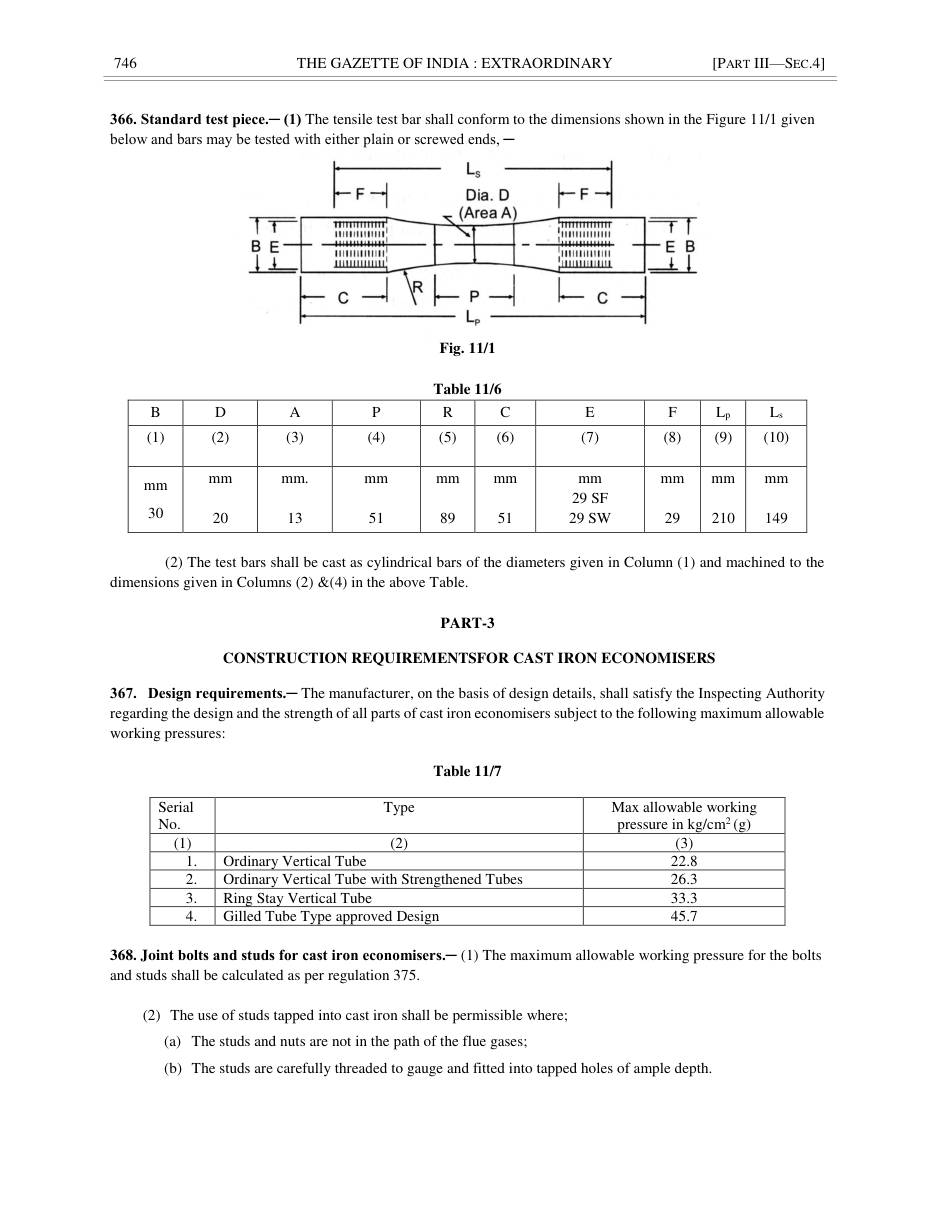
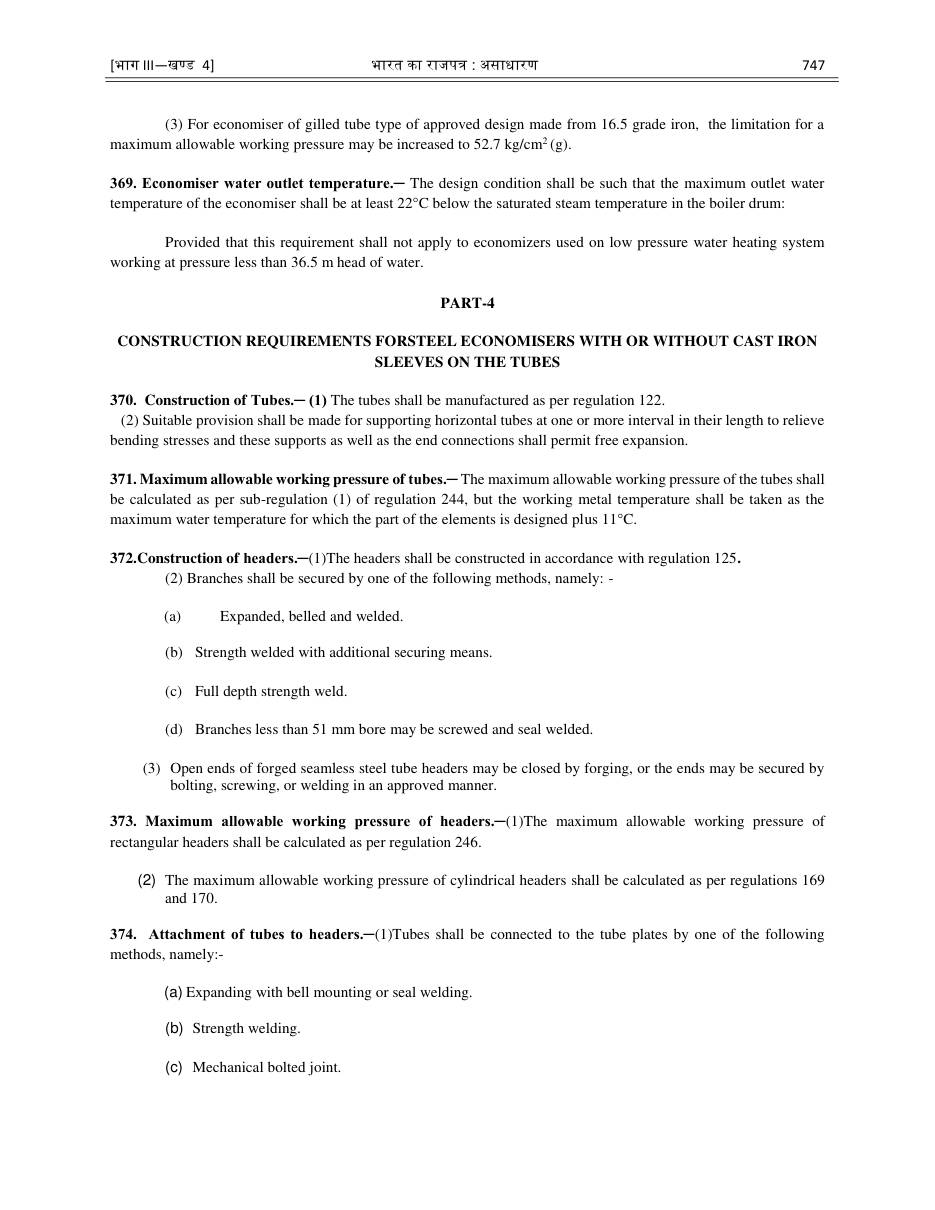
368. Joint bolts and studs for cast iron economisers.─ (1) The maximum allowable working pressure for the bolts and studs shall be calculated as per regulation 375.

(2)The use of studs tapped into cast iron shall be permissible where;

(a)The studs and nuts are not in the path of the flue gases;

(b)The studs are carefully threaded to gauge and fitted into tapped holes of ample depth.

(3)For economiser of gilled tube type of approved design made from 16.5 grade iron, the limitation for a maximum allowable working pressure may be increased to 52.7 kg/cm2 (g).

Referenced provisions

Reg. 375

Independent explanation — not the law · draft · engineer review in progress

In short

Regulation 368 covers joint bolts and studs in cast iron economisers.

Key points

  • (1) The maximum allowable working pressure for the bolts and studs is calculated by regulation 375.
  • (2) Studs tapped into cast iron are allowed only where (a) the studs and nuts are not in the path of the flue gases, and (b) the studs are carefully threaded to gauge and fitted into tapped holes of ample depth.
  • (3) For gilled tube economisers of approved design made from 16.5 grade iron, the maximum allowable working pressure limit may be increased to 52.7 kg/cm² (g).

Written by IBRsource editors · last edited 2026-11-20. Explanations simplify and are not a design method, testing procedure or authorisation. Requirements come from the complete regulations, the Gazette and approved documentation.

Comparison pending: the IBR 1950 text in force on 30 September 2026 is not yet established for this provision, so no change is claimed (how this works).

Orientation hints (unverified)

These candidates come from automated heading matching against DPIIT's scanned historical print edition of IBR 1950. That edition uses imperial units and riveted-construction provisions, so it is not the operative 2026 predecessor text. Regulation numbers alone never prove equivalence.

Historical 1950-edition reg.Heading as OCR'dHeading similaritySource image
208Bolts and Studs100%Chapter IV (DPIIT scan), image 8
511Joint bolts and studs for Cast Iron Economisers100%Chapter XI (DPIIT scan), image 4
IBR 1950 regulation 208 as last published in the DPIIT web edition (archived 2022)

Unofficial archived copy, not verified; see the regulation 208 page for its amendments.

Reg. 208
STAYS

Bolts and Studs

a) Bolts and studs connecting parts by boilers such as shell, end plates, tube plates, furnaces, up takes, externally fitted manhole covers, mountings, etc. may be made either of steel or good quality wrought iron.
b) The maximum working pressure for the bolts or studs shall be calculated by the following formula: -
W. P. =

N x C

( D - 1.28 )2 Eqn.(45)
A n

where
D is the diameter of bolt or stud over threads in inches

N is the number of bolts or studs securing the part,

n is the number of threads of screws per inch,

C = 4,700 for steel bolts or studs of 28 tons/sq. in. minimum ultimate tensile stress where the diameter over thread is less than 3/4 inch,

C = 5,100 for steel bolts or studs of 30 tons/sq. in. minimum ultimate tensile stress where the diameter over thread is less than 3/4 inch

C = 5,600 for steel bolts or studs of 35 tons/sq. in minimum ultimate tensile stress where the diameter over thread is less than 3/4 inch.

C = 5,600 for steel bolts or studs of 28 tons/sq. in minimum ultimate tensile stress where the diameter over thread is not less than 3/4 inch and not greater than 7/8 inch.

C = 7,000 for steel bolts for studs of 28 tons/sq. in minimum ultimate tensile stress where the diameter over thread is greater than 7/8 inch.

When the material is iron, a reduction, of 15 per cent shall be made in the working pressure as calculated by the formula.

A is the area in square inches of the surface supported by the bolts or studs. For jointed flanges the area shall be taken to extend to midway between the pitch line of the bolts and the inner edge of the flange by which the part is secured.
IBR 1950 regulation 511 as last published in the DPIIT web edition (archived 2022)

Unofficial archived copy, not verified; see the regulation 511 page for its amendments.


Reg. 509, Reg. 510, Reg. 511
STANDARD CONDITIONS FOR THE DESIGN AND CONSTRUCTION OF ECONOMISER, FEED PIPES, FEED HEATERS AND OTHER SIMILAR VESSELS

CAST IRON, TUBES AND HEADERS

Standard test piece

The tensile test bar shall conform to the dimensions shown in the following drawing. Bars may be tested with either plain or screwed ends.

B D A P R C E F Lp Ls

In.
1.20

In.
0.798
Sq.in.
0.50
In.
2
In.
3-1/2
In.
2
In.
1-1/8
SF
1-1/8
SW
In
1-1/8
In.
8-1/4
In.
5-7/8

The test bars shall be cast as cylindrical bars of the diameters given in Col. B and machined to the dimensions given in Cols. D & P in the above Table.

See Figure


Reg. 510
STANDARD CONDITIONS FOR THE DESIGN AND CONSTRUCTION OF ECONOMIZER, FEED PIPES, FEED HEATERS AND OTHER SIMILAR VESSELS

CONSTRUCTIONAL REQUIREMENTS

Cast Iron Economisers

The manufacturer shall, on the basis of design details, satisfy the Inspecting Authority regarding the design and the strength of all parts of cast iron economisers subject to the following maximum working pressure:-

Max. W.P.
(1) Ordinary Vertical Tube 325 lbs. /sq. in.
(2) Ordinary Vertical Tube with strengthened tubes 375 lbs. /sq.in.
(3) Ring Stay Vertical Tube 475 lbs./sq. in.
(4) Gilled Tube type approved design 45.7 kg/cm² (650 lbs./sq.in.)

Reg. 511
STANDARD CONDITIONS FOR THE DESIGN AND CONSTGRUCTION OF ECONOMIZER, FEED PIPES, FEED HEATERS AND OTHER SIMILAR VESSELS

CONSTRUCTIONAL REQUIREMENTS

Joint bolts and studs for Cast Iron Economisers
a) The maximum working pressure for the bolts and studs shall be calculated by Regulation 518.
b) The use of studs tapped into cast iron is permissible where:-

(i) The studs and nuts are not in the path of the flue gases.
(ii) The studs are carefully threaded to gauge and fitted into tapped holes of ample depth.

For economiser of Gilled Tube type of approved design made from 16.5 grade iron the limitation for a maximum working pressure may be increased to 52.7 kg/cm² (750 lbs./sq.in.)

Images of the official Gazette pages that contain this regulation. Click to zoom. Compare word by word before relying on the extracted text.
Instrument
Indian Boiler Regulations, 2026 (made by the Central Boilers Board under s.40 of the Boilers Act, 2025)
Notification
F.No. P-30014/3/2021-Boiler dated 7 Aug 2026
Published
Gazette of India, Extraordinary, Part III Sec. 4, No. 596, 1 Oct 2026 (CG-DL-E-06102026-276813)
In force
1 Oct 2026 (reg. 1(3): date of publication in the Official Gazette)
Printed Gazette page
746–747
PDF page index
746–747 · open official e-Gazette PDF
Extraction
pdftotext layout mode, sequential regulation detector · text hash 57d2462ac39c9988
Verification
Official text — not yet verified
Amendments checked
None known after 1 Oct 2026 as of build date (not a guarantee). Amendment log
How to cite

Indian Boiler Regulations, 2026, reg. 368, Regulation 368, Gazette of India, Extraordinary, Part III—Section 4, No. 596, 1 October 2026, printed p.746–747. https://egazette.gov.in/WriteReadData/2026/276813.pdf (text consulted via IBRsource, 2026-11-23).

The citation refers to the government publication. Cite the Gazette, not this website.

Help improve this page

Engineers like you keep IBRsource accurate. Every checked correction or tip helps the next reader.