
Indian Boiler Regulations, 2026 · Chapter 11 · Standard Conditions for the Design and Construction of Economisers, Feed Pipes, Feed Heaters and Other Similar Vessels
Regulation 377. Maximum allowable working pressure for feed piping
Not yet checked against the official Gazette; verify before relying on it.
377.Maximum allowable working pressure for feed piping .─The maximum allowable working pressure shall be the maximum pressure generated in overcoming friction and other losses in the feed piping under ordinary working conditions, or the maximum pressure which can be generated by the boiler feed pumps unless special provision is made to prevent that pressure being communicated to the pipe line.
Note: For boilers operating at design pressure 100 kg/cm2 (g) and above feed water discharge piping for feed water system without economizer inlet isolating valve can be designed based on boiler design pressure with provision of mechanical relief device or a three way valve for bypassing H.P Heater, to prevent Boiler Feed Pump (BFP) shut off pressure being communicated to the piping system and with such a feed water system, boiler shall be hydro tested up to the last isolation valve in the feed water line.
In short
Regulation 377 defines the maximum allowable working pressure for feed piping: the highest pressure from friction and other losses under ordinary working, or the highest pressure the boiler feed pumps can generate, unless special provision stops that pressure reaching the pipe line.
Watch out
- Note: for boilers at design pressure 100 kg/cm² (g) and above, feed discharge piping without an economiser inlet isolating valve may be designed on boiler design pressure. This needs a mechanical relief device or a three way valve bypassing the H.P. heater, so feed pump shut-off pressure does not reach the piping. The boiler is then hydro tested up to the last isolation valve in the feed water line.
Written by IBRsource editors · last edited 2026-11-20. Explanations simplify and are not a design method, testing procedure or authorisation. Requirements come from the complete regulations, the Gazette and approved documentation.
Comparison pending: the IBR 1950 text in force on 30 September 2026 is not yet established for this provision, so no change is claimed (how this works).
Orientation hints (unverified)
These candidates come from automated heading matching against DPIIT's scanned historical print edition of IBR 1950. That edition uses imperial units and riveted-construction provisions, so it is not the operative 2026 predecessor text. Regulation numbers alone never prove equivalence.
No candidate heading found in the historical print edition.
Images of the official Gazette pages that contain this regulation. Click to zoom. Compare word by word before relying on the extracted text.
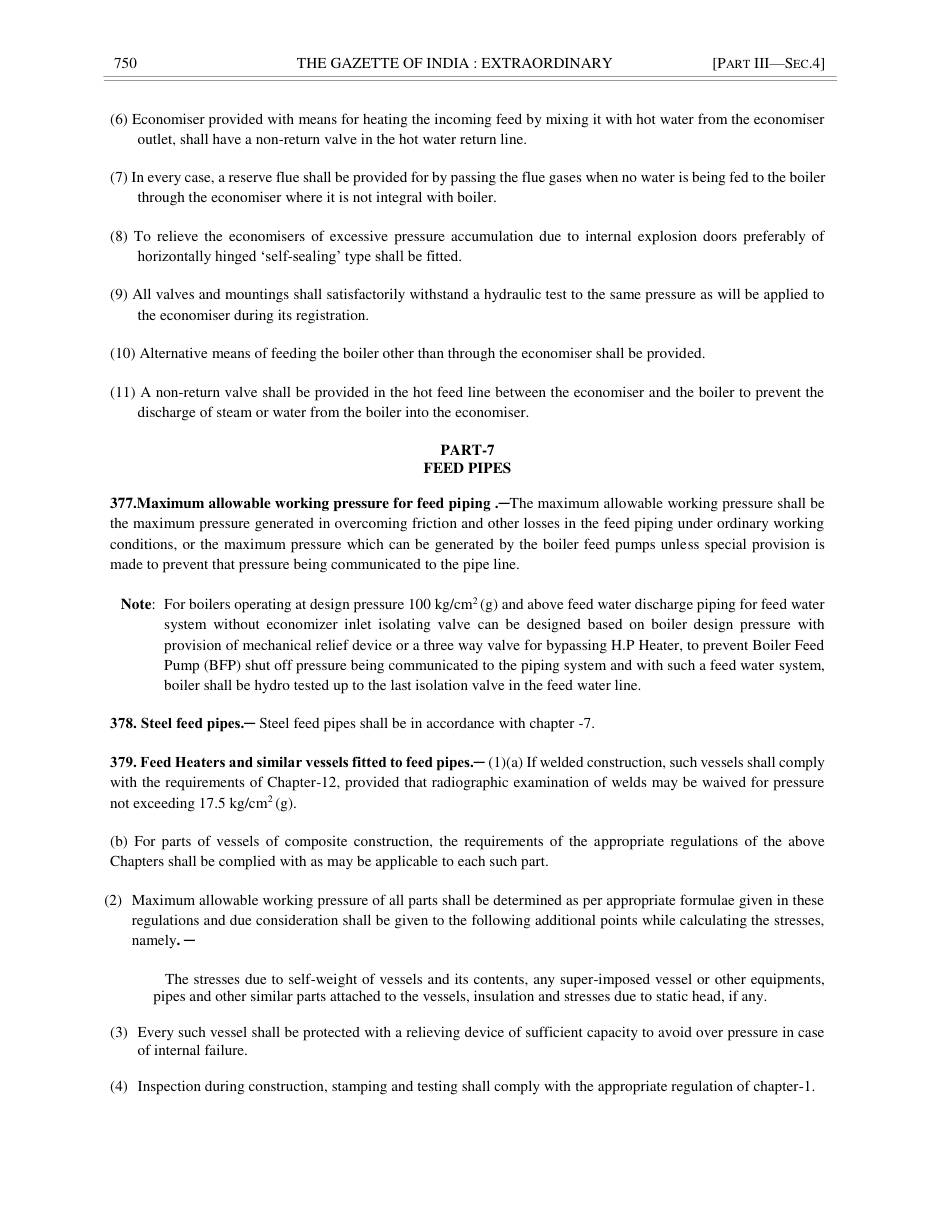
Indian Boiler Regulations, 2026, reg. 377, Regulation 377, Gazette of India, Extraordinary, Part III—Section 4, No. 596, 1 October 2026, printed p.750. https://egazette.gov.in/WriteReadData/2026/276813.pdf (text consulted via IBRsource, 2026-11-23).
The citation refers to the government publication. Cite the Gazette, not this website.