
Indian Boiler Regulations, 2026 · Chapter 11 · Standard Conditions for the Design and Construction of Economisers, Feed Pipes, Feed Heaters and Other Similar Vessels
Regulation 381. Procedure for registration
Not yet checked against the official Gazette; verify before relying on it.
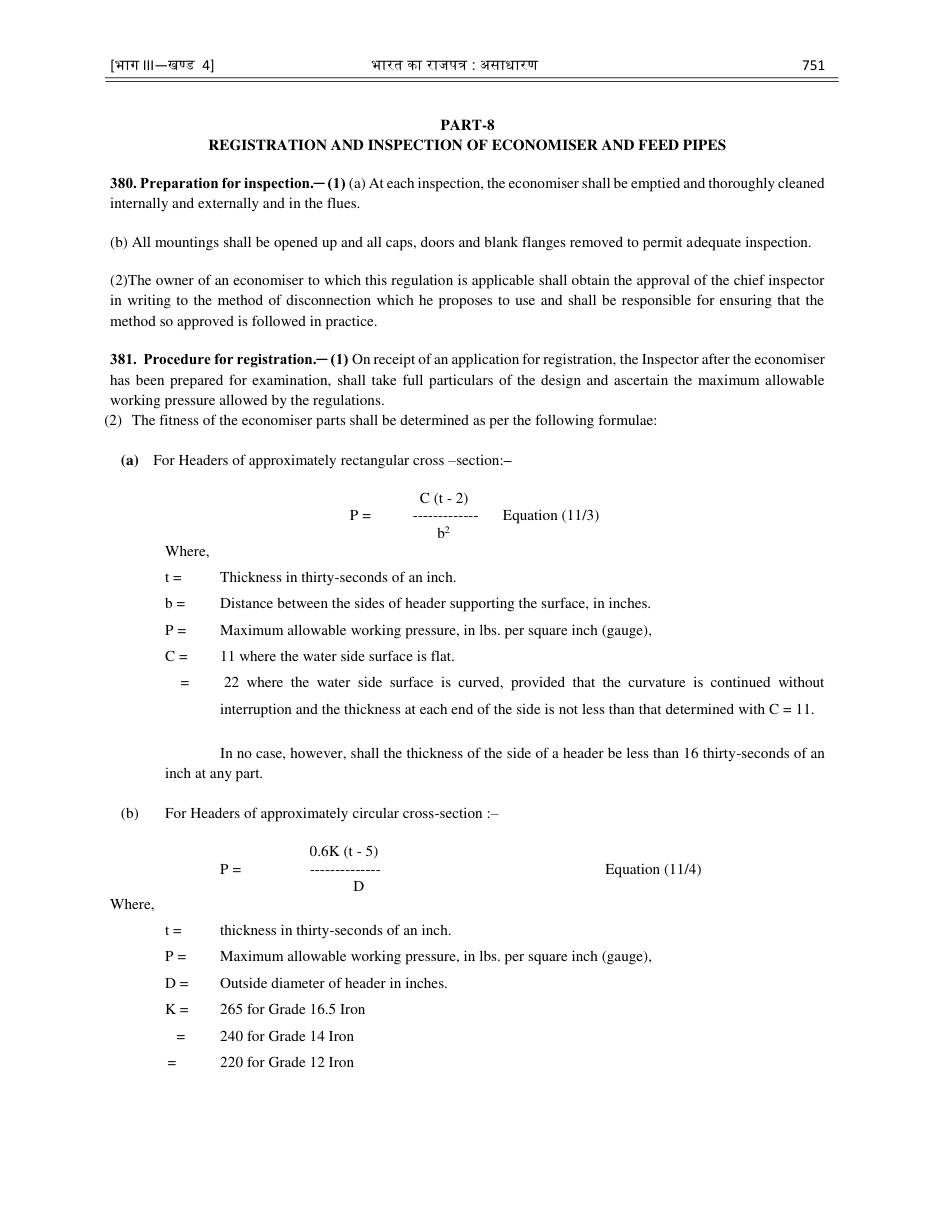
381. Procedure for registration.─ (1) On receipt of an application for registration, the Inspector after the economiser has been prepared for examination, shall take full particulars of the design and ascertain the maximum allowable working pressure allowed by the regulations.
(2)The fitness of the economiser parts shall be determined as per the following formulae:
(a)For Headers of approximately rectangular cross –section:–
                C (t - 2)

P =             ------------- Equation (11/3)

                b2
Where, t = Thickness in thirty-seconds of an inch.
b = Distance between the sides of header supporting the surface, in inches.
P = Maximum allowable working pressure, in lbs. per square inch (gauge),
C = 11 where the water side surface is flat.
= 22 where the water side surface is curved, provided that the curvature is continued without interruption and the thickness at each end of the side is not less than that determined with C = 11.
In no case, however, shall the thickness of the side of a header be less than 16 thirty-seconds of an inch at any part.
(b)For Headers of approximately circular cross-section :–
                        0.6K (t - 5)

                   P =  --------------                                 Equation (11/4)

                        D

Where,             thickness in thirty-seconds of an inch.
          t =      Maximum allowable working pressure, in lbs. per square inch (gauge),
          P =      Outside diameter of header in inches.
          D =      265 for Grade 16.5 Iron
          K =      240 for Grade 14 Iron
             =     220 for Grade 12 Iron
=
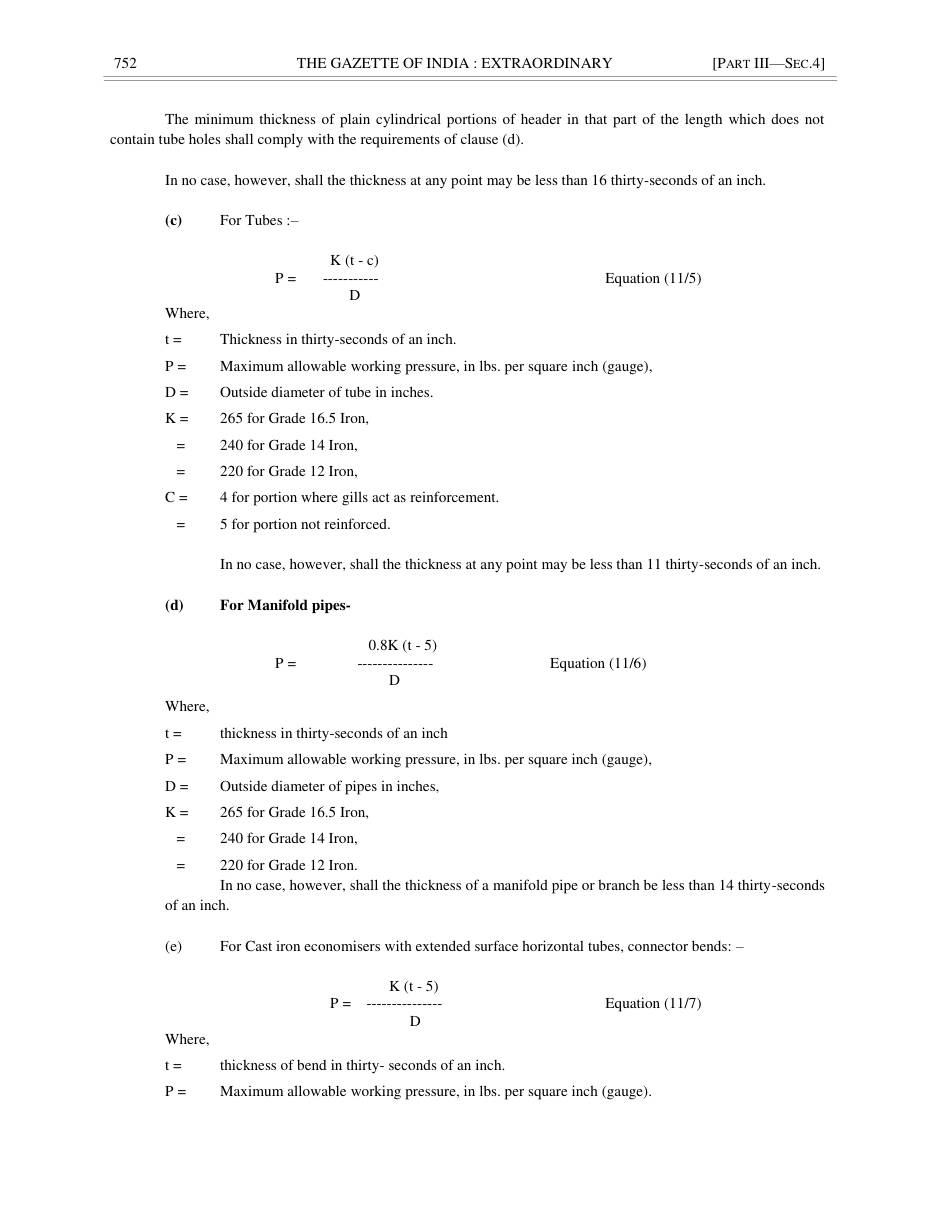
The minimum thickness of plain cylindrical portions of header in that part of the length which does not contain tube holes shall comply with the requirements of clause (d).
In no case, however, shall the thickness at any point may be less than 16 thirty-seconds of an inch.
(c)For Tubes :–
          K (t - c)                               Equation (11/5)
P = -----------

              D
Where, t = Thickness in thirty-seconds of an inch.
P = Maximum allowable working pressure, in lbs. per square inch (gauge),
D = Outside diameter of tube in inches.
K = 265 for Grade 16.5 Iron,
= 240 for Grade 14 Iron,
= 220 for Grade 12 Iron,
C = 4 for portion where gills act as reinforcement.
= 5 for portion not reinforced.
In no case, however, shall the thickness at any point may be less than 11 thirty-seconds of an inch.
(d)For Manifold pipes-
                  0.8K (t - 5)

P =              ---------------                  Equation (11/6)

                      D
Where, t = thickness in thirty-seconds of an inch
P = Maximum allowable working pressure, in lbs. per square inch (gauge),
D = Outside diameter of pipes in inches,
K = 265 for Grade 16.5 Iron,
= 240 for Grade 14 Iron,
= 220 for Grade 12 Iron.
In no case, however, shall the thickness of a manifold pipe or branch be less than 14 thirty-seconds of an inch.
(e)For Cast iron economisers with extended surface horizontal tubes, connector bends: –
           K (t - 5)                Equation (11/7)
P = ---------------

               D
Where, t = thickness of bend in thirty- seconds of an inch.
P = Maximum allowable working pressure, in lbs. per square inch (gauge).
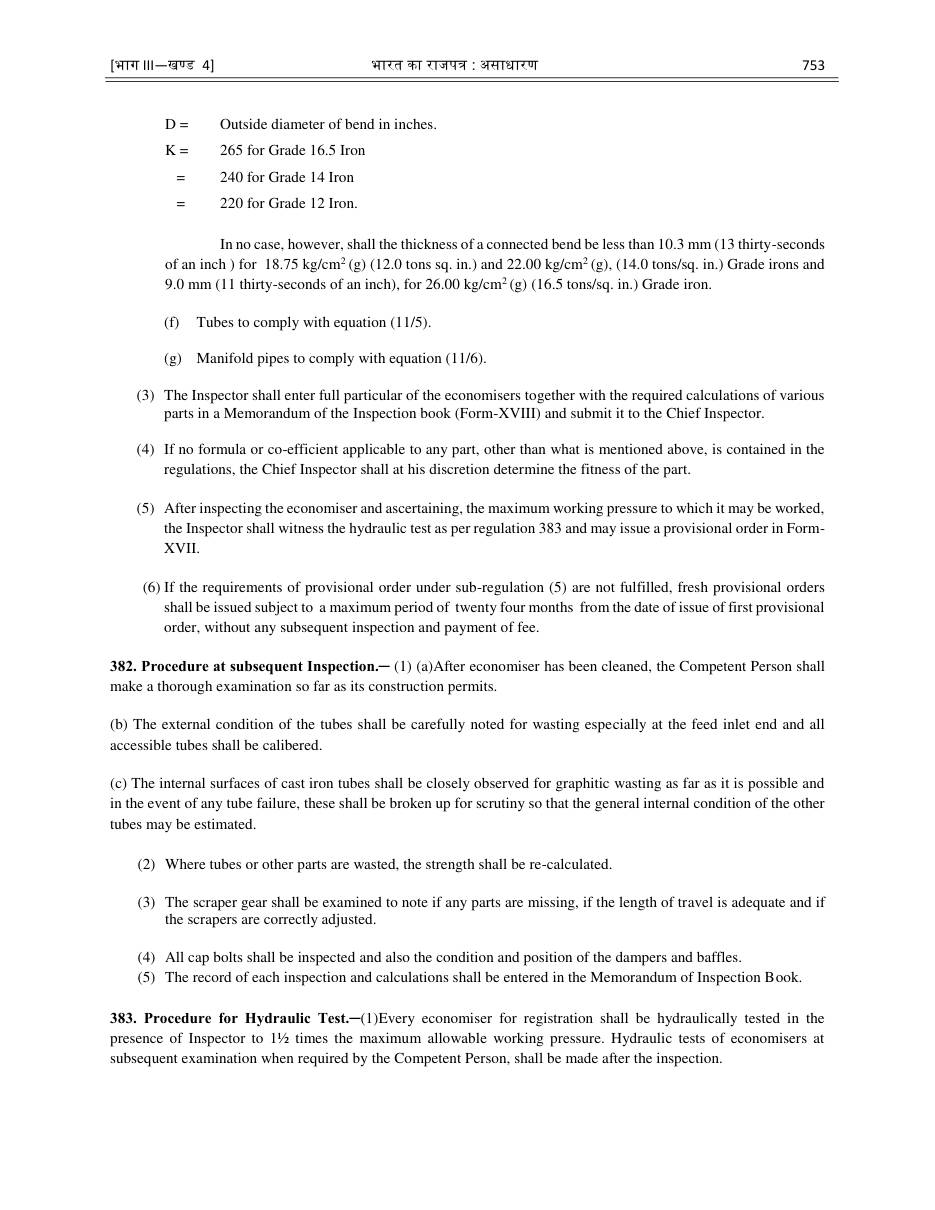
D = Outside diameter of bend in inches.
K = 265 for Grade 16.5 Iron
= 240 for Grade 14 Iron
= 220 for Grade 12 Iron.
In no case, however, shall the thickness of a connected bend be less than 10.3 mm (13 thirty-seconds of an inch ) for 18.75 kg/cm2 (g) (12.0 tons sq. in.) and 22.00 kg/cm2 (g), (14.0 tons/sq. in.) Grade irons and
9.0 mm (11 thirty-seconds of an inch), for 26.00 kg/cm2 (g) (16.5 tons/sq. in.) Grade iron.
(f)Tubes to comply with equation (11/5).
(g)Manifold pipes to comply with equation (11/6).
(3)The Inspector shall enter full particular of the economisers together with the required calculations of various parts in a Memorandum of the Inspection book (Form-XVIII) and submit it to the Chief Inspector.
(4)If no formula or co-efficient applicable to any part, other than what is mentioned above, is contained in the regulations, the Chief Inspector shall at his discretion determine the fitness of the part.
(5)After inspecting the economiser and ascertaining, the maximum working pressure to which it may be worked, the Inspector shall witness the hydraulic test as per regulation 383 and may issue a provisional order in Form-XVII.
(6)If the requirements of provisional order under sub-regulation (5) are not fulfilled, fresh provisional orders shall be issued subject to a maximum period of twenty four months from the date of issue of first provisional order, without any subsequent inspection and payment of fee.
Parts of this extracted text look garbled; read the Gazette page before using any value.
Tables and formulae are shown in their extracted layout. Alignment, superscripts and subscripts may be lost. The Gazette page image is authoritative.
In short
Regulation 381 sets the procedure for registering an economiser: the Inspector records the design, checks each part's strength by formula, witnesses the hydraulic test and may issue a provisional order.
Key points
- (1) After the economiser is prepared, the Inspector takes full particulars of the design and finds the maximum allowable working pressure allowed.
- (2) Fitness of parts is found from equations in inch units (thickness t in thirty-seconds of an inch, P in lbs. per square inch gauge):
- (a) rectangular headers, Equation (11/3), with C depending on whether the water side surface is flat or curved;
- (b) circular headers, Equation (11/4);
- (c) tubes, Equation (11/5), with a different constant where gills act as reinforcement;
- (d) manifold pipes, Equation (11/6);
- (e) connector bends of cast iron economisers with extended surface horizontal tubes, Equation (11/7).
- K depends on the iron grade (Grade 16.5, 14 or 12). Take the constants from the Official text tab.
- (3) The Inspector enters the particulars and calculations in the Memorandum of Inspection Book (Form-XVIII) and submits it to the Chief Inspector.
- (4) For a part with no formula or coefficient in the regulations, the Chief Inspector decides its fitness at his discretion.
- (5) The Inspector then witnesses the hydraulic test under regulation 383 and may issue a provisional order in Form-XVII.
- (6) If the provisional order's requirements are not met, fresh provisional orders are issued, up to twenty four months from the first, without further inspection or fee.
Watch out
- Minimum thicknesses apply whatever the formula gives: 16 thirty-seconds of an inch for header sides, 11 for tubes, 14 for manifold pipes or branches. For connector bends the minimum is 10.3 mm or 9.0 mm depending on the iron grade.
- The equations are garbled in the extracted text. Check the Gazette page for their exact form.
Written by IBRsource editors · last edited 2026-11-20. Explanations simplify and are not a design method, testing procedure or authorisation. Requirements come from the complete regulations, the Gazette and approved documentation.
Comparison pending: the IBR 1950 text in force on 30 September 2026 is not yet established for this provision, so no change is claimed (how this works).
Orientation hints (unverified)
These candidates come from automated heading matching against DPIIT's scanned historical print edition of IBR 1950. That edition uses imperial units and riveted-construction provisions, so it is not the operative 2026 predecessor text. Regulation numbers alone never prove equivalence.
| Historical 1950-edition reg. | Heading as OCR'd | Heading similarity | Source image |
|---|---|---|---|
| 381 | Procedure for registration | 100% | Chapter IX (DPIIT scan), image 2 |
| 525 | Procedure for Registration | 100% | Chapter XI (DPIIT scan), image 7 |
| 385 | Registration fee | 86% | Chapter IX (DPIIT scan), image 4 |
Amendment history of the candidate IBR 1950 regulations: Reg. 381 (2 amendments) · Reg. 525 (1 amendment) · Reg. 385 (5 amendments)
IBR 1950 regulation 381 as last published in the DPIIT web edition (archived 2022)
Unofficial archived copy, not verified; see the regulation 381 page for its amendments.
| Reg. 381
|
IBR 1950 regulation 525 as last published in the DPIIT web edition (archived 2022)
Unofficial archived copy, not verified; see the regulation 525 page for its amendments.
| Reg. 524, Reg. 525 REGULATIONS FOR REGISTRATION AND INSPECTION OF ECONOMISERS AND FEED PIPES | |||||||||||||||||||
| |||||||||||||||||||
|
REGULATIONS FOR REGISTRATION AND INSPECTION OF ECONOMISERS AND FEED PIPES | |||||||||||||||||||
|
| Next >>> |
IBR 1950 regulation 385 as last published in the DPIIT web edition (archived 2022)
Unofficial archived copy, not verified; see the regulation 385 page for its amendments.
| Reg. 384
Reg. 385
| ||||
Images of the official Gazette pages that contain this regulation. Click to zoom. Compare word by word before relying on the extracted text.
Indian Boiler Regulations, 2026, reg. 381, Regulation 381, Gazette of India, Extraordinary, Part III—Section 4, No. 596, 1 October 2026, printed p.751–753. https://egazette.gov.in/WriteReadData/2026/276813.pdf (text consulted via IBRsource, 2026-11-23).
The citation refers to the government publication. Cite the Gazette, not this website.