BETAIndependent engineering reference. Source-text verification is ongoing.Verification ongoing.Verification status →
IBRsourceIndian Boiler Regulations, made clear

Indian Boiler Regulations, 2026 · Chapter 11 · Standard Conditions for the Design and Construction of Economisers, Feed Pipes, Feed Heaters and Other Similar Vessels

Regulation 393. Inspection of feed pipes

Official text — not yet verifiedGazette 1 Oct 2026 · printed p. 755

Not yet checked against the official Gazette; verify before relying on it.

Reproduced from the Gazette of India · verification status above

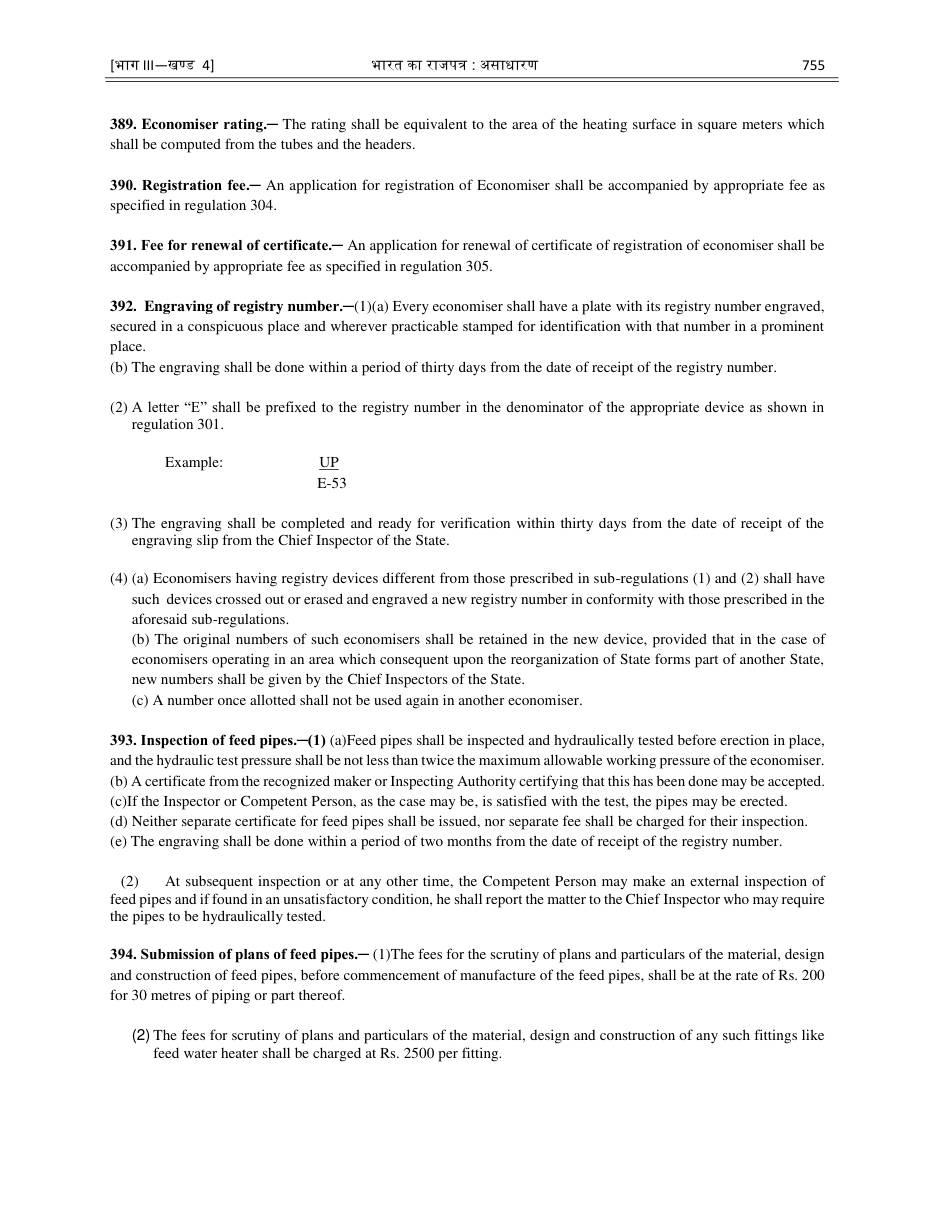
393. Inspection of feed pipes.─(1) (a)Feed pipes shall be inspected and hydraulically tested before erection in place, and the hydraulic test pressure shall be not less than twice the maximum allowable working pressure of the economiser.

(b)A certificate from the recognized maker or Inspecting Authority certifying that this has been done may be accepted.

(c)If the Inspector or Competent Person, as the case may be, is satisfied with the test, the pipes may be erected.

(d)Neither separate certificate for feed pipes shall be issued, nor separate fee shall be charged for their inspection.

(e)The engraving shall be done within a period of two months from the date of receipt of the registry number.

(2)At subsequent inspection or at any other time, the Competent Person may make an external inspection of feed pipes and if found in an unsatisfactory condition, he shall report the matter to the Chief Inspector who may require the pipes to be hydraulically tested.

Independent explanation — not the law · draft · engineer review in progress

In short

Regulation 393 covers the inspection and hydraulic testing of economiser feed pipes.

Key points

  • (1)(a) Feed pipes are inspected and hydraulically tested before erection, to not less than twice the economiser's maximum allowable working pressure.
  • (1)(b) A certificate from a recognised maker or Inspecting Authority confirming this may be accepted.
  • (1)(c) If the Inspector or Competent Person is satisfied with the test, the pipes may be erected.
  • (1)(e) Engraving is done within two months of receiving the registry number.
  • (2) At later inspections or any other time, the Competent Person may inspect feed pipes externally. If they are unsatisfactory, he reports to the Chief Inspector, who may require a hydraulic test.

Watch out

  • (1)(d) No separate certificate is issued and no separate fee is charged for feed pipe inspection.

Written by IBRsource editors · last edited 2026-11-20. Explanations simplify and are not a design method, testing procedure or authorisation. Requirements come from the complete regulations, the Gazette and approved documentation.

Comparison pending: the IBR 1950 text in force on 30 September 2026 is not yet established for this provision, so no change is claimed (how this works).

Orientation hints (unverified)

These candidates come from automated heading matching against DPIIT's scanned historical print edition of IBR 1950. That edition uses imperial units and riveted-construction provisions, so it is not the operative 2026 predecessor text. Regulation numbers alone never prove equivalence.

Historical 1950-edition reg.Heading as OCR'dHeading similaritySource image
523Copper feed pipes74%Chapter XI (DPIIT scan), image 6
522Cast Iron feed pipes73%Chapter XI (DPIIT scan), image 6
528Memorandum of Inspection Book70%Chapter XI (DPIIT scan), image 8

Amendment history of the candidate IBR 1950 regulations: Reg. 528 (1 amendment)

IBR 1950 regulation 523 as last published in the DPIIT web edition (archived 2022)

Unofficial archived copy, not verified; see the regulation 523 page for its amendments.

Reg. 523, Reg. 523 A, Reg. 523 B
STANDARD CONDITIONS FOR THE DESIGN AND CONSTRUCTION OF ECONOMISER, FEED PIPES, FEED HEATERS AND OTHER SIMILAR VESSELS

FEED PIPES

Copper feed pipes
a) The standard conditions for material of construction and tests for copper pipes shall comply with Regulation 35.
b)

The maximum working pressure shall be determined by the following formula:-

W.P. = 60(t-3) Eqn.(123)
d

Where,

t = thickness in hundredths of an inch.
d = external diameter of the pipe in inches.


Reg. 523 A

STANDARD CONDITIONS FOR THE DESIGN AND CONSTRUCTION OF ECONOMISER, FEED PIPES, FEED HEATERS AND OTHER SIMILAR VESSELS

FEED PIPES

(a) Feed Heaters and similar vessels fitted to feed pipes
Standard requirements, materials of construction and allowable working pressure.

These shall comply with the requirements of Chapter I, II and III for riveted construction. If so welded construction, such vessels shall comply with the requirements of Chapter XII, provided that radiographic examination of welds may be waived, for pressures not exceeding 17.5 kg./cm.² (250 lbs./sq. in.). For parts of vessels of composite construction, the requirements of the appropriate regulations of the above Chapters shall be complied with as may be applicable to each such part.

Reg. 523 B
STANDARD CONDITIONS FOR THE DESIGN AND CONSTRUCTION OF ECONOMISER, FEED PIPES, FEED HEATERS AND OTHER SIMILAR VESSELS

FEED PIPES

(b) Working Pressure
Working pressure of all parts shall be determined by the appropriate formulae given in these regulations. Due consideration shall be given to the following additional points while calculating the stresses.

The stresses due to self-weight of vessels and its contents and any supper imposed vessel or other equipments, insulation and these due to static head, if any and pipes and other similar parts attached to the vessel.
IBR 1950 regulation 522 as last published in the DPIIT web edition (archived 2022)

Unofficial archived copy, not verified; see the regulation 522 page for its amendments.

Reg. 520, Reg. 521, Reg. 522
STANDARD CONDITIONS FOR THE DESIGN AND CONSTRUCTION OF ECONOMISER, FEED PIPES, FEED HEATERS AND OTHER SIMILAR VESSELS

FEED PIPES

General
Feed pipers may be made of steel, cast iron or copper cut cast iron pipes will not be accepted for a working pressure over 200 lbs. per sq. in. or 425°F. Copper feed pipes shall be solid drawn and not exceeding 8” external diameter and may be used for a working pressure not exceeding 350 lbs. or 300°F.

Design pressure for feed piping:-

The design pressure shall be the maximum pressure generated in overcoming friction and other losses in the feed piping under ordinary working conditions, or the maximum pressure which can be generated by the boiler feed pumps unless special provision is made to prevent that pressure being communicated to the pipe line.


Reg. 521

STANDARD CONDITIONS FOR THE DESIGN AND CONSTRUCTION OF ECONOMISER, FEED PIPES, FEED HEATERS AND OTHER SIMILAR VESSELS

FEED PIPES

Steel feed pipes
Steel feed pipes shall be in accordance with Chapter VIII.

Reg. 522
STANDARD CONDITIONS FOR THE DESIGN AND CONSTRUCTION OF ECONOMIZER, FEED PIPES, FEED HEATERS AND OTHER SIMILAR VESSELS

FEED PIPES

Cast Iron feed pipes
a) The standard conditions for material of construction and tests for cast iron pipes shall comply with Regulation 505 to 509.
b) The maximum working pressure shall be determined by the following formula:-

W.P. = 130(t-6) Eqn.(122)
d


Where,

t=thickness in thirty second of an inch.
d=the external diameter of the pipe in inches.
IBR 1950 regulation 528 as last published in the DPIIT web edition (archived 2022)

Unofficial archived copy, not verified; see the regulation 528 page for its amendments.


Reg. 526
, Reg. 527, Reg. 528
STANDARD CONDITIONS FOR THE DESIGN AND CONSTRUCTION OF ECONOMIZER, FEED PIPES, FEED HEATERS AND OTHER SIMILAR VESSELS

REGULATIONS FOR REGISTRATION AND INSPECTION OF ECONOMISERS AND FEED PIPES

Procedure at subsequent inspection
a)

After the economiser has been cleaned the Inspector shall make a thorough examination so far as its construction permits. The external condition of the tubes should be carefully noted for wasting especially at the feed inlet end and all accessible tubes should be calibered. The internal surfaces of cast iron tubes should be closely observed for graphitic wasting as far as it is possible and in the event of any tube failure these should be broken up for scrutiny so that the general internal condition of the other tubes may be estimated.

b) Where tubes or other parts are wasted, the strength should be recalculated.
c) The scraper gear should be examined to note if any parts are missing if the length of travel is adequate and if the scrapers are correctly adjusted.
d) All cap bolts are to be inspected, also the condition and position of the dampers and baffles.
e) The record of each inspection and calculations will be entered in the Memorandum of Inspection Book.


Reg. 527

STANDARD CONDITIONS FOR THE DESIGN AND CONSTRUCTION OF ECONOMIZER, FEED PIPES, FEED HEATERS AND OTHER SIMILAR VESSELS

REGULATIONS FOR REGISTRATION AND INSPECTION OF ECONOMISERS AND FEED PIPES

Procedure for Hydraulic test

Every economiser for registration shall be hydraulically tested in the presence of an Inspector to 1 ½ times the working pressure. Hydraulic tests of economisers at subsequent examinations shall when required by the Inspector, be made after the inspection. The test pressure to be applied to economisers at subsequent examinations shall be from 1-1/4  to 1-1/2 times the working pressure of the economisers. During the test, all parts externally and in the flues shall be noted for leakage.


Reg. 528

STANDARD CONDITIONS FOR THE DESIGN AND CONSTRUCTION OF ECONOMIZER, FEED PIPES, FEED HEATERS AND OTHER SIMILAR VESSELS

REGULATIONS FOR REGISTRATION AND INSPECTION OF ECONOMISERS AND FEED PIPES

Memorandum of Inspection Book

In this book the Inspector shall enter all particulars and dimensions of the economiser with the required calculations for the various parts together with details of hydraulic test. At subsequent inspection the Inspector shall enter all notes pertaining to the condition of the various parts.

Images of the official Gazette pages that contain this regulation. Click to zoom. Compare word by word before relying on the extracted text.
Instrument
Indian Boiler Regulations, 2026 (made by the Central Boilers Board under s.40 of the Boilers Act, 2025)
Notification
F.No. P-30014/3/2021-Boiler dated 7 Aug 2026
Published
Gazette of India, Extraordinary, Part III Sec. 4, No. 596, 1 Oct 2026 (CG-DL-E-06102026-276813)
In force
1 Oct 2026 (reg. 1(3): date of publication in the Official Gazette)
Printed Gazette page
755
PDF page index
755 · open official e-Gazette PDF
Extraction
pdftotext layout mode, sequential regulation detector · text hash d1387b2435108dc4
Verification
Official text — not yet verified
Amendments checked
None known after 1 Oct 2026 as of build date (not a guarantee). Amendment log
How to cite

Indian Boiler Regulations, 2026, reg. 393, Regulation 393, Gazette of India, Extraordinary, Part III—Section 4, No. 596, 1 October 2026, printed p.755. https://egazette.gov.in/WriteReadData/2026/276813.pdf (text consulted via IBRsource, 2026-11-23).

The citation refers to the government publication. Cite the Gazette, not this website.

Help improve this page

Engineers like you keep IBRsource accurate. Every checked correction or tip helps the next reader.