
Indian Boiler Regulations, 2026 · Chapter 11 · Standard Conditions for the Design and Construction of Economisers, Feed Pipes, Feed Heaters and Other Similar Vessels
Regulation 365. Number of tensile tests
Not yet checked against the official Gazette; verify before relying on it.
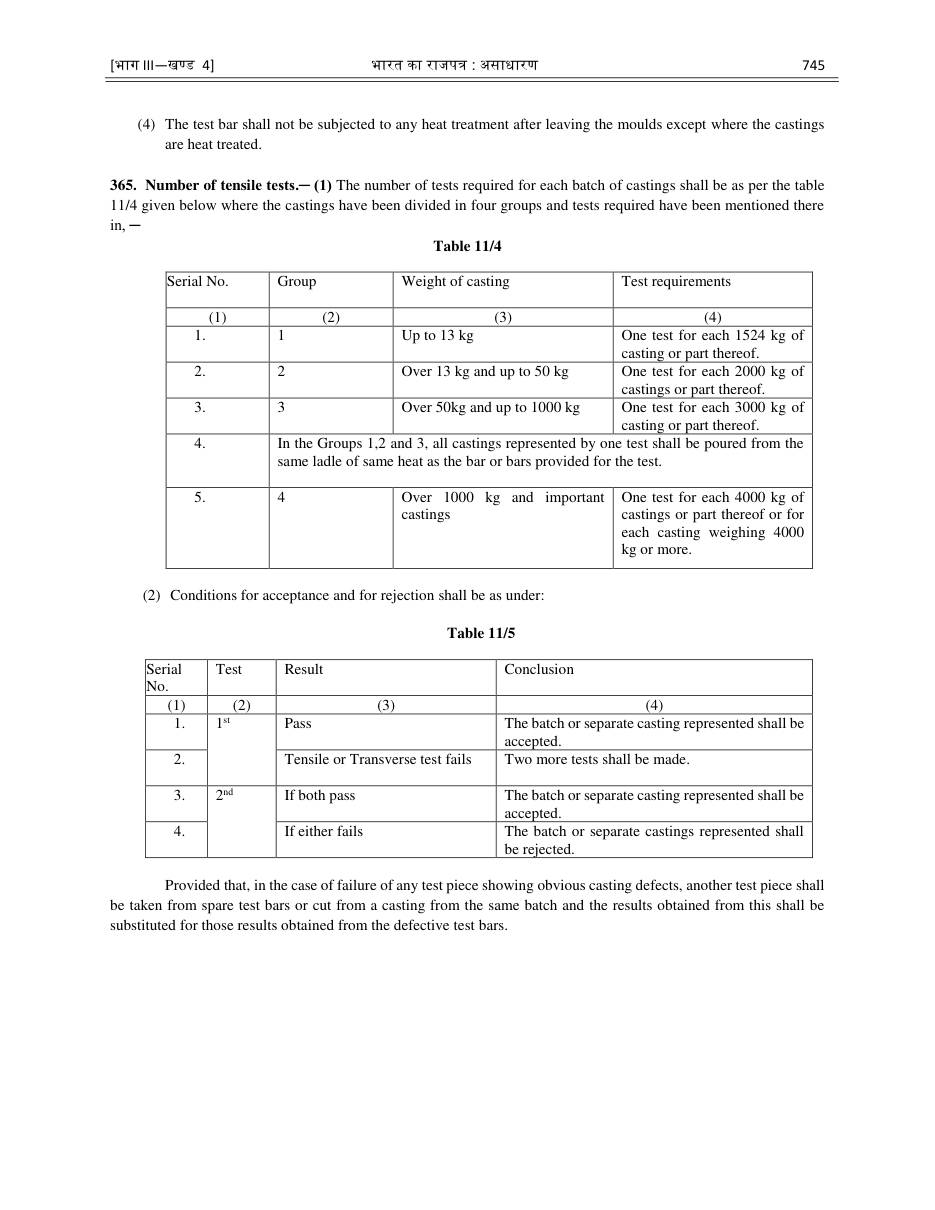
365. Number of tensile tests.─ (1) The number of tests required for each batch of castings shall be as per the table 11/4 given below where the castings have been divided in four groups and tests required have been mentioned there
| Serial No. | Group | Weight of casting | Test requirements |
|---|---|---|---|
| (1) | (2) | (3) | (4) |
| 1. | 1 | Up to 13 kg | One test for each 1524 kg of casting or part thereof. |
| 2. | 2 | Over 13 kg and up to 50 kg | One test for each 2000 kg of castings or part thereof. |
| 3. | 3 | Over 50kg and up to 1000 kg | One test for each 3000 kg of casting or part thereof. |
| 4. | In the Groups 1,2 and 3, all castings represented by one test shall be poured from the same ladle of same heat as the bar or bars provided for the test. | ||
| 5. | 4 | Over 1000 kg and important castings | One test for each 4000 kg of castings or part thereof or for each casting weighing 4000 kg or more. |
Table structure read from the Gazette PDF, page 745. Verification status as for the text above.
Table 11/4
Table 11/5
| Serial No. | Test | Result | Conclusion |
|---|---|---|---|
| (1) | (2) | (3) | (4) |
| 1. | 1st | Pass | The batch or separate casting represented shall be accepted. |
| 2. | Tensile or Transverse test fails | Two more tests shall be made. | |
| 3. | 2nd | If both pass | The batch or separate casting represented shall be accepted. |
| 4. | If either fails | The batch or separate castings represented shall be rejected. |
Table structure read from the Gazette PDF, page 745. Verification status as for the text above.
Show original extracted text (diagnostic, not authoritative)
in, ─

                                                                Table 11/4

Serial No.                 Group       Weight of casting            Test requirements

           (1)                    (2)                        (3)                              (4)
         1.
         2.                1           Up to 13 kg                  One test for each 1524 kg of

         3.                                                         casting or part thereof.
         4.
                           2           Over 13 kg and up to 50 kg   One test for each 2000 kg of

                                                                    castings or part thereof.

                           3           Over 50kg and up to 1000 kg  One test for each 3000 kg of

                                                                    casting or part thereof.

                           In the Groups 1,2 and 3, all castings represented by one test shall be poured from the

                           same ladle of same heat as the bar or bars provided for the test.

         5.                4           Over 1000 kg and important   One test for each 4000 kg of
                                       castings                     castings or part thereof or for
                                                                    each casting weighing 4000
                                                                    kg or more.

(2) Conditions for acceptance and for rejection shall be as under:

                                       Table 11/5

Serial             Test    Result                            Conclusion
No.                   (2)                    (3)
                                                                                         (4)
    (1)            1st     Pass                              The batch or separate casting represented shall be
     1.                    Tensile or Transverse test fails  accepted.
                   2nd     If both pass                      Two more tests shall be made.
     2.                    If either fails
                                                             The batch or separate casting represented shall be
     3.                                                      accepted.
                                                             The batch or separate castings represented shall
     4.                                                      be rejected.
Provided that, in the case of failure of any test piece showing obvious casting defects, another test piece shall be taken from spare test bars or cut from a casting from the same batch and the results obtained from this shall be substituted for those results obtained from the defective test bars.
Parts of this extracted text look garbled; read the Gazette page before using any value.
Tables and formulae are shown in their extracted layout. Alignment, superscripts and subscripts may be lost. The Gazette page image is authoritative.
In short
Regulation 365 sets how many tests are needed for each batch of economiser castings and how a batch is accepted or rejected.
Key points
- (1) Table 11/4 divides castings into four groups by weight:
- Group 1, up to 13 kg: one test for each 1524 kg of casting or part thereof.
- Group 2, over 13 kg and up to 50 kg: one test for each 2000 kg.
- Group 3, over 50 kg and up to 1000 kg: one test for each 3000 kg.
- Group 4, over 1000 kg and important castings: one test for each 4000 kg, or for each casting weighing 4000 kg or more.
- In Groups 1, 2 and 3, all castings represented by one test must be poured from the same ladle of the same heat as the test bar or bars.
- (2) Table 11/5: if the first test passes, the batch or casting is accepted. If the tensile or transverse test fails, two more tests are made. If both pass, it is accepted; if either fails, it is rejected.
Watch out
- Proviso: if a test piece fails and shows obvious casting defects, another piece is taken from spare test bars or cut from a casting of the same batch, and its result replaces the defective one.
- The table layout in the extracted text is broken; check the Gazette page for the exact wording.
Written by IBRsource editors · last edited 2026-11-20. Explanations simplify and are not a design method, testing procedure or authorisation. Requirements come from the complete regulations, the Gazette and approved documentation.
Comparison pending: the IBR 1950 text in force on 30 September 2026 is not yet established for this provision, so no change is claimed (how this works).
Orientation hints (unverified)
These candidates come from automated heading matching against DPIIT's scanned historical print edition of IBR 1950. That edition uses imperial units and riveted-construction provisions, so it is not the operative 2026 predecessor text. Regulation numbers alone never prove equivalence.
| Historical 1950-edition reg. | Heading as OCR'd | Heading similarity | Source image |
|---|---|---|---|
| 17 | Number of Tensile Tests | 100% | Chapter II (DPIIT scan), image 2 |
| 83 | Tensile Tests | 100% | Chapter II (DPIIT scan), image 16 |
| 260 | Tensile Tests | 100% | Chapter V (DPIIT scan), image 6 |
Amendment history of the candidate IBR 1950 regulations: Reg. 17 (3 amendments) · Reg. 260 (1 amendment)
IBR 1950 regulation 17 as last published in the DPIIT web edition (archived 2022)
Unofficial archived copy, not verified; see the regulation 17 page for its amendments.
| Reg. 17 MATERIALS OF CONSTRUCTION STEEL PLATES, RIVETS, SECTION AND BARS IN CARBON STEEL |
| (a) Plates – For shell plates, butt straps and plates, gusset plates, end plates, furnace plates and flanging plates one tensile test piece shall be cut from each plate as rolled. (b) Angle, tee, rivet, and stay bars.- One tensile test shall be made from each 15 or part of 15 bars rolled of each section or diameter from the same charge, but not less than two tensile tests shall be made unless the total number of bars rolled from the same charge is 8 or less than 8 and the bars of the same section or diameter, in which case one tensile test shall suffice. For round bars of 1¾ inches diameter and under, the numbers 50 and 20 shall be substituted for 15 and 8 respectively for determining the number of tests required. |
IBR 1950 regulation 83 as last published in the DPIIT web edition (archived 2022)
Unofficial archived copy, not verified; see the regulation 83 page for its amendments.
| Reg. 83 MATERIALS OF CONSTRUCTION FORGED OR ROLLED PRESSURE PARTS OTHER THAN SEAMLESS DRUMS OF CARBON STEEL Tensile strength |
| (a) The tensile strength of the material shall conform to one of the following four grades:- (i) 37 to 45 kgf/mm2 (b) The upper yield point at room temperature shall be not less than 50% of the specified minimum tensile strength. (c) The minimum values of the stress at proof limit 0.2% at elevated temperature Et of the material may be calculated by multiplying the minimum specified tensile strength at room temperature R20 by the value of the ratio Et/R20 given in the table under Regulation 16. (d) The breaking elongation in percentage shall not be less than
|
IBR 1950 regulation 260 as last published in the DPIIT web edition (archived 2022)
Unofficial archived copy, not verified; see the regulation 260 page for its amendments.
|
| ||||||
Reg. 260
(b) All-weld Metal
|
Images of the official Gazette pages that contain this regulation. Click to zoom. Compare word by word before relying on the extracted text.
Indian Boiler Regulations, 2026, reg. 365, Regulation 365, Gazette of India, Extraordinary, Part III—Section 4, No. 596, 1 October 2026, printed p.745–746. https://egazette.gov.in/WriteReadData/2026/276813.pdf (text consulted via IBRsource, 2026-11-23).
The citation refers to the government publication. Cite the Gazette, not this website.