
Indian Boiler Regulations, 2026 · Chapter 10 · Electrode Boilers
Regulation 336. Materials
Not yet checked against the official Gazette; verify before relying on it.
336. Materials.─ The material specifications for structural parts of electrode boilers shall comply with Chapter-2, as regards the process of manufacture, chemical composition, mode of manufacture and test, and the certificates for the steel plates, provided that the ultimate tensile stress and elongation of materials shall be between the following limits:-
(a)For fusion welded construction, as mentioned in Chapter-2.
(b)For seamless construction as mentioned in regulation 250 and for seamless carbon steel pipes as mentioned in
Table 7/3 of regulation 253.
Tables and formulae are shown in their extracted layout. Alignment, superscripts and subscripts may be lost. The Gazette page image is authoritative.
In short
Materials for structural parts of electrode boilers must comply with Chapter-2 for process of manufacture, chemical composition, mode of manufacture and test, and the steel plate certificates. The ultimate tensile stress and elongation must be within these limits:
- (a) fusion welded construction: as in Chapter-2;
- (b) seamless construction: as in regulation 250, and for seamless carbon steel pipes as in Table 7/3 of regulation 253.
Written by IBRsource editors · last edited 2026-11-20. Explanations simplify and are not a design method, testing procedure or authorisation. Requirements come from the complete regulations, the Gazette and approved documentation.
Comparison pending: the IBR 1950 text in force on 30 September 2026 is not yet established for this provision, so no change is claimed (how this works).
Orientation hints (unverified)
These candidates come from automated heading matching against DPIIT's scanned historical print edition of IBR 1950. That edition uses imperial units and riveted-construction provisions, so it is not the operative 2026 predecessor text. Regulation numbers alone never prove equivalence.
| Historical 1950-edition reg. | Heading as OCR'd | Heading similarity | Source image |
|---|---|---|---|
| 6 | Standard specifications for materials | 100% | Chapter I (DPIIT scan), image 3 |
| 626 | Materials | 100% | Chapter XV (DPIIT scan), image 1 |
Amendment history of the candidate IBR 1950 regulations: Reg. 626 (1 amendment)
IBR 1950 regulation 6 as last published in the DPIIT web edition (archived 2022)
Unofficial archived copy, not verified; see the regulation 6 page for its amendments.
| Reg. 6 Standard specifications for materials. |
| The standard specifications for steel wrought iron and copper plates and bar, and for cast steel shall be those prescribed in Chapter II. |
IBR 1950 regulation 626 as last published in the DPIIT web edition (archived 2022)
Unofficial archived copy, not verified; see the regulation 626 page for its amendments.
| Reg. 626 FEED WATER FOR BOILER | |||||||||||||||||||||||||||||||||||||||||||||||||||||||||||||||||||||||||||||||||||||||||||||||||||||||||||||||||||||||||||||||||||||||||||||||||||||||||||||||||||||||||||||||||||||||||||||||||||||||||
Tests shall be carried out as prescribed in the appropriate clauses of IS : 3025-1964* and IS : 3550-1965! as indicated against the characteristics in Table 1.
| |||||||||||||||||||||||||||||||||||||||||||||||||||||||||||||||||||||||||||||||||||||||||||||||||||||||||||||||||||||||||||||||||||||||||||||||||||||||||||||||||||||||||||||||||||||||||||||||||||||||||
Images of the official Gazette pages that contain this regulation. Click to zoom. Compare word by word before relying on the extracted text.
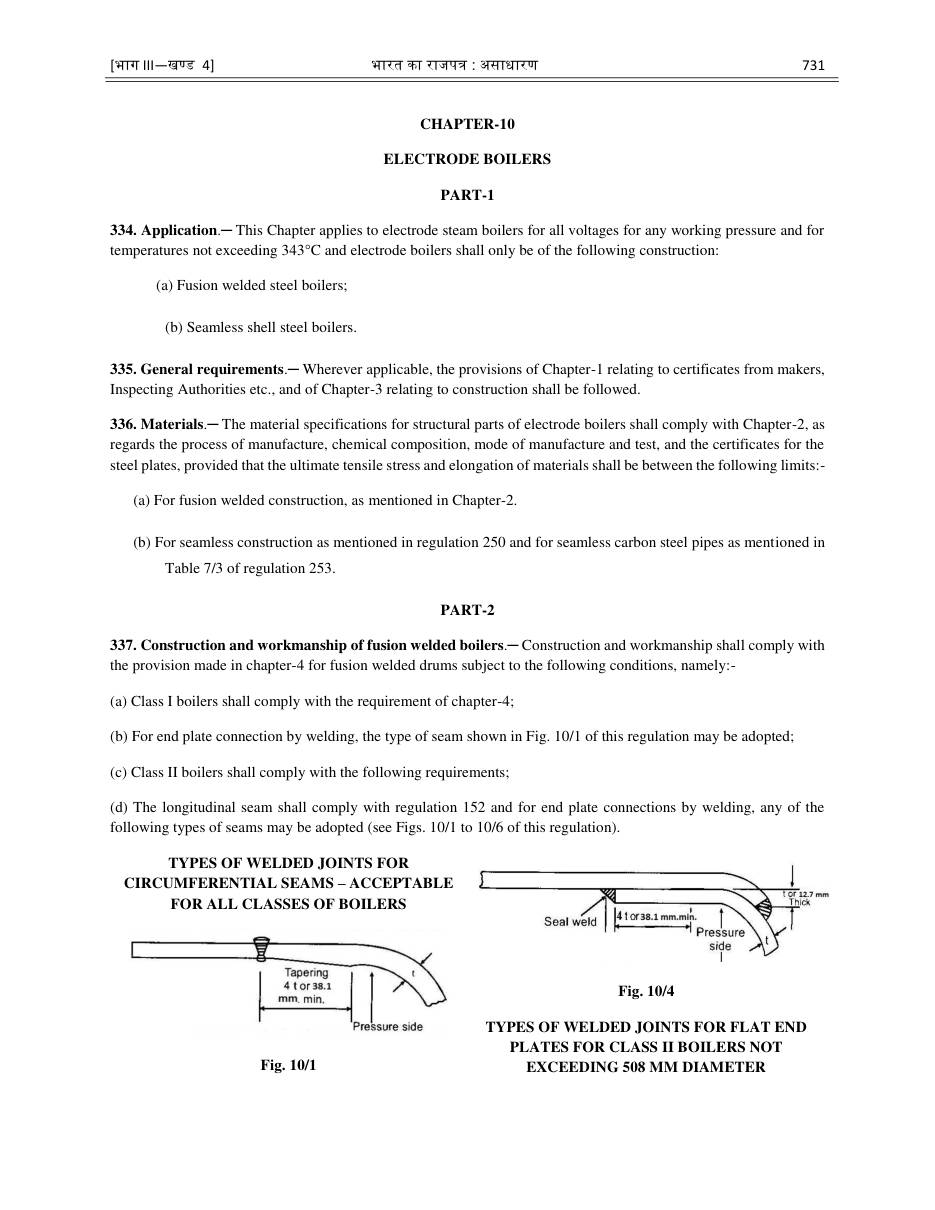
Indian Boiler Regulations, 2026, reg. 336, Regulation 336, Gazette of India, Extraordinary, Part III—Section 4, No. 596, 1 October 2026, printed p.731. https://egazette.gov.in/WriteReadData/2026/276813.pdf (text consulted via IBRsource, 2026-11-23).
The citation refers to the government publication. Cite the Gazette, not this website.