BETAIndependent engineering reference. Source-text verification is ongoing.Verification ongoing.Verification status →
IBRsourceIndian Boiler Regulations, made clear

Indian Boiler Regulations, 2026 · Chapter 10 · Electrode Boilers

Regulation 348. Manholes and other opening in shells

Official text — not yet verifiedGazette 1 Oct 2026 · printed p. 736

Not yet checked against the official Gazette; verify before relying on it.

Reproduced from the Gazette of India · verification status above

348. Manholes and other opening in shells.─ (a) Manholes and other opening in boilers shall be placed away from any welded seam and Oval opening shall be arranged with their minor axis parallel to the longitudinal center line of the boiler.

(b)Un-compensated and compensated openings shall comply with regulation 179.

Referenced provisions

Reg. 179

Independent explanation — not the law · draft · engineer review in progress

In short

In fusion welded electrode boilers, manholes and other openings must be placed away from any welded seam. Oval openings must have their minor axis parallel to the longitudinal centre line of the boiler. Both compensated and un-compensated openings must comply with regulation 179.

Written by IBRsource editors · last edited 2026-11-20. Explanations simplify and are not a design method, testing procedure or authorisation. Requirements come from the complete regulations, the Gazette and approved documentation.

Comparison pending: the IBR 1950 text in force on 30 September 2026 is not yet established for this provision, so no change is claimed (how this works).

Orientation hints (unverified)

These candidates come from automated heading matching against DPIIT's scanned historical print edition of IBR 1950. That edition uses imperial units and riveted-construction provisions, so it is not the operative 2026 predecessor text. Regulation numbers alone never prove equivalence.

Historical 1950-edition reg.Heading as OCR'dHeading similaritySource image
564Shells100%Chapter XII (DPIIT scan), image 2
427Manholes and other openings in Shells99%Chapter X (DPIIT scan), image 8

Amendment history of the candidate IBR 1950 regulations: Reg. 564 (1 amendment)

IBR 1950 regulation 564 as last published in the DPIIT web edition (archived 2022)

Unofficial archived copy, not verified; see the regulation 564 page for its amendments.

Reg. 563, Reg. 564

Classification of Fusion-Welded Boilers

The boilers covered by this Chapter shall be classified in accordance with Table XII/3.

TABLE XII/3

Classification of Fusion-Welded Boilers
Classification Limits of application Minimum thickness
Class I No. limit ¼ inch.
Class II When the following limits are not exceed:

(a) Working pressure105 pounds per sq. in.
(b) Working pressure in pounds per sq. in. multiplied by internal diameter in inches = 5250


Boilers up to and including 36 inches internal diameter-5/16 inch.
Class III When the following limits are not exceeded:

(a) Working presure 30 lbs. per sq. in.
(b) Working pressure multiplied by internal diameter in inches = 3000.
Boiler over 36 inches internal diameter-3/8 inch.


Reg. 564

Shells

a)

The working pressure of cylindrical shells for class I boilers shall be determined in accordance with regulations 270 and 271.
b) The working pressure of cylindrical shells for Class II and Class III boilers shall be determined by the following formula:-

WP = (t – 1.5)SC Equation XII/1
0.7 D

Where,

t is minimum thickness of shell plate in mm.
WP is working pressure in kg/cm².
D is maximum internal diameter in mm.
S is minimum tensile strength of plate in kg/mm².
C is a constant, as given below.

In no case, however, shall the factor of safety of the shell be less than 4 or the plate thickness be less than specified in Table XII/3 given under Regulation 563.

C=27 where Class II requirements are complied with.
C=23 for Class III boilers when stress relieved.
C=21 for Class III boilers when not stress relieved.

Where boilers have a nest or nests of horizontal tubes, so that there is a direct tension on the tube plates due to the vertical load on the boiler ends or to tube plates acting as horizontal ties across the shell:

i) each alternate tube in the outer vertical row of tubes shall be a stay tube.
ii) The thickness of tube plates and the spacing of the tubes shall be such that the section of metal taking the load is sufficient to keep the stress within that allowed on the shell plate, as determined by the following formula:-

WP = (t – 2) SJ Equation XII/2
2D

Where,

t is the thickness of the tube plate in mm.
WP is the working pressure in kg/cm².
S is the minimum tensile strength in kg/mm².
D is twice the radial distance of the centre of the outer row of tube holes from the axis of the shell in mm.
J is the percentage strength of the plate through the tube holes,

i.e. = 100 (P-D) Eqn. XII/3
P

P is the vertical pitch of tubes in mm.
D is the diameter of the tube holes in mm.

NOTE:- The tube plates between the stay tubes shall comply with the requirements for tubes plates (Regulation 577).
IBR 1950 regulation 427 as last published in the DPIIT web edition (archived 2022)

Unofficial archived copy, not verified; see the regulation 427 page for its amendments.

Reg. 427, Reg. 428, Reg. 429, Reg. 430
TESTS FOR CLASS II FUSION WELDED SEAMS

Manholes and other openings in Shells

Manholes and other openings in boiler shells shall be placed away from any welded seam. Oval openings shall be arranged with their minor axis parallel to the longitudinal centre line of the boiler.

(a) Un-compensated openings shall comply with Regulation 187.
(b) Compensated openings shall comply with Regulations 170, 171, 186 and 279.


Reg. 428
TESTS FOR CLASS II FUSION WELDED SEAMS

Dished End Plates with pressure on Concave side

This shall comply with Regulation 408.


Reg. 429
TESTS FOR CLASS II FUSION WELDED SEAMS

Unstayed Flat End Plates

The working pressure of unstayed flat end plates shall comply with Regulation 412.

Where the diameter of the openings in an unstayed flat end plate is greater than 2½ inches or the pitch in inches is less than four times the diameter of the holes full compensation shall be provided as in Regulation 279.


Reg. 430
TESTS FOR CLASS II FUSION WELDED SEAMS

Thickness of Angle Rings

Thickness of angle rings shall comply with Regulation 379(a).

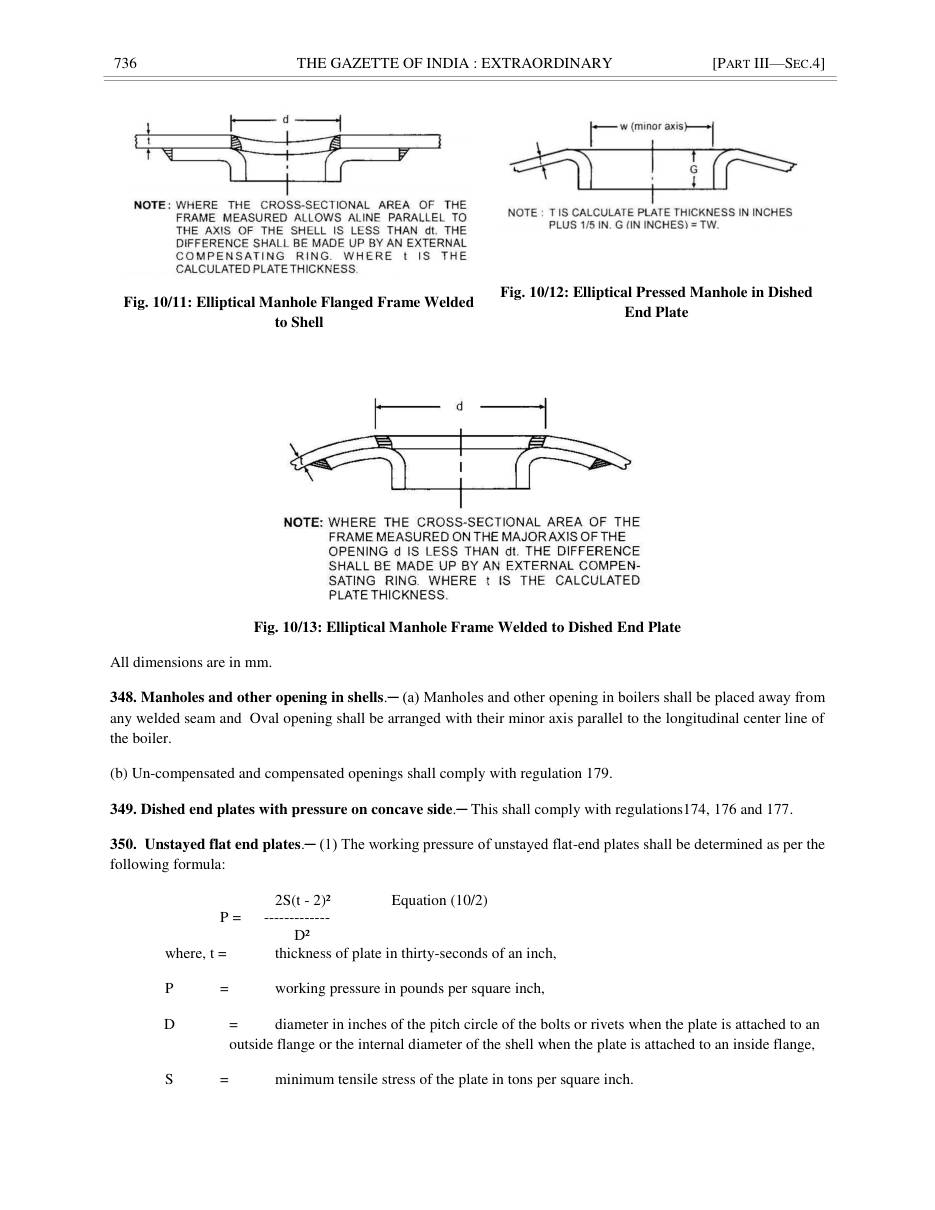
Images of the official Gazette pages that contain this regulation. Click to zoom. Compare word by word before relying on the extracted text.
Instrument
Indian Boiler Regulations, 2026 (made by the Central Boilers Board under s.40 of the Boilers Act, 2025)
Notification
F.No. P-30014/3/2021-Boiler dated 7 Aug 2026
Published
Gazette of India, Extraordinary, Part III Sec. 4, No. 596, 1 Oct 2026 (CG-DL-E-06102026-276813)
In force
1 Oct 2026 (reg. 1(3): date of publication in the Official Gazette)
Printed Gazette page
736
PDF page index
736 · open official e-Gazette PDF
Extraction
pdftotext layout mode, sequential regulation detector · text hash 6f4ad9403bfdde98
Verification
Official text — not yet verified
Amendments checked
None known after 1 Oct 2026 as of build date (not a guarantee). Amendment log
How to cite

Indian Boiler Regulations, 2026, reg. 348, Regulation 348, Gazette of India, Extraordinary, Part III—Section 4, No. 596, 1 October 2026, printed p.736. https://egazette.gov.in/WriteReadData/2026/276813.pdf (text consulted via IBRsource, 2026-11-23).

The citation refers to the government publication. Cite the Gazette, not this website.

Help improve this page

Engineers like you keep IBRsource accurate. Every checked correction or tip helps the next reader.