
Indian Boiler Regulations, 2026 · Chapter 10 · Electrode Boilers
Regulation 337. Construction and workmanship of fusion welded boilers
Not yet checked against the official Gazette; verify before relying on it.
337. Construction and workmanship of fusion welded boilers.─ Construction and workmanship shall comply with the provision made in chapter-4 for fusion welded drums subject to the following conditions, namely:-
(a)Class I boilers shall comply with the requirement of chapter-4;
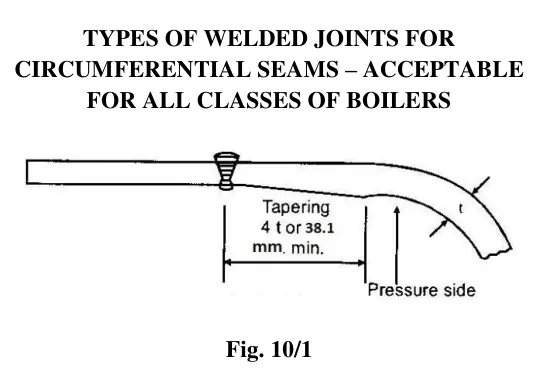
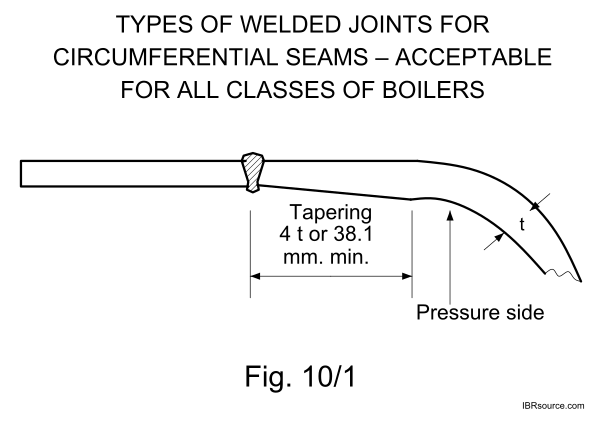
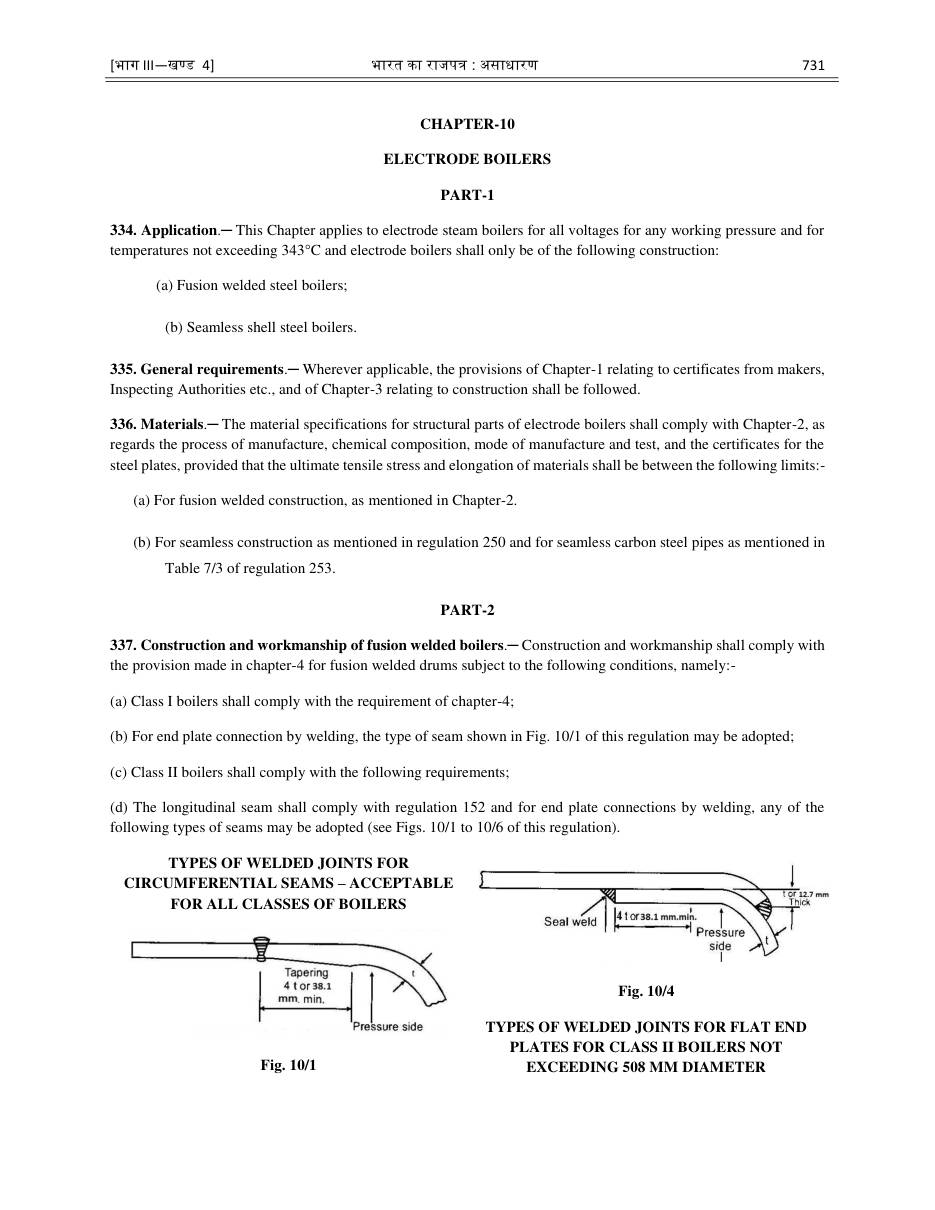
(b)For end plate connection by welding, the type of seam shown in Fig. 10/1 of this regulation may be adopted;
(c)Class II boilers shall comply with the following requirements;
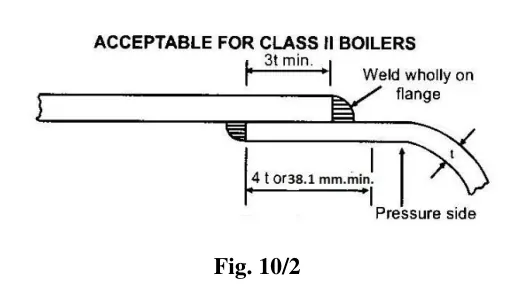
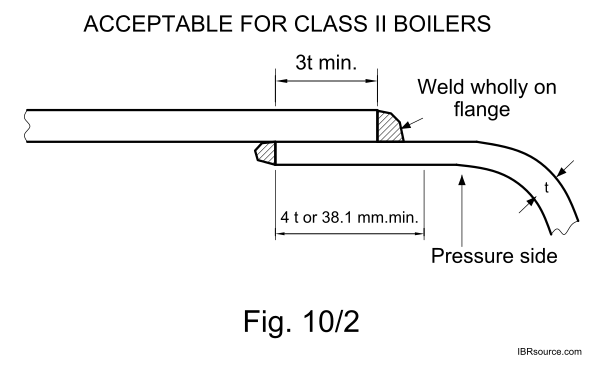
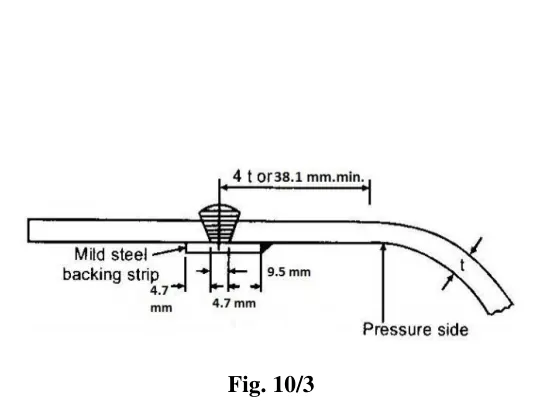
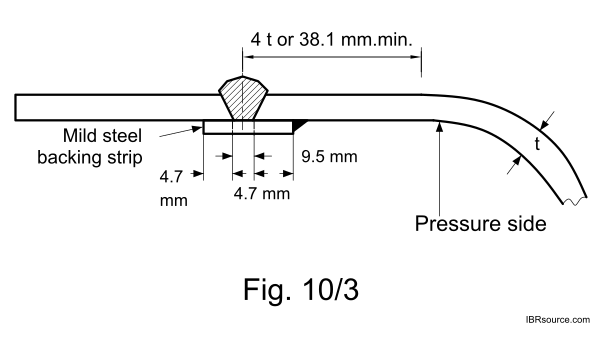
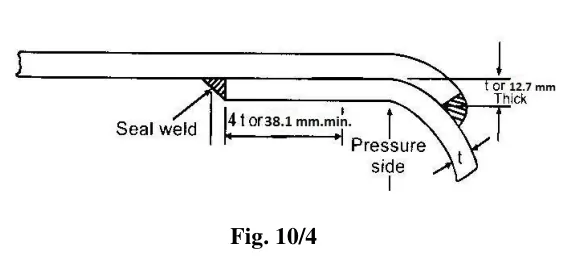
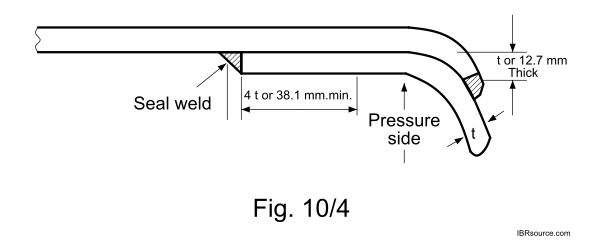
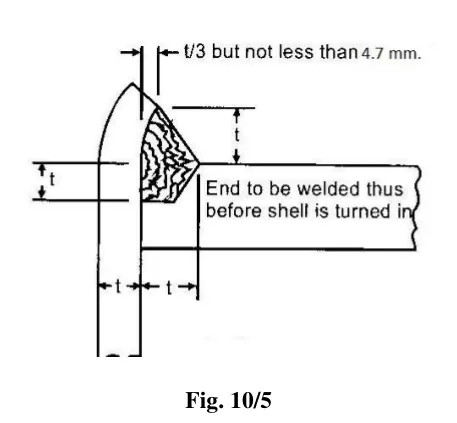
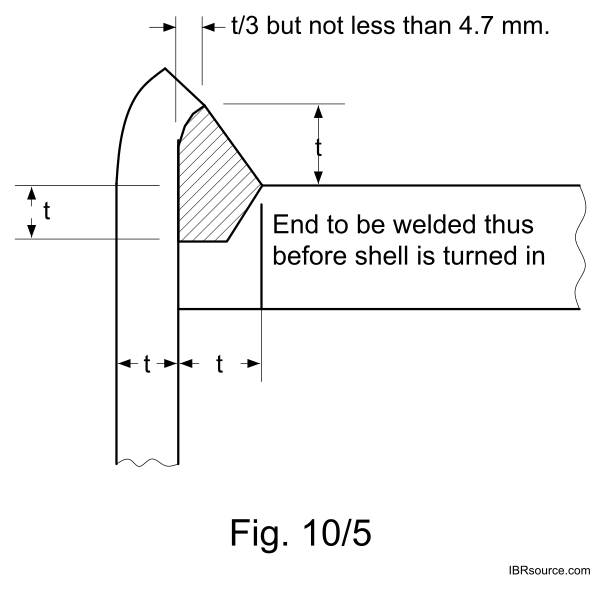
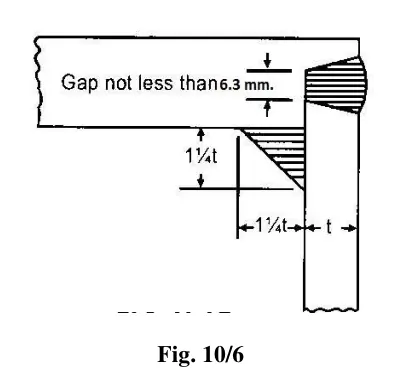
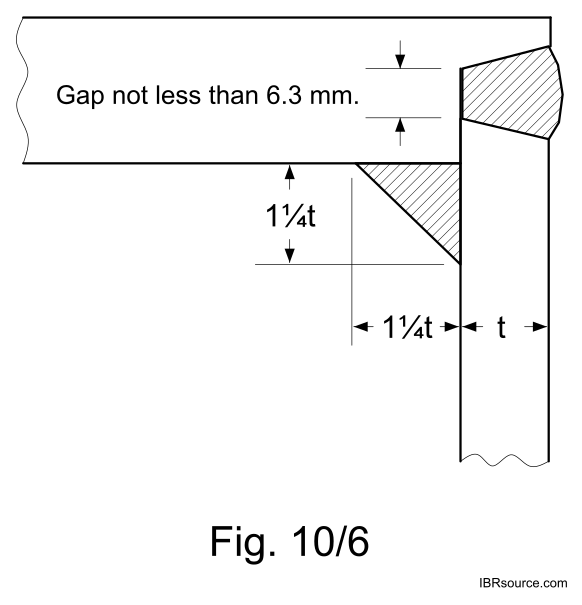
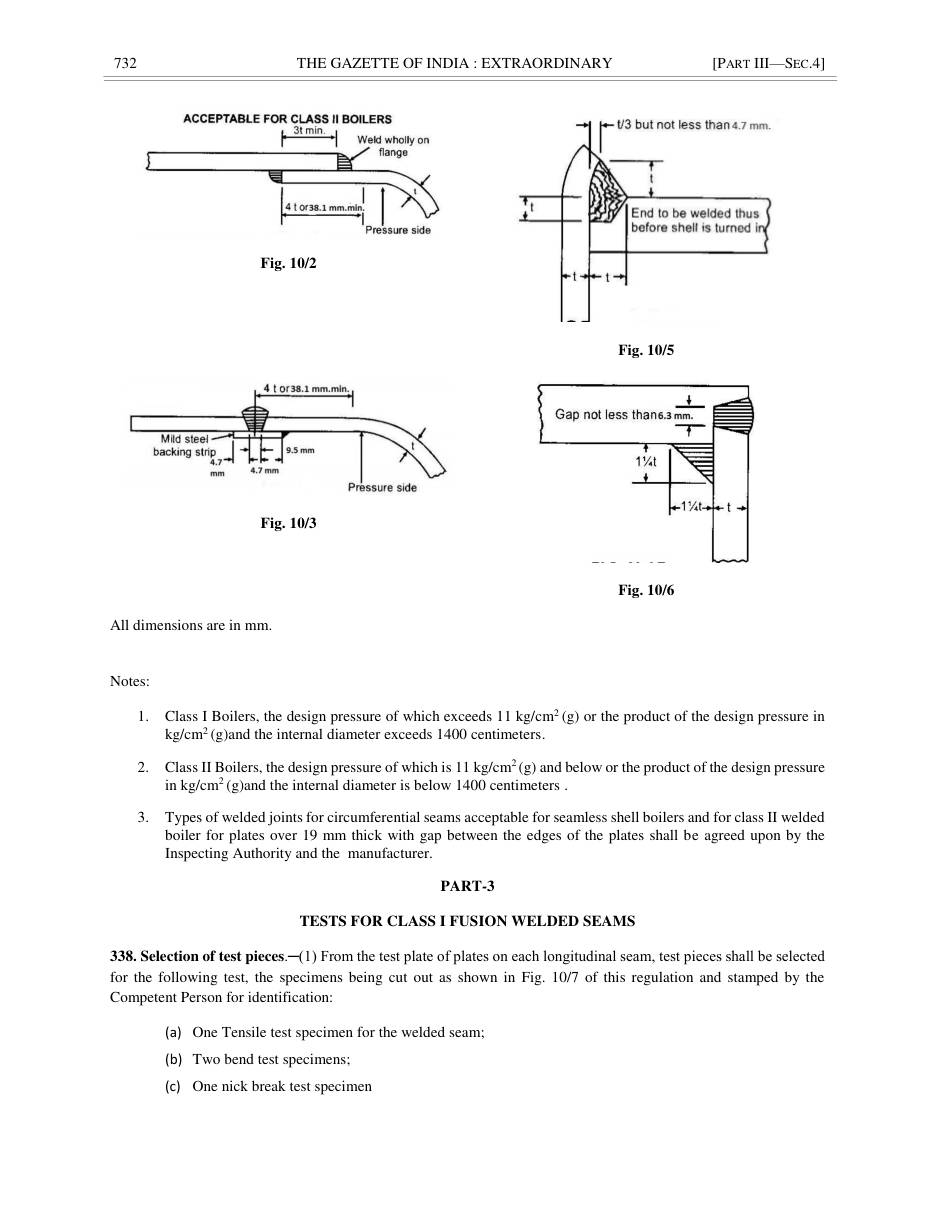
(d)The longitudinal seam shall comply with regulation 152 and for end plate connections by welding, any of the following types of seams may be adopted (see Figs. 10/1 to 10/6 of this regulation).
TYPES OF WELDED JOINTS FOR
CIRCUMFERENTIAL SEAMS – ACCEPTABLE
FOR ALL CLASSES OF BOILERS
Fig. 10/1 Fig. 10/4
TYPES OF WELDED JOINTS FOR FLAT END
PLATES FOR CLASS II BOILERS NOT
EXCEEDING 508 MM DIAMETER
Fig. 10/2
Fig. 10/5
Fig. 10/3
Fig. 10/6
All dimensions are in mm.
Notes:
1. Class I Boilers, the design pressure of which exceeds 11 kg/cm2 (g) or the product of the design pressure in kg/cm2 (g)and the internal diameter exceeds 1400 centimeters.
2. Class II Boilers, the design pressure of which is 11 kg/cm2 (g) and below or the product of the design pressure in kg/cm2 (g)and the internal diameter is below 1400 centimeters .
3. Types of welded joints for circumferential seams acceptable for seamless shell boilers and for class II welded boiler for plates over 19 mm thick with gap between the edges of the plates shall be agreed upon by the Inspecting Authority and the manufacturer.
Parts of this extracted text look garbled; read the Gazette page before using any value.
Tables and formulae are shown in their extracted layout. Alignment, superscripts and subscripts may be lost. The Gazette page image is authoritative.
Figures cited in this regulation (6, exact crops of the Gazette)
View Gazette page 731 · figure catalogue
Reconstructed CAD: DXF · SVG · Preview (redrawn, checked against the print; technical review pending)
View Gazette page 732 · figure catalogue
Reconstructed CAD: DXF · SVG · Preview (redrawn, checked against the print; technical review pending)
View Gazette page 732 · figure catalogue
Reconstructed CAD: DXF · SVG · Preview (redrawn, checked against the print; technical review pending)
View Gazette page 731 · figure catalogue
Reconstructed CAD: DXF · SVG · Preview (redrawn, checked against the print; technical review pending)
View Gazette page 732 · figure catalogue
Reconstructed CAD: DXF · SVG · Preview (redrawn, checked against the print; technical review pending)
View Gazette page 732 · figure catalogue
Reconstructed CAD: DXF · SVG · Preview (redrawn, checked against the print; technical review pending)
In short
Construction and workmanship of fusion welded electrode boilers must follow the provisions of Chapter-4 for fusion welded drums, with conditions that depend on whether the boiler is Class I or Class II.
Key points
- (a) Class I boilers comply with Chapter-4.
- (b) For welded end plate connections, the seam in Fig. 10/1 may be used.
- (c)–(d) Class II boilers: the longitudinal seam must comply with regulation 152, and any of the seam types in Figs. 10/1 to 10/6 may be used for welded end plate connections.
- The figures show circumferential seam joints acceptable for all classes, and flat end plate joints for Class II boilers not exceeding 508 mm diameter. Check the Gazette page for the joint details.
- Class I means a design pressure over 11 kg/cm2 (g), or a product of design pressure in kg/cm2 (g) and internal diameter over 1400 centimeters. Class II means 11 kg/cm2 (g) and below, or that product below 1400 centimeters. Read together, a boiler is Class I if either limit is exceeded, so the printed "or" in the Class II note works as "and": both limits must be met for Class II.
Watch out
- Circumferential seam joints for seamless shell boilers, and for Class II welded boilers with plates over 19 mm thick with a gap between plate edges, must be agreed between the Inspecting Authority and the manufacturer.
Written by IBRsource editors · last edited 2026-11-20. Explanations simplify and are not a design method, testing procedure or authorisation. Requirements come from the complete regulations, the Gazette and approved documentation.
Comparison pending: the IBR 1950 text in force on 30 September 2026 is not yet established for this provision, so no change is claimed (how this works).
Orientation hints (unverified)
These candidates come from automated heading matching against DPIIT's scanned historical print edition of IBR 1950. That edition uses imperial units and riveted-construction provisions, so it is not the operative 2026 predecessor text. Regulation numbers alone never prove equivalence.
| Historical 1950-edition reg. | Heading as OCR'd | Heading similarity | Source image |
|---|---|---|---|
| 416 | Construction and Workmanship | 100% | Chapter X (DPIIT scan), image 5 |
| 624 | Construction and Workmanship | 100% | Chapter XV (DPIIT scan), image 1 |
Amendment history of the candidate IBR 1950 regulations: Reg. 624 (1 amendment)
IBR 1950 regulation 416 as last published in the DPIIT web edition (archived 2022)
Unofficial archived copy, not verified; see the regulation 416 page for its amendments.
| Reg. 413, Reg. 414, Reg. 415, Reg. 416
Reg. 414
Reg. 415
Reg. 416
|
IBR 1950 regulation 624 as last published in the DPIIT web edition (archived 2022)
Unofficial archived copy, not verified; see the regulation 624 page for its amendments.
| Reg. 623, Reg. 624, Reg. 625 | |||||||||||
Reg. 624 Requirements
Reg. 625 Sampling Sampling shall be done following general directions given in 2 of IS:3025-1964*. In particular, the following points shall be observed :
| |||||||||||
Images of the official Gazette pages that contain this regulation. Click to zoom. Compare word by word before relying on the extracted text.
Indian Boiler Regulations, 2026, reg. 337, Regulation 337, Gazette of India, Extraordinary, Part III—Section 4, No. 596, 1 October 2026, printed p.731–732. https://egazette.gov.in/WriteReadData/2026/276813.pdf (text consulted via IBRsource, 2026-11-23).
The citation refers to the government publication. Cite the Gazette, not this website.