BETAIndependent engineering reference. Source-text verification is ongoing.Verification ongoing.Verification status →
IBRsourceIndian Boiler Regulations, made clear

Indian Boiler Regulations, 2026 · Chapter 16 · Heat Exchangers and Pressure Vessels

Regulation 575. Tube plates

Official text — not yet verifiedGazette 1 Oct 2026 · printed p. 862

Not yet checked against the official Gazette; verify before relying on it.

Reproduced from the Gazette of India · verification status above

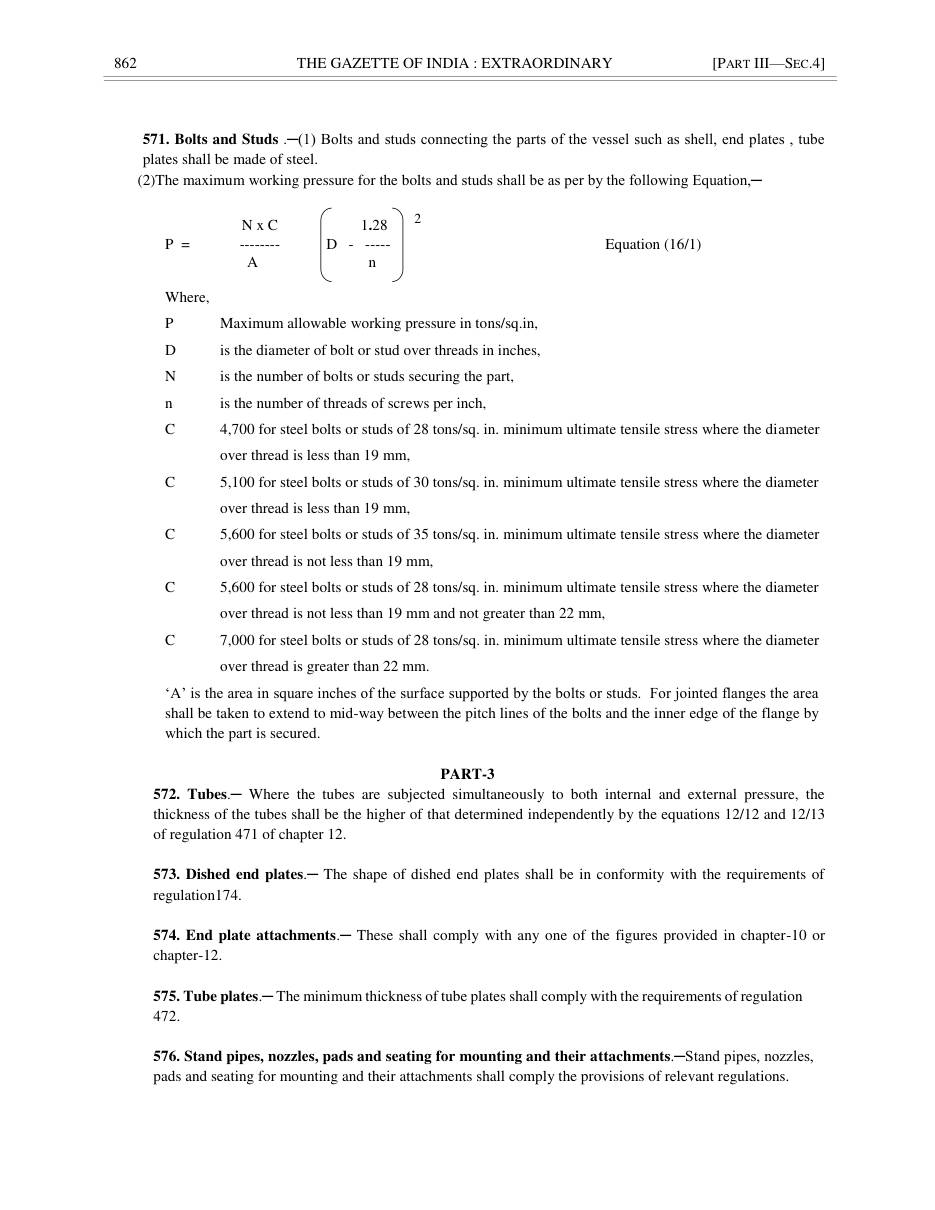
575. Tube plates.─ The minimum thickness of tube plates shall comply with the requirements of regulation

472.

Referenced provisions

Reg. 472

Independent explanation — not the law · draft · engineer review in progress

In short

The minimum thickness of tube plates must comply with the requirements of regulation 472.

Written by IBRsource editors · last edited 2026-11-20. Explanations simplify and are not a design method, testing procedure or authorisation. Requirements come from the complete regulations, the Gazette and approved documentation.

Comparison pending: the IBR 1950 text in force on 30 September 2026 is not yet established for this provision, so no change is claimed (how this works).

Orientation hints (unverified)

These candidates come from automated heading matching against DPIIT's scanned historical print edition of IBR 1950. That edition uses imperial units and riveted-construction provisions, so it is not the operative 2026 predecessor text. Regulation numbers alone never prove equivalence.

Historical 1950-edition reg.Heading as OCR'dHeading similaritySource image
33Plates100%Chapter II (DPIIT scan), image 3
118Tube Plates100%Chapter III (DPIIT scan), image 2
577Parts of flat plates within tube nests100%Chapter XII (DPIIT scan), image 8

Amendment history of the candidate IBR 1950 regulations: Reg. 577 (1 amendment)

IBR 1950 regulation 33 as last published in the DPIIT web edition (archived 2022)

Unofficial archived copy, not verified; see the regulation 33 page for its amendments.

Reg. 33
MATERIALS OF CONSTRUCTION

COPPER PLATES, STAY AND RIVET BARS

Plates

(a) Process.- The copper shall be fire-refined or electrolytic and hot-rolled from suitable cakes.

(b) Chemical Composition.- The chemical composition of the plates shall be as follows:-

Per cent.
Copper 99.2 minimum
Arsenic .30 to .50
Antimony 0.05 maximum
Bismuth 0.05 maximum
Oxygen 0.10 maximum

(c) Freedom from defects.- The plates shall be clean, smooth and free from defects and shall have a workmanlike finish. They shall be thoroughly annealed.

(d) Rolling Margin.- No plate shall be under the specified thickness at any part, not more than 5% over the calculated weight. The scrap margin, partly sheared and left attached, shall be not less than 3 inches at the ends and 1½ inches at each side.

(e) Tensile Tests.- One tensile test shall be taken from each plate as rolled.

The tensile breaking strength, from Standard Test Piece A, shall not be less than 14 tons per sq. inch with an elongation of not less than 35%.

(f) Hot and Cold Bend tests.- One hot (temperature between 1200°F and 1400°F) and one cold bend test shall be taken from each plate as rolled.

For either hot or cold bend tests, the test piece shall withstand being doubled over without fracture until the sides are touching and parallel.

IBR 1950 regulation 118 as last published in the DPIIT web edition (archived 2022)

Unofficial archived copy, not verified; see the regulation 118 page for its amendments.

Reg. 118, Reg. 119, Reg. 120
END PLATES


Tube Plates

Smoke-box tube plates shall be flanged for attachment to the barrel or shall be flat and connected thereto by an external riveted angle ring.

Reg. 119
END PLATES


Parts of flat tube plates within the tube nests

a) where the total area of all tube nests in directly fired multi-tubular boilers exceeds 7 sq. ft., stay tubes shall be fitted.

Where the total number of tubes in horizontal multitubular waste heat boilers and direct fired loco type boilers is arranged in one next, the area of which exceed 21 sq. ft., stay tubes shall be fitted.

In all cases where the total number of tubes is arranged in more than one nest, stay tubes shall be fitted.
b) The parts of tube plates which lie outside the nests of tubes shall be stayed or supported wherever the size of the area of plate subject to steam pressure necessitates staying or support, either by marginal stay tubes or other means.


Reg. 120
END PLATES
Flanging of End Plates

All flanges shall be a good fit to the shell and flues. Flogging and/or hammering in the fitting of these parts is prohibited. The caulking edges of all flanged plates shall be machined or machine gas cut.

IBR 1950 regulation 577 as last published in the DPIIT web edition (archived 2022)

Unofficial archived copy, not verified; see the regulation 577 page for its amendments.

Reg. 575, Reg. 576, Reg. 577 a, Reg. 577 b


Flat crown plates for vertical boilers

i)

Flat crown plates shall be supported by the uptake and/ or bar stays .
ii) The inside radius of curvature of the flange to the shell or fire box shall be not less than four times the thickness of the plate and in no case less than 63 mm where the plate is flanged for attachment to the uptake, the inside radius of curvature of the flange shall be not less than twice the thickness of the plate and in no case less than 25 mm.
iii) The thickness of flat crown plates shall be determined in accordance with Regulation 574.


Reg. 576

Wide water spaces between and around tube nests

The thickness of plate at wide water spaces shall be calculated as per regulation 574 taking d = (A² + B²)1/2

Where,

A - is width of the wide water space between the tube nests in mm measured from centre to centre of the tubes; and
B - is pitch of the tubes in the boundary rows of the wide water space in mm.


Reg. 577 

Flat tube plates and tube nests

a) Stay tubes and plain tubes

(i) Stay tubes are tubes having a weld depth equal to the nominal tube thickness plus 3 mm as shown typically in figures XII/68A(i) to (iv). These stay tubes are not required within tube nests except when the tube nests comprise tubes which are expanded only as shown typically in figure XII/67A (iii).
(ii) If tube nests comprise plain tubes which are expanded and beaded, expanded and belled as shown typically in figure XII/67A(iv) or expanded and welded (as shown typically in Figs. XII/67A (i) and (ii) ), welded stay tubes (as shown  typically in Figs. XII/67A (i) to (iv)  shall be used in boundary rows in sufficient numbers to carry the flat plate loadings outside the tube area.
(iii) For plain tube and stay tubes exposed to flame or gas temperatures exceeding 600°C, the ends of welded tubes shall be dressed flush with the welds and the ends of the expended tubes shall be as shown in figures XII/67A(iii) and (iv). If not so exposed, the ends of welded tubes shall extended a maximum of 10 mm beyond the weld or, in the case of expanded tubes, the tubes shall project beyond the tube plate up to a maximum of 15 mm.
(iv) Each stay tube shall be designed to carry its due proportion for the load on the plates which it supports. The thickness of stay tubes welded into tube plates shall be such that the axial stress on the thinnest part of the tube does not exceed 70 N/mm².


Reg. 577 b

Parts of flat plates within tube nests

If stay tubes are used within tubes nests, the thickness of the tube plate shall be calculated in accordance with regulation 574.

Images of the official Gazette pages that contain this regulation. Click to zoom. Compare word by word before relying on the extracted text.
Instrument
Indian Boiler Regulations, 2026 (made by the Central Boilers Board under s.40 of the Boilers Act, 2025)
Notification
F.No. P-30014/3/2021-Boiler dated 7 Aug 2026
Published
Gazette of India, Extraordinary, Part III Sec. 4, No. 596, 1 Oct 2026 (CG-DL-E-06102026-276813)
In force
1 Oct 2026 (reg. 1(3): date of publication in the Official Gazette)
Printed Gazette page
862
PDF page index
862 · open official e-Gazette PDF
Extraction
pdftotext layout mode, sequential regulation detector · text hash 1ddc4fa13fc05fbe
Verification
Official text — not yet verified
Amendments checked
None known after 1 Oct 2026 as of build date (not a guarantee). Amendment log
How to cite

Indian Boiler Regulations, 2026, reg. 575, Regulation 575, Gazette of India, Extraordinary, Part III—Section 4, No. 596, 1 October 2026, printed p.862. https://egazette.gov.in/WriteReadData/2026/276813.pdf (text consulted via IBRsource, 2026-11-23).

The citation refers to the government publication. Cite the Gazette, not this website.

Help improve this page

Engineers like you keep IBRsource accurate. Every checked correction or tip helps the next reader.