BETAIndependent engineering reference. Source-text verification is ongoing.Verification ongoing.Verification status →
IBRsourceIndian Boiler Regulations, made clear

Indian Boiler Regulations, 2026 · Chapter 16 · Heat Exchangers and Pressure Vessels

Regulation 572. Tubes

Official text — not yet verifiedGazette 1 Oct 2026 · printed p. 862Formula / symbols

Not yet checked against the official Gazette; verify before relying on it.

Reproduced from the Gazette of India · verification status above

572. Tubes.─ Where the tubes are subjected simultaneously to both internal and external pressure, the thickness of the tubes shall be the higher of that determined independently by the equations 12/12 and 12/13 of regulation 471 of chapter 12.

Tables and formulae are shown in their extracted layout. Alignment, superscripts and subscripts may be lost. The Gazette page image is authoritative.

Referenced provisions

Reg. 471

Independent explanation — not the law · draft · engineer review in progress

In short

Where tubes are under internal and external pressure at the same time, the tube thickness is the higher of the two values found independently from equations 12/12 and 12/13 of regulation 471 in Chapter 12.

Written by IBRsource editors · last edited 2026-11-20. Explanations simplify and are not a design method, testing procedure or authorisation. Requirements come from the complete regulations, the Gazette and approved documentation.

Comparison pending: the IBR 1950 text in force on 30 September 2026 is not yet established for this provision, so no change is claimed (how this works).

Orientation hints (unverified)

These candidates come from automated heading matching against DPIIT's scanned historical print edition of IBR 1950. That edition uses imperial units and riveted-construction provisions, so it is not the operative 2026 predecessor text. Regulation numbers alone never prove equivalence.

Historical 1950-edition reg.Heading as OCR'dHeading similaritySource image
145Steel and Wrought Iron Tubes100%Chapter III (DPIIT scan), image 7
147Screw Threads of Stay Tubes100%Chapter III (DPIIT scan), image 7
212Holding power of plain tubes100%Chapter IV (DPIIT scan), image 9
IBR 1950 regulation 145 as last published in the DPIIT web edition (archived 2022)

Unofficial archived copy, not verified; see the regulation 145 page for its amendments.

Reg. 145, Reg. 146
BOILER TUBES SUBJECT TO EXTERNAL PRESSURE
Steel and Wrought Iron Tubes

Both plain and stay smoke tubes may be made either of wrought iron or steel and may be electric-resistance-welded lap-welded or weldless.


Reg. 146
BOILER TUBES SUBJECT TO EXTERNAL PRESSURE Fitting of Plain Tubes

a) Plain tubes shall be expanded at both ends. The expanding shall be parallel throughout the full thickness of the tube plate. Plain tubes may also be bell-mouthed, beaded, or welded at the gas inlet end.
b) Where stay tubes are not fitted, the ends of the tubes shall be beaded over at the fire box end and beaded or bell-mouthed at the other end. If bell-mouthed the tubes shall protrude not less than ¼ inch beyond the tube plate.
IBR 1950 regulation 147 as last published in the DPIIT web edition (archived 2022)

Unofficial archived copy, not verified; see the regulation 147 page for its amendments.

Reg. 147
STAY TUBES
Screw Threads of Stay Tubes

a) Stay tubes shall be screwed at both ends with continuous threads, and the holes in the tube plates shall be tapped with continuous threads. The pitch of the threads shall not be finer than 11 threads per inch. The stay tubes shall be expanded by roller expanders and not made tight by caulking only.
b) Stay tubes may be attached by welding in which case they shall not be adjacent within the same tube next except in local areas, where not more than two adjacent stay tubes may be attached by welding. The form of attachment shall be such that there is a mechanical hold in addition to the welding, as shown in Figure 9A. On completion of welding the stay tubes shall be lightly re-expanded.
IBR 1950 regulation 212 as last published in the DPIIT web edition (archived 2022)

Unofficial archived copy, not verified; see the regulation 212 page for its amendments.

Reg. 210, Reg. 211, Reg. 212
TUBE PLATES


Parts to be stayed

a) The stiffness of tube plates and pitch of stays within the nests of tubes where stay tubes are required and where marginal stay tubes are required in support of blank spaces adjacent to or between the nests shall be determined by flat plate rules under Regulation 195.
b) Tubes plates within the nests of tubes whether fitted with stay tubes or not shall comply with the requirements of Regulation 211 in regard to thickness and cross section between tubes.


Reg. 211
TUBE PLATES


Minimum thickness and cross-section

To provide a secure attachment for plain tubes in the tube plates the thickness and cross-section of the plate between the tube holes shall be not less than :-

Steel tube plate

.125D + .2 = minimum thickness in inches Eqn.(47)

.17 + .025 = minimum cross section in square inches Eqn.(48)

Copper tube plate,

.2D + .4 = minimum thickness in inches Eqn.(49)

.527D - .263 = minimum cross section in square inches Eqn.(50)

D is the diameter in inches of the tube at the part of attachment to tube plate.

Where the thickness and cross-section of the tube plates are less than the minimum the appropriate co-efficient in Eqn.(51) shall be reduced in proportion to the deficit.

Reg. 212
TUBE PLATES


Holding power of plain tubes

a) Where tube plates are not specially stayed in nests of tubes the working pressure, based on the holding power of the tubes shall not exceed that found by the following formula ; -
W.P. = C x D Eqn.(51)
A

Where
D = the diameter of tube at the part of attachment to tube plate in inches,

A = the area in square inches of the tube plate supported by each tube which generally may be taken as the product of the horizontal and vertical pitches of the tube less the area of the tube itself.

C = 470 for tubes expanded into parallel holes in steel or iron tube plates,

C = 530 for tubes expanded into taper holes in steel or iron tube plates.

For copper tube plates or copper or brass tubes the appropriate co-efficient should be deducted 20 percent.

b) In the unstayed tube plates of locotype boilers and in other tube plate in which stay tubes are not required the support afforded by the plain tube shall not be taken to extend beyond the lines enclosing the outer edges of the tubes. Parts of flat plate outside this line shall either lie in the plate margin or be separately supported. No account need be taken of the stiffness of tube plate in the nests of tubes when the above conditions are fulfilled.

Ordinarily the requirements of this clause are applicable only to expanded smoke and water tubes in flat continuous tube plates containing more than one row of tubes

(See Reg. 152 for attachment of tubes in Water Tubes Boilers).

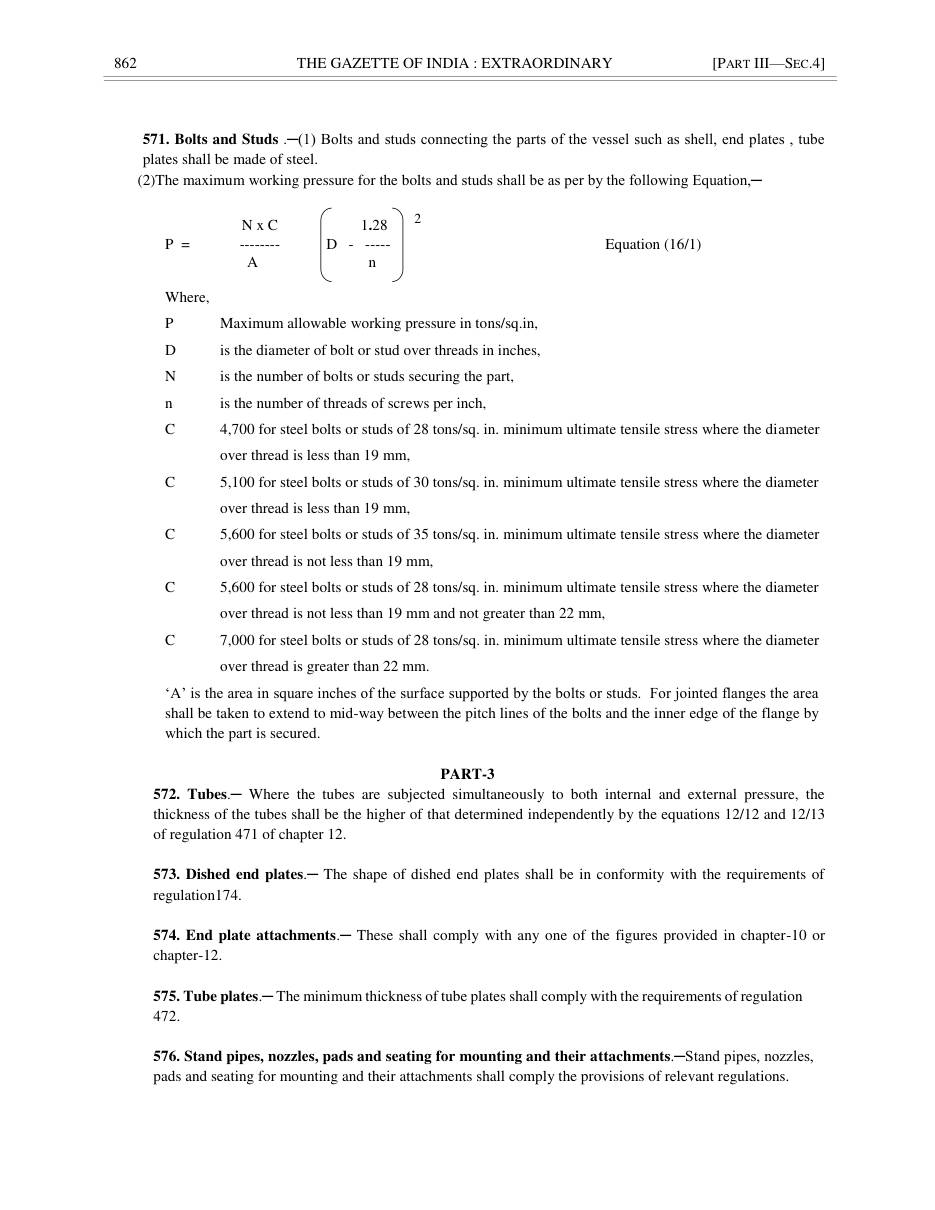
Images of the official Gazette pages that contain this regulation. Click to zoom. Compare word by word before relying on the extracted text.
Instrument
Indian Boiler Regulations, 2026 (made by the Central Boilers Board under s.40 of the Boilers Act, 2025)
Notification
F.No. P-30014/3/2021-Boiler dated 7 Aug 2026
Published
Gazette of India, Extraordinary, Part III Sec. 4, No. 596, 1 Oct 2026 (CG-DL-E-06102026-276813)
In force
1 Oct 2026 (reg. 1(3): date of publication in the Official Gazette)
Printed Gazette page
862
PDF page index
862 · open official e-Gazette PDF
Extraction
pdftotext layout mode, sequential regulation detector · text hash 76f466d4031b8bde
Verification
Official text — not yet verified
Amendments checked
None known after 1 Oct 2026 as of build date (not a guarantee). Amendment log
How to cite

Indian Boiler Regulations, 2026, reg. 572, Regulation 572, Gazette of India, Extraordinary, Part III—Section 4, No. 596, 1 October 2026, printed p.862. https://egazette.gov.in/WriteReadData/2026/276813.pdf (text consulted via IBRsource, 2026-11-23).

The citation refers to the government publication. Cite the Gazette, not this website.

Help improve this page

Engineers like you keep IBRsource accurate. Every checked correction or tip helps the next reader.