
Indian Boiler Regulations, 2026 · Chapter 16 · Heat Exchangers and Pressure Vessels
Regulation 583. Acceptance criteria for macro-examination
Not yet checked against the official Gazette; verify before relying on it.
583. Acceptance criteria for macro-examination.─ (1) The mock up welds shall be sectioned through the center of the tube for macro‐examination.
(2)The four exposed surfaces shall be smoothed and etched with a suitable etchant to give a clear definition of the weld and heat‐affected zone.
(3)Using a magnification of 10X to 20X, the exposed cross sections of the weld shall conform to as under;-
(i)minimum leak path dimension required by the design;
(ii)no cracking;
(iii)complete fusion of the weld deposit into the tube-sheet and tube wall face;
(iv)complete penetration of the weld deposit to within 0.4 mm of the root of the joint; and
(v)porosity shall not reduce the weld throat below the required minimum leak path thickness.
In short
The final test on the mock-up welds is a macro-examination of sections cut through the centre of the tube, examined at 10X to 20X magnification.
Key points
- (1) Each mock-up weld is sectioned through the centre of the tube.
- (2) The four exposed surfaces are smoothed and etched with a suitable etchant so that the weld and heat-affected zone are clearly defined.
- (3) The exposed cross sections must show:
- (i) the minimum leak path dimension required by the design;
- (ii) no cracking;
- (iii) complete fusion of the weld deposit into the tube-sheet and tube wall face;
- (iv) complete penetration of the weld deposit to within 0.4 mm of the root of the joint;
- (v) no porosity that reduces the weld throat below the required minimum leak path thickness.
Written by IBRsource editors · last edited 2026-11-20. Explanations simplify and are not a design method, testing procedure or authorisation. Requirements come from the complete regulations, the Gazette and approved documentation.
Comparison pending: the IBR 1950 text in force on 30 September 2026 is not yet established for this provision, so no change is claimed (how this works).
Orientation hints (unverified)
These candidates come from automated heading matching against DPIIT's scanned historical print edition of IBR 1950. That edition uses imperial units and riveted-construction provisions, so it is not the operative 2026 predecessor text. Regulation numbers alone never prove equivalence.
No candidate heading found in the historical print edition.
Images of the official Gazette pages that contain this regulation. Click to zoom. Compare word by word before relying on the extracted text.
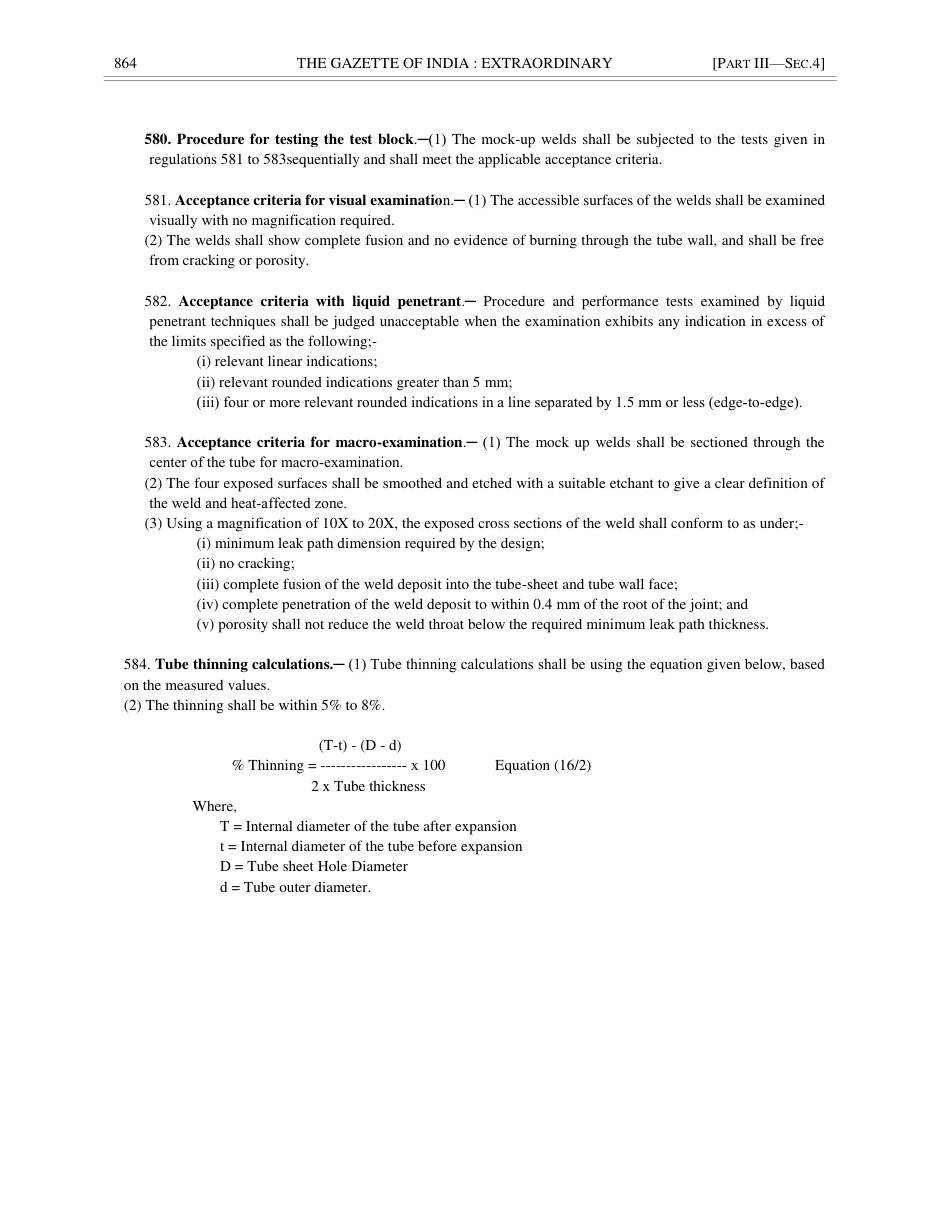
Indian Boiler Regulations, 2026, reg. 583, Regulation 583, Gazette of India, Extraordinary, Part III—Section 4, No. 596, 1 October 2026, printed p.864. https://egazette.gov.in/WriteReadData/2026/276813.pdf (text consulted via IBRsource, 2026-11-23).
The citation refers to the government publication. Cite the Gazette, not this website.