
Indian Boiler Regulations, 2026 · Chapter 13 · Qualification Tests for Welders and Welding Operators
Regulation 520. Essential variables for welder or welding operator requalification
Not yet checked against the official Gazette; verify before relying on it.
520.Essential variables for welder or welding operator requalification. ─ A welder or welding operator shall require requalification whenever a change is made in one of the following essential variables, namely:-.
(i)An omission of backing- A welder or welding operator needs requalification when the backing is removed and double‐welded groove welds are considered welding with backing.
(ii)An addition of the backing in gas welding - A welder or welding operator shall require requalification when the backing is introduced in gas welding process.
(iii)A change in U number of electrode - A welder shall require requalification when the consumable group designation is changed from one U number to other U number (refer Table 13/5 & Table 13/6 of this regulation).
(iv)A change in the base metal (M number) to be welded - A welder shall require requalification when the base metal is changed (refer Table 2/1 in Chapter-2 and Table13/7 in this Chapter). However, a welder who is qualified in a higher grade of steel shall be permitted to weld a lower grade of steel.
(v)A change from one welding process to any other process - A welder shall require requalification when the welding process is changed.
(vi)A change from direct current to alternating current, and vice versa - A welder shall require requalification when the current type is changed from ‘dc’ to ‘ac’ and vice versa.
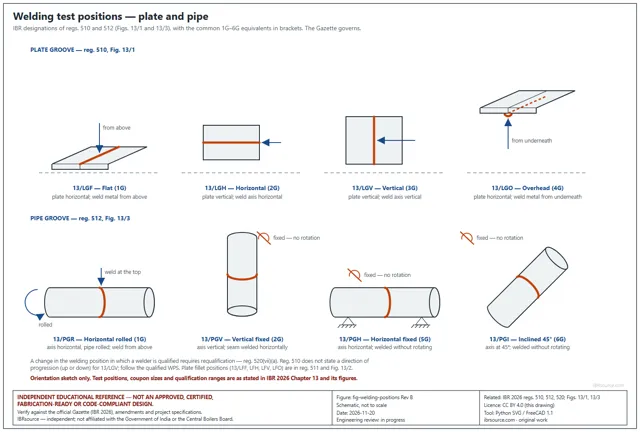
(vii)A change in welding position –(a) A welder shall require requalification when the position in which he is qualified is changed.
Parts of this extracted text look garbled; read the Gazette page before using any value.
Tables and formulae are shown in their extracted layout. Alignment, superscripts and subscripts may be lost. The Gazette page image is authoritative.
In short
A welder or welding operator must requalify whenever one of the essential variables listed here changes.
Key points
- (i) Backing omitted. Double-welded groove welds count as welding with backing.
- (ii) Backing added in gas welding.
- (iii) U number of the electrode changed, meaning the consumable group moves from one U number to another (Tables 13/5 and 13/6; see regulation 509).
- (iv) Base metal (M number) changed (Table 2/1 in Chapter 2 and Table 13/7). A welder qualified on a higher grade of steel may weld a lower grade.
- (v) Welding process changed.
- (vi) Current type changed, from dc to ac or the other way.
- (vii) Welding position changed from the one he is qualified in.
Watch out
- Clause (vii) appears to continue beyond item (a) in the source. Check the Gazette page for the full text.
Written by IBRsource editors · last edited 2026-11-20. Explanations simplify and are not a design method, testing procedure or authorisation. Requirements come from the complete regulations, the Gazette and approved documentation.
Original drawings for this regulation
Comparison pending: the IBR 1950 text in force on 30 September 2026 is not yet established for this provision, so no change is claimed (how this works).
Orientation hints (unverified)
These candidates come from automated heading matching against DPIIT's scanned historical print edition of IBR 1950. That edition uses imperial units and riveted-construction provisions, so it is not the operative 2026 predecessor text. Regulation numbers alone never prove equivalence.
| Historical 1950-edition reg. | Heading as OCR'd | Heading similarity | Source image |
|---|---|---|---|
| 8 | Welding | 100% | Chapter I (DPIIT scan), image 3 |
| 610 | Tests for Requalification | 86% | Chapter XIII (DPIIT scan), image 3 |
Amendment history of the candidate IBR 1950 regulations: Reg. 8 (2 amendments)
IBR 1950 regulation 8 as last published in the DPIIT web edition (archived 2022)
Unofficial archived copy, not verified; see the regulation 8 page for its amendments.
| Reg. 8 Welding:- |
| (a) The use of welding in the construction of boilers shall be permitted only where specifically provided for in the standard conditions. |
IBR 1950 regulation 610 as last published in the DPIIT web edition (archived 2022)
Unofficial archived copy, not verified; see the regulation 610 page for its amendments.
| Reg. 610, Reg. 611 A, Reg. 611 B Reg 610 Tests for Requalification | |||||||||||||||||||||||||||||||||||||||||||
Reg. 611 Examination of test specimens for initial qualification tests:- (a) Groove welded plate specimens
(b) Fillet welded plate specimens.-
| |||||||||||||||||||||||||||||||||||||||||||
Images of the official Gazette pages that contain this regulation. Click to zoom. Compare word by word before relying on the extracted text.
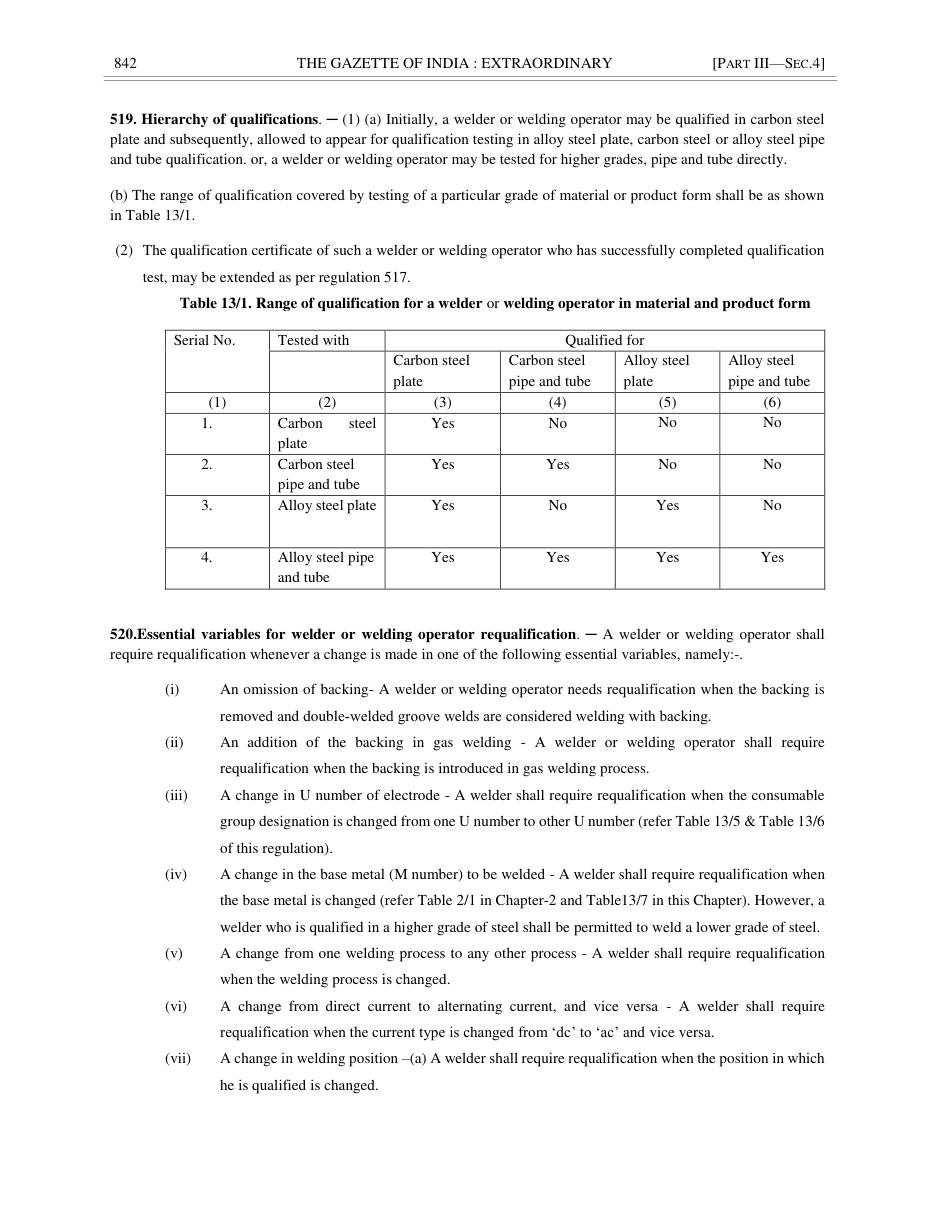
Indian Boiler Regulations, 2026, reg. 520, Regulation 520, Gazette of India, Extraordinary, Part III—Section 4, No. 596, 1 October 2026, printed p.842. https://egazette.gov.in/WriteReadData/2026/276813.pdf (text consulted via IBRsource, 2026-11-23).
The citation refers to the government publication. Cite the Gazette, not this website.