
Indian Boiler Regulations, 2026 · Chapter 13 · Qualification Tests for Welders and Welding Operators
Regulation 529. Fillet welded plate specimens
Not yet checked against the official Gazette; verify before relying on it.
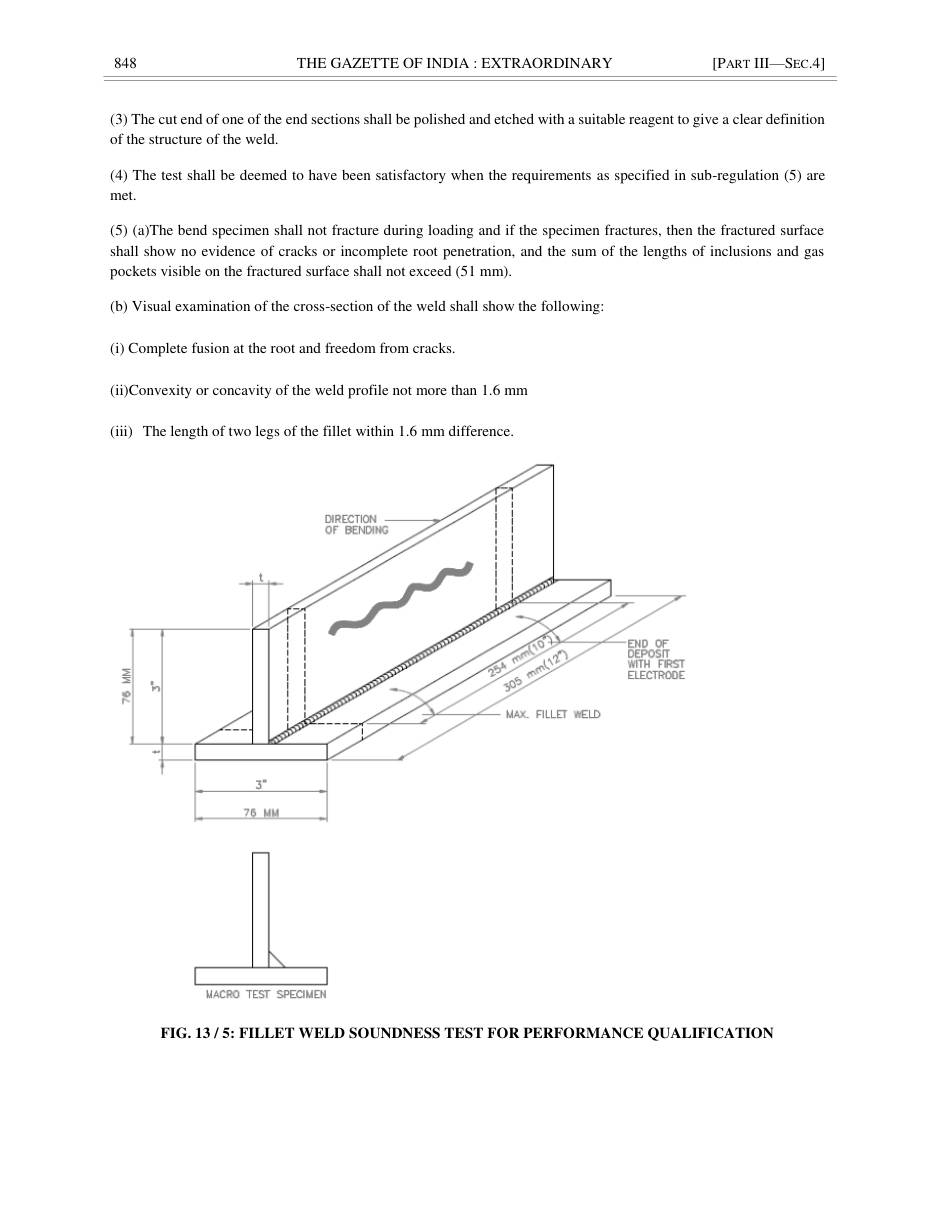
529.Fillet welded plate specimens.─ (1) (a) The preparation of the fillet-weld test specimen shall conform to Fig. 13/5 of chapter 13.
(b)The test specimen shall not contain any visible cracks. It shall be cut transversely to provide a centre section (254 mm) long and two end sections each approximately (25 mm) long.
(2)(a) The centre section shall be loaded laterally in such a way that the root of the weld is in tension.
(b)The load shall be steadily increased until the specimen fractures or bends flat upon itself.
(3)The cut end of one of the end sections shall be polished and etched with a suitable reagent to give a clear definition of the structure of the weld.
(4)The test shall be deemed to have been satisfactory when the requirements as specified in sub-regulation (5) are met.
(5)(a)The bend specimen shall not fracture during loading and if the specimen fractures, then the fractured surface shall show no evidence of cracks or incomplete root penetration, and the sum of the lengths of inclusions and gas pockets visible on the fractured surface shall not exceed (51 mm).
(b)Visual examination of the cross-section of the weld shall show the following:
(i)Complete fusion at the root and freedom from cracks.
(ii)Convexity or concavity of the weld profile not more than 1.6 mm
(iii)The length of two legs of the fillet within 1.6 mm difference.
FIG. 13 / 5: FILLET WELD SOUNDNESS TEST FOR PERFORMANCE QUALIFICATION
In short
Regulation 529 sets how fillet welded plate test specimens are prepared, tested and judged.
Key points
- (1) Prepare the specimen as in Fig. 13/5. It must have no visible cracks. Cut it across into a centre section 254 mm long and two end sections each about 25 mm long.
- (2) Load the centre section sideways with the root of the weld in tension. Increase the load steadily until the specimen fractures or bends flat on itself.
- (3) Polish and etch the cut end of one end section to show the weld structure clearly.
- (5)(a) The bend specimen should not fracture. If it does, the fracture surface must show no cracks or incomplete root penetration, and the visible inclusions and gas pockets must not total more than 51 mm in length.
- (5)(b) The etched cross-section must show:
- complete fusion at the root and no cracks;
- weld profile convexity or concavity not more than 1.6 mm;
- fillet leg lengths within 1.6 mm of each other.
Written by IBRsource editors · last edited 2026-11-20. Explanations simplify and are not a design method, testing procedure or authorisation. Requirements come from the complete regulations, the Gazette and approved documentation.
Comparison pending: the IBR 1950 text in force on 30 September 2026 is not yet established for this provision, so no change is claimed (how this works).
Orientation hints (unverified)
These candidates come from automated heading matching against DPIIT's scanned historical print edition of IBR 1950. That edition uses imperial units and riveted-construction provisions, so it is not the operative 2026 predecessor text. Regulation numbers alone never prove equivalence.
| Historical 1950-edition reg. | Heading as OCR'd | Heading similarity | Source image |
|---|---|---|---|
| 157 | Plate les, | 71% | Chapter III (DPIIT scan), image 10 |
IBR 1950 regulation 157 as last published in the DPIIT web edition (archived 2022)
Unofficial archived copy, not verified; see the regulation 157 page for its amendments.
| Reg. 157 STAND PIPES, PADS ETC. Pressed Plate Saddles |
Images of the official Gazette pages that contain this regulation. Click to zoom. Compare word by word before relying on the extracted text.
Indian Boiler Regulations, 2026, reg. 529, Regulation 529, Gazette of India, Extraordinary, Part III—Section 4, No. 596, 1 October 2026, printed p.847–849. https://egazette.gov.in/WriteReadData/2026/276813.pdf (text consulted via IBRsource, 2026-11-23).
The citation refers to the government publication. Cite the Gazette, not this website.