
Indian Boiler Regulations, 2026 · Chapter 13 · Qualification Tests for Welders and Welding Operators
Regulation 530. Groove and Fillet Welded Pipe and Tube Specimens
Not yet checked against the official Gazette; verify before relying on it.
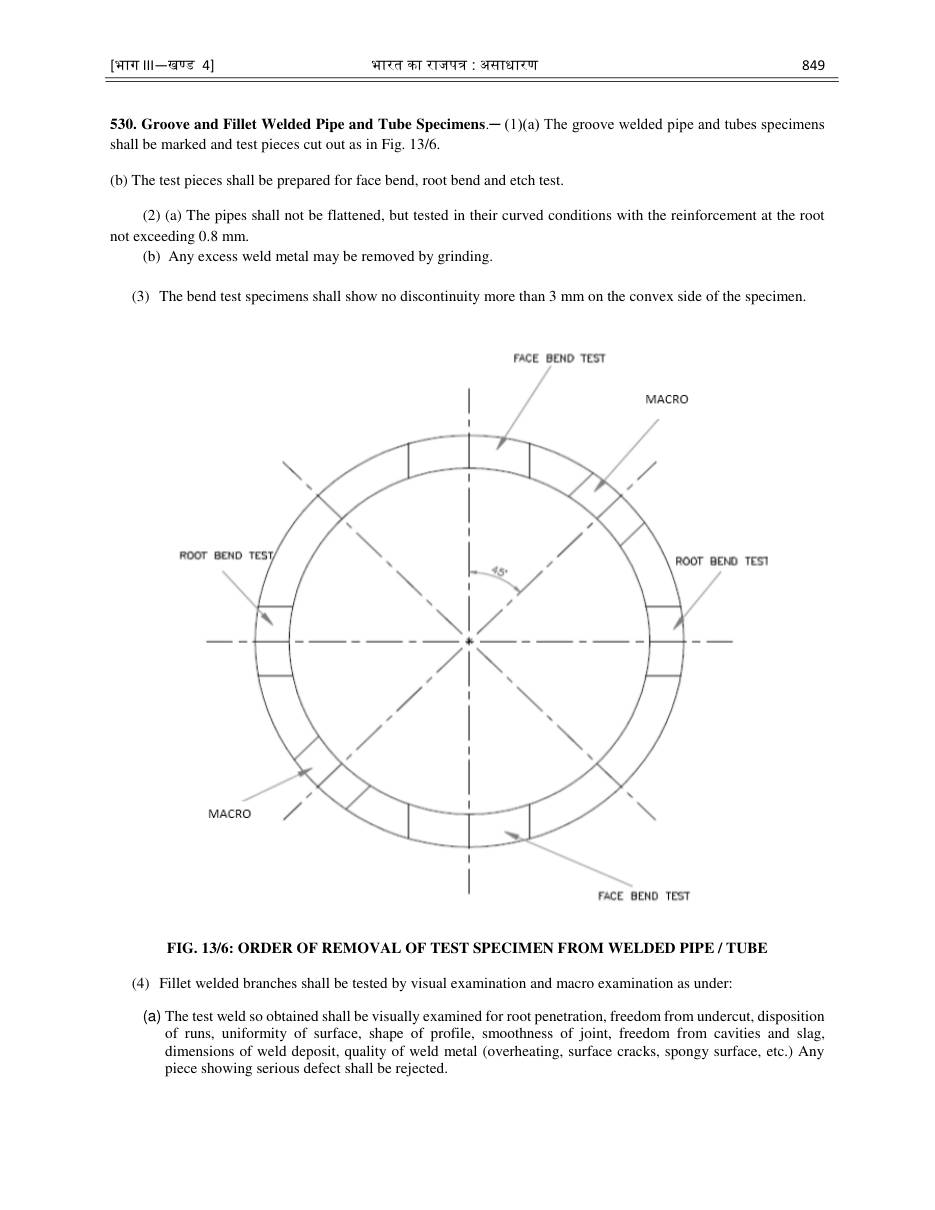
530. Groove and Fillet Welded Pipe and Tube Specimens.─ (1)(a) The groove welded pipe and tubes specimens shall be marked and test pieces cut out as in Fig. 13/6.
(b)The test pieces shall be prepared for face bend, root bend and etch test.
(2)(a) The pipes shall not be flattened, but tested in their curved conditions with the reinforcement at the root not exceeding 0.8 mm.
(b)Any excess weld metal may be removed by grinding.
(3)The bend test specimens shall show no discontinuity more than 3 mm on the convex side of the specimen.
FIG. 13/6: ORDER OF REMOVAL OF TEST SPECIMEN FROM WELDED PIPE / TUBE
(4)Fillet welded branches shall be tested by visual examination and macro examination as under:
(a)The test weld so obtained shall be visually examined for root penetration, freedom from undercut, disposition of runs, uniformity of surface, shape of profile, smoothness of joint, freedom from cavities and slag, dimensions of weld deposit, quality of weld metal (overheating, surface cracks, spongy surface, etc.) Any piece showing serious defect shall be rejected.
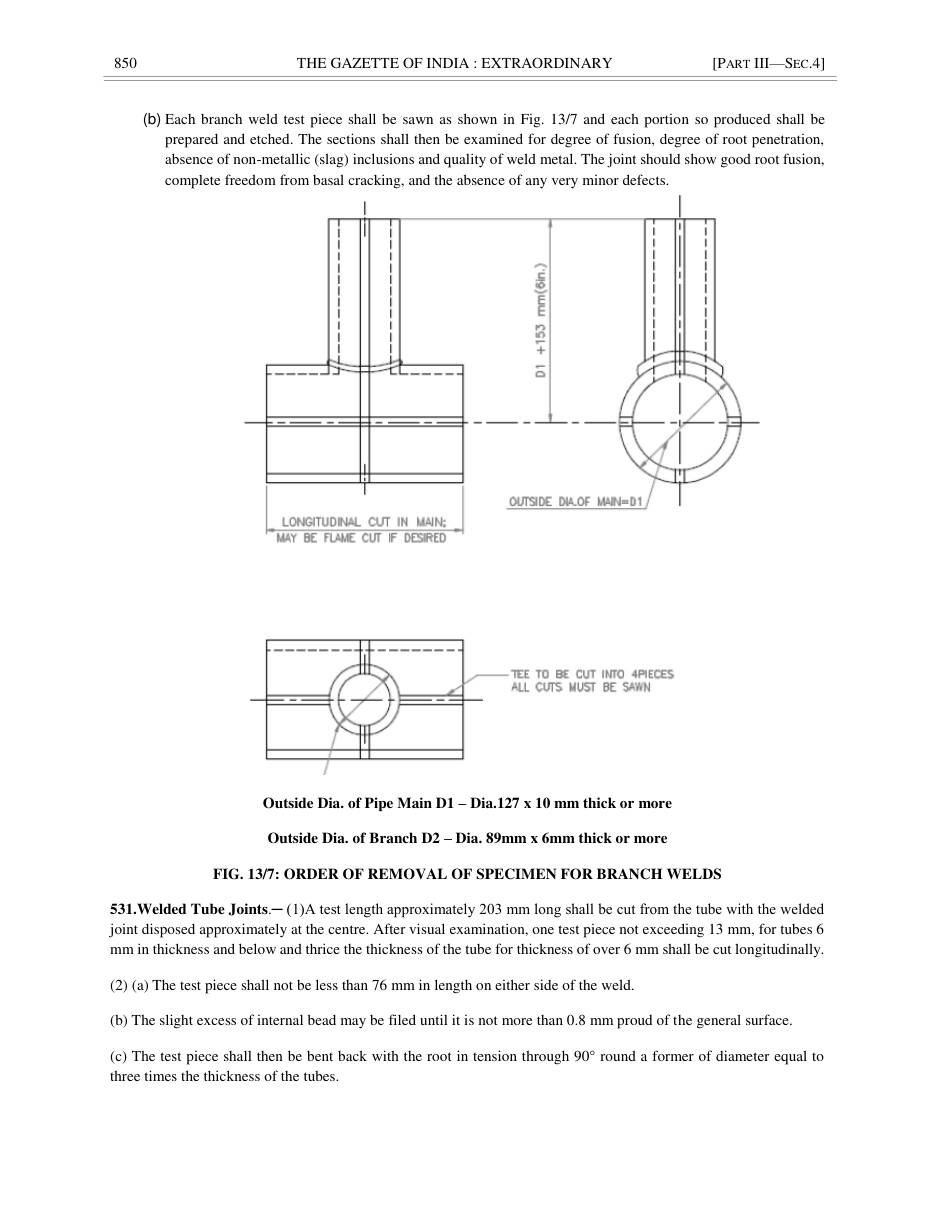
(b)Each branch weld test piece shall be sawn as shown in Fig. 13/7 and each portion so produced shall be prepared and etched. The sections shall then be examined for degree of fusion, degree of root penetration, absence of non-metallic (slag) inclusions and quality of weld metal. The joint should show good root fusion, complete freedom from basal cracking, and the absence of any very minor defects.
Outside Dia. of Pipe Main D1 – Dia.127 x 10 mm thick or more
Outside Dia. of Branch D2 – Dia. 89mm x 6mm thick or more
FIG. 13/7: ORDER OF REMOVAL OF SPECIMEN FOR BRANCH WELDS
In short
Regulation 530 sets how groove welded pipe and tube specimens, and fillet welded branch specimens, are tested.
Key points
- (1) Groove welded pipe and tube specimens are marked and cut as in Fig. 13/6, then prepared for face bend, root bend and etch tests.
- (2) Pipes are not flattened. They are tested curved, with root reinforcement not over 0.8 mm. Excess weld metal may be removed by grinding.
- (3) Bend specimens must show no discontinuity over 3 mm on the convex side.
- (4)(a) Fillet welded branches are checked visually for root penetration, undercut, run layout, surface uniformity, profile, smoothness, cavities and slag, weld size and weld metal quality. Any piece with a serious defect is rejected.
- (4)(b) Each branch weld is sawn as in Fig. 13/7. Each portion is etched and examined for fusion, root penetration, slag inclusions and weld metal quality. The joint should show good root fusion and no basal cracking.
- The Fig. 13/7 caption shows a pipe main of 127 x 10 mm thick or more and a branch of 89 mm x 6 mm thick or more.
Written by IBRsource editors · last edited 2026-11-20. Explanations simplify and are not a design method, testing procedure or authorisation. Requirements come from the complete regulations, the Gazette and approved documentation.
Comparison pending: the IBR 1950 text in force on 30 September 2026 is not yet established for this provision, so no change is claimed (how this works).
Orientation hints (unverified)
These candidates come from automated heading matching against DPIIT's scanned historical print edition of IBR 1950. That edition uses imperial units and riveted-construction provisions, so it is not the operative 2026 predecessor text. Regulation numbers alone never prove equivalence.
No candidate heading found in the historical print edition.
Images of the official Gazette pages that contain this regulation. Click to zoom. Compare word by word before relying on the extracted text.
Indian Boiler Regulations, 2026, reg. 530, Regulation 530, Gazette of India, Extraordinary, Part III—Section 4, No. 596, 1 October 2026, printed p.849–850. https://egazette.gov.in/WriteReadData/2026/276813.pdf (text consulted via IBRsource, 2026-11-23).
The citation refers to the government publication. Cite the Gazette, not this website.