BETAIndependent engineering reference. Source-text verification is ongoing.Verification ongoing.Verification status →
IBRsourceIndian Boiler Regulations, made clear

Indian Boiler Regulations, 2026 · Chapter 6 · Boiler and Superheater Tubes, Headers and Other Parts

Regulation 243. Material and Construction of Tubes

Official text — not yet verifiedGazette 1 Oct 2026 · printed p. 641

Not yet checked against the official Gazette; verify before relying on it.

Reproduced from the Gazette of India · verification status above

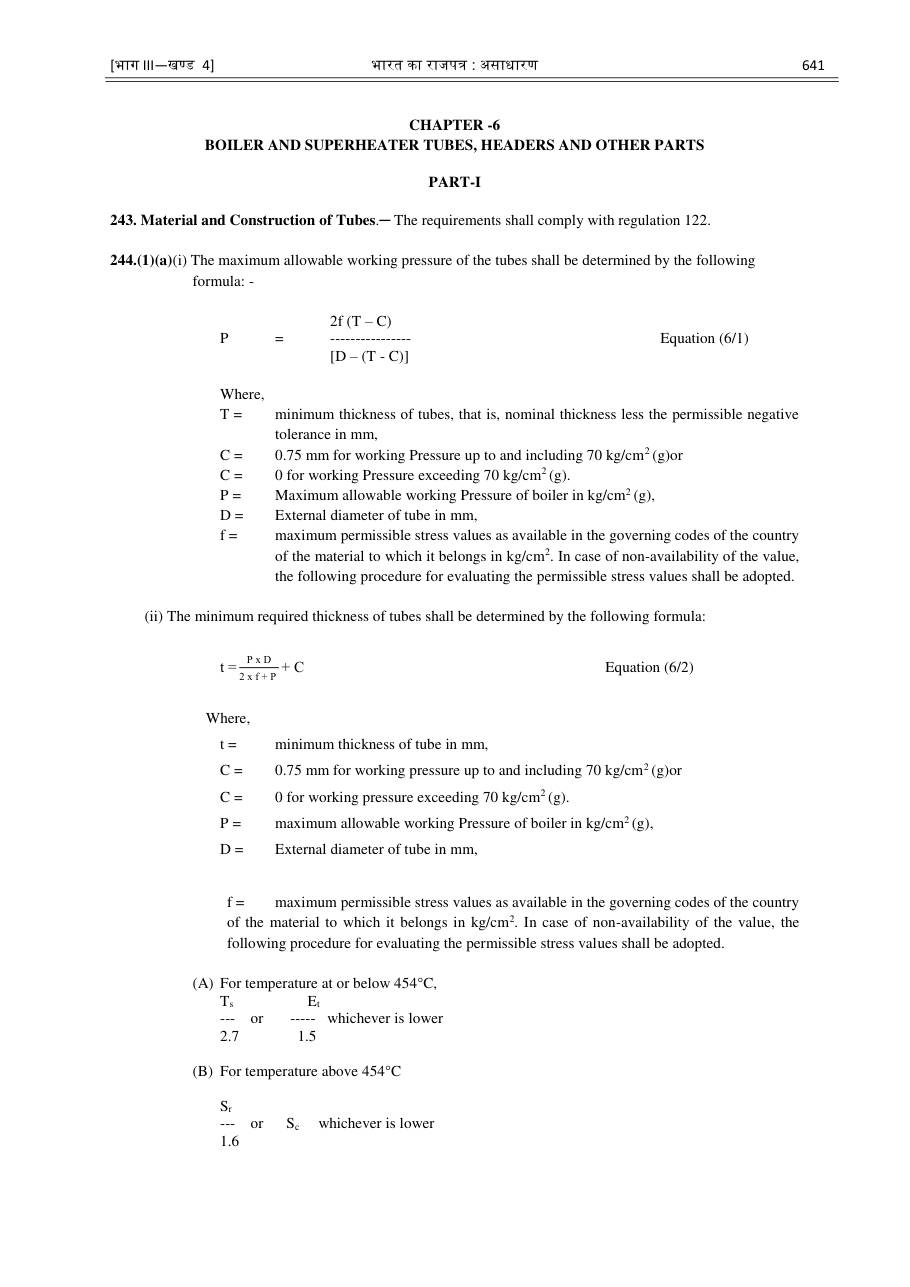
243. Material and Construction of Tubes.─ The requirements shall comply with regulation 122.

Referenced provisions

Reg. 122

Independent explanation — not the law · draft · engineer review in progress

In short

The material and construction of tubes must comply with regulation 122. This regulation adds no separate requirement of its own; read regulation 122 for the detail.

Written by IBRsource editors · last edited 2026-11-20. Explanations simplify and are not a design method, testing procedure or authorisation. Requirements come from the complete regulations, the Gazette and approved documentation.

Comparison pending: the IBR 1950 text in force on 30 September 2026 is not yet established for this provision, so no change is claimed (how this works).

Orientation hints (unverified)

These candidates come from automated heading matching against DPIIT's scanned historical print edition of IBR 1950. That edition uses imperial units and riveted-construction provisions, so it is not the operative 2026 predecessor text. Regulation numbers alone never prove equivalence.

Historical 1950-edition reg.Heading as OCR'dHeading similaritySource image
631Tubes100%Chapter XV (DPIIT scan), image 3
416Construction and Workmanship73%Chapter X (DPIIT scan), image 5
580Pitch of tubes73%Chapter XII (DPIIT scan), image 9
IBR 1950 regulation 416 as last published in the DPIIT web edition (archived 2022)

Unofficial archived copy, not verified; see the regulation 416 page for its amendments.

Reg. 413, Reg. 414, Reg. 415, Reg. 416
RIVETED STEEL BOILERS

Thickness of Angle Rings

Where flange or angle rings are used for pressure purposes in no case shall the thickness after machining be less than 5/16 inch. The thickness shall be as given in Regulation 106.


Reg. 414
RIVETED STEEL BOILERS

Bolts, Nuts and Studs

These shall conform to Regulation 208.


Reg. 415
RIVETED STEEL BOILERS

Hydraulic Test

Each completed boiler shall pass the hydraulic adopted see Fig 44, 45, 46, 47, 48 & 49.


Reg. 416
FUSION WELDED BOILERS

Construction and Workmanship

Construction and workmanship shall comply with the provisions made in Chapter V for fusion welded drums subject to the following conditions, namely:-

Class I boilers shall comply with the requirements of Chapter V.
For end plate connection by welding, the type of steam shown in Figure 44 may be adopted.
Class II boilers shall comply with the following requirements.

The longitudinal seams shall comply with Regulation 253. For end plate connections by welding any of the following types of seams, may be adopted (see Figure 44,45,46,47,48 & 49 ).

Forms of welded joints for circumferential seams acceptable for  for all class of boilers

acceptable For Class II welded boilers

Forms of welded joints for circumferential seams acceptable for seamless shell boilers and for Class II boilers.

For plates over 3/4 inch thick, width of gap between the edges of the plates to be agreed upon by inspecting authority & manufacturer.

Forms of welded joints for circumferential seams acceptable for seamless shell boilers and for Class II boilers.

FORMS OF WELDED JOINTS FOR FLAT END PLATES FOR CLASS II BOILERS NOT EXCEEDING 20 INCH DIAMETER.

Class I Boilers, the working pressure of which exceeds 165 lbs./ sq. in. or the product of the working pressure in pounds per square inch and the internal diameter in inches exceeds 8250.

Class II Boilers, the working pressure of which is 165 lbs./sq. in. and below or the product of the working pressure in pounds per square inch and the internal diameter in inches is below 8250.

IBR 1950 regulation 580 as last published in the DPIIT web edition (archived 2022)

Unofficial archived copy, not verified; see the regulation 580 page for its amendments.

Reg. 580, Reg. 581

Pitch of tubes

The spacing of tube holes shall be such that the minimum width in inches of any ligament between the tube holes shall be not less than:-

D + ½
8

alternatively,

the thickness and cross-section of the plate between the tube holes shall be not less than

0.125D+0.2=minimum thickness in inches.
0.17D+0.025=minimum cross-section in square inches where D is diameter of the tube holes in inches.

In no case shall the minimum thickness of any tube plate in the tube area be less than the following limits:-

T=1/2 inch, Where the diameter of the tube holes does not exceed 2 inches.
T=9/16 inch, Where the diameter of the tube hole is greater than 2 inches.


Reg. 581

Stay tubes

Stay tubes shall be of steel seamless or electrically resistance welded.
a) Minimum thickness of stay tubes – The minimum thickness of stay tubes shall be as per regulation 148.
b) The maximum working pressure for screwed in stay tube shall be calculated by the following formula:

WP = 5900         1.28
[(D---------------/N )² - D1²]
Equation XII/16
A

D is diameter of the stay tube over threads in inches.
D1 is internal diameter of the tubes under the threads in inches.
N is number of threads per inch.

A is the area in square inches supported by one Stay tube, measured from centre to centre of stay tubes. When the area contains tubes or parts of tubes their aggregate area, calculated from their smallest external diameter of body when in tension and smallest internal diameter when in compression, shall be deducted from the area of the containing figure and the remainder used as A in the formula.

Where stay tubes have their thickness increased at the screwed, ends to provide for plus threads the increased thickness shall be obtained by up-setting and not by welding, and the tubes shall be subsequently annealed.

Stay tubes may be attached to the tube plates either by screwing or by metal arc welding.

Where stay tubes are screwed into the tube plates they shall be screwed with a continuous thread not finer than 11 threads per inch at both ends and shall be expanded into the tube plates, by roller expander and, if desired, may be seal welded.

Welded attachment of stay tubes be as shown in Figure XII/67,XII/67A,XII/68, ,XII/68A and XII/69.

Images of the official Gazette pages that contain this regulation. Click to zoom. Compare word by word before relying on the extracted text.
Instrument
Indian Boiler Regulations, 2026 (made by the Central Boilers Board under s.40 of the Boilers Act, 2025)
Notification
F.No. P-30014/3/2021-Boiler dated 7 Aug 2026
Published
Gazette of India, Extraordinary, Part III Sec. 4, No. 596, 1 Oct 2026 (CG-DL-E-06102026-276813)
In force
1 Oct 2026 (reg. 1(3): date of publication in the Official Gazette)
Printed Gazette page
641
PDF page index
641 · open official e-Gazette PDF
Extraction
pdftotext layout mode, sequential regulation detector · text hash 231023cd26dc55ca
Verification
Official text — not yet verified
Amendments checked
None known after 1 Oct 2026 as of build date (not a guarantee). Amendment log
How to cite

Indian Boiler Regulations, 2026, reg. 243, Regulation 243, Gazette of India, Extraordinary, Part III—Section 4, No. 596, 1 October 2026, printed p.641. https://egazette.gov.in/WriteReadData/2026/276813.pdf (text consulted via IBRsource, 2026-11-23).

The citation refers to the government publication. Cite the Gazette, not this website.

Help improve this page

Engineers like you keep IBRsource accurate. Every checked correction or tip helps the next reader.