
Indian Boiler Regulations, 2026 · Chapter 14 · Small Industrial Boilers
Regulation 554. Valves, gauges, fittings and feed supply
Not yet checked against the official Gazette; verify before relying on it.
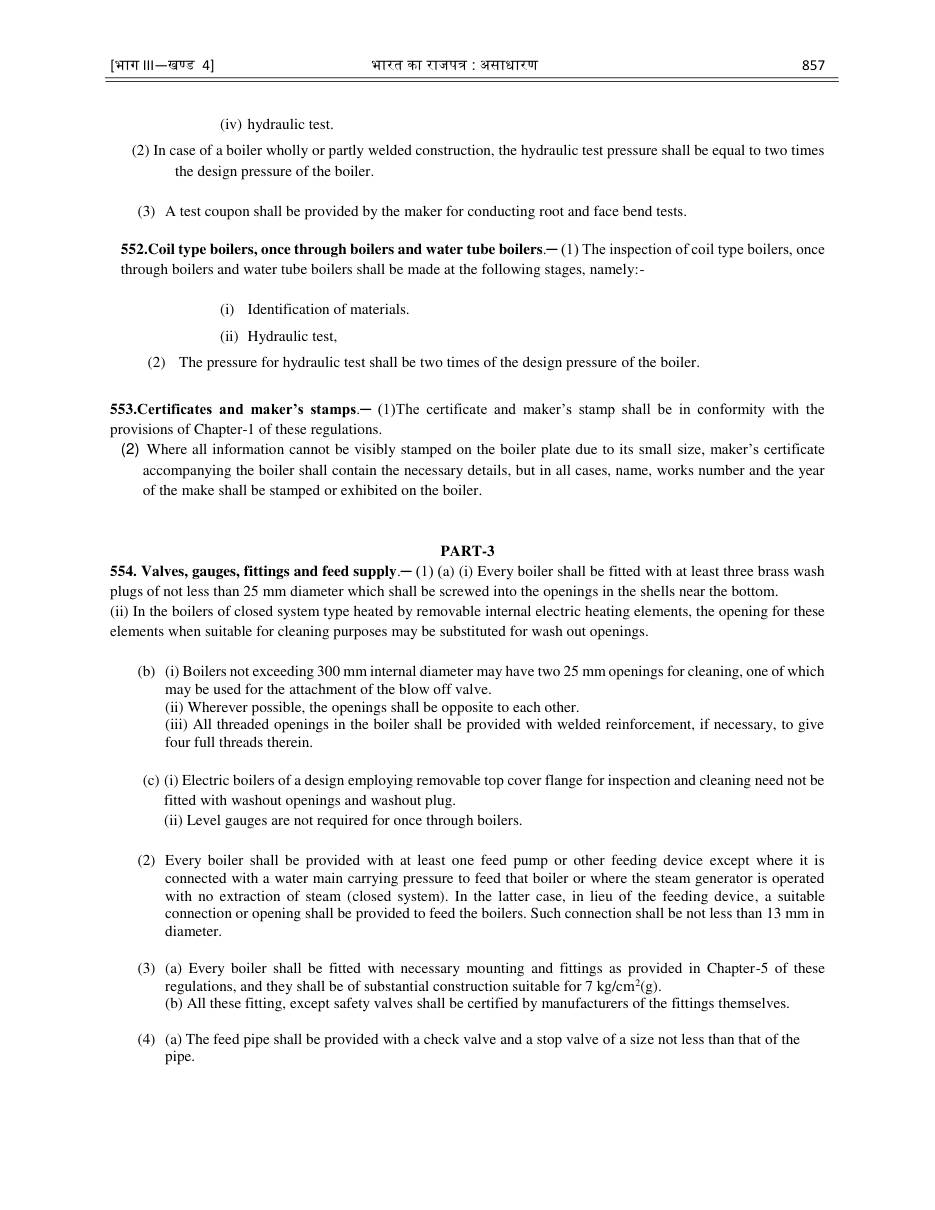
554. Valves, gauges, fittings and feed supply.─ (1) (a) (i) Every boiler shall be fitted with at least three brass wash plugs of not less than 25 mm diameter which shall be screwed into the openings in the shells near the bottom.
(ii)In the boilers of closed system type heated by removable internal electric heating elements, the opening for these elements when suitable for cleaning purposes may be substituted for wash out openings.
(b)(i) Boilers not exceeding 300 mm internal diameter may have two 25 mm openings for cleaning, one of which may be used for the attachment of the blow off valve.
(ii)Wherever possible, the openings shall be opposite to each other.
(iii)All threaded openings in the boiler shall be provided with welded reinforcement, if necessary, to give four full threads therein.
(c)(i) Electric boilers of a design employing removable top cover flange for inspection and cleaning need not be fitted with washout openings and washout plug.
(ii)Level gauges are not required for once through boilers.
(2)Every boiler shall be provided with at least one feed pump or other feeding device except where it is connected with a water main carrying pressure to feed that boiler or where the steam generator is operated with no extraction of steam (closed system). In the latter case, in lieu of the feeding device, a suitable connection or opening shall be provided to feed the boilers. Such connection shall be not less than 13 mm in diameter.
(3)(a) Every boiler shall be fitted with necessary mounting and fittings as provided in Chapter-5 of these regulations, and they shall be of substantial construction suitable for 7 kg/cm2(g).
(b)All these fitting, except safety valves shall be certified by manufacturers of the fittings themselves.
(4)(a) The feed pipe shall be provided with a check valve and a stop valve of a size not less than that of the pipe.
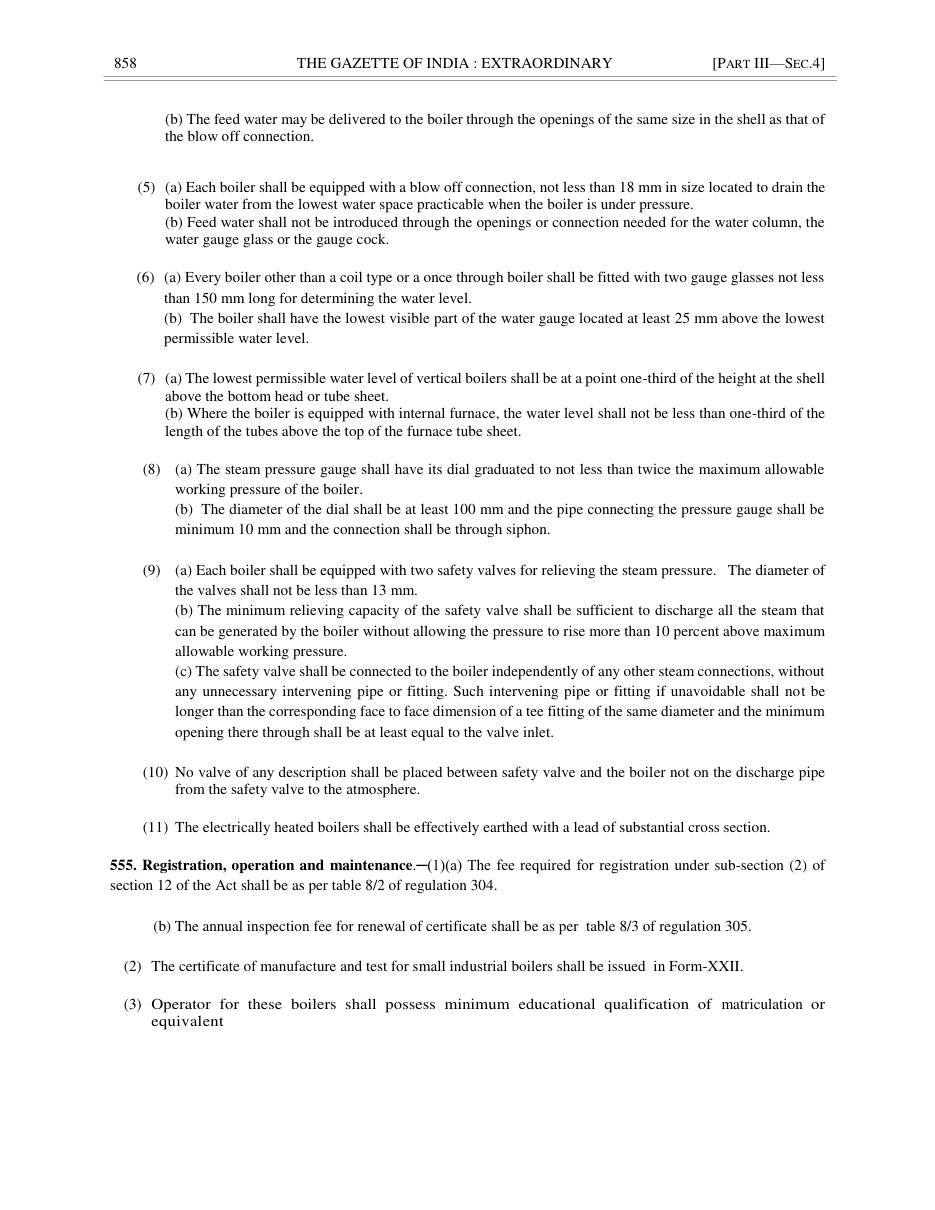
(b)The feed water may be delivered to the boiler through the openings of the same size in the shell as that of the blow off connection.
(5)(a) Each boiler shall be equipped with a blow off connection, not less than 18 mm in size located to drain the boiler water from the lowest water space practicable when the boiler is under pressure.
(b)Feed water shall not be introduced through the openings or connection needed for the water column, the water gauge glass or the gauge cock.
(6)(a) Every boiler other than a coil type or a once through boiler shall be fitted with two gauge glasses not less than 150 mm long for determining the water level.
(b)The boiler shall have the lowest visible part of the water gauge located at least 25 mm above the lowest permissible water level.
(7)(a) The lowest permissible water level of vertical boilers shall be at a point one-third of the height at the shell above the bottom head or tube sheet.
(b)Where the boiler is equipped with internal furnace, the water level shall not be less than one-third of the length of the tubes above the top of the furnace tube sheet.
(8)(a) The steam pressure gauge shall have its dial graduated to not less than twice the maximum allowable working pressure of the boiler.
(b)The diameter of the dial shall be at least 100 mm and the pipe connecting the pressure gauge shall be minimum 10 mm and the connection shall be through siphon.
(9)(a) Each boiler shall be equipped with two safety valves for relieving the steam pressure. The diameter of the valves shall not be less than 13 mm.
(b)The minimum relieving capacity of the safety valve shall be sufficient to discharge all the steam that can be generated by the boiler without allowing the pressure to rise more than 10 percent above maximum allowable working pressure.
(c)The safety valve shall be connected to the boiler independently of any other steam connections, without any unnecessary intervening pipe or fitting. Such intervening pipe or fitting if unavoidable shall not be longer than the corresponding face to face dimension of a tee fitting of the same diameter and the minimum opening there through shall be at least equal to the valve inlet.
(10)No valve of any description shall be placed between safety valve and the boiler not on the discharge pipe from the safety valve to the atmosphere.
(11)The electrically heated boilers shall be effectively earthed with a lead of substantial cross section.
In short
This regulation sets the minimum valves, gauges, fittings and feed arrangements for small industrial boilers, with several relaxations for small, electric, closed-system and once through designs.
Key points
- Wash-out and cleaning openings (1)
- (a)(i) At least three brass wash plugs, not less than 25 mm in diameter, screwed into openings in the shell near the bottom.
- (a)(ii) Closed-system boilers with removable internal electric heating elements may use the element openings for cleaning instead of wash-out openings, if suitable.
- (b) Boilers not exceeding 300 mm internal diameter may have two 25 mm cleaning openings, one of which may take the blow off valve. Openings should be opposite each other wherever possible. Threaded openings get welded reinforcement, if necessary, to give four full threads.
- (c) Electric boilers with a removable top cover flange for inspection and cleaning need no washout openings or plug. Once through boilers need no level gauges.
- Feed (2), (4) At least one feed pump or other feeding device, unless the boiler is fed from a water main carrying pressure, or is a closed system with no steam extraction. A closed system needs a feed connection or opening of not less than 13 mm diameter. The feed pipe needs a check valve and a stop valve no smaller than the pipe. Feed water may enter through openings of the same size as the blow off connection.
- Mountings (3) Mountings and fittings as in Chapter-5, of substantial construction suitable for 7 kg/cm2(g). All except safety valves are certified by their own manufacturers.
- Blow off (5) A blow off connection of not less than 18 mm, draining from the lowest practicable water space under pressure. Feed water must not enter through the water column, gauge glass or gauge cock connections.
- Water level (6), (7) Boilers other than coil type or once through need two gauge glasses not less than 150 mm long. The lowest visible part of the gauge is at least 25 mm above the lowest permissible water level. For vertical boilers that level is one-third of the shell height above the bottom head or tube sheet. With an internal furnace, it is not less than one-third of the tube length above the top of the furnace tube sheet.
- Pressure gauge (8) Dial graduated to not less than twice the maximum allowable working pressure, at least 100 mm in diameter, on a connecting pipe of minimum 10 mm through a siphon.
- Safety valves (9) Two safety valves, each not less than 13 mm in diameter. Together they must discharge all the steam the boiler can generate without the pressure rising more than 10 percent above the maximum allowable working pressure. They connect to the boiler independently of other steam connections. Any unavoidable intervening pipe or fitting is no longer than the face to face dimension of a tee of the same diameter, with an opening at least equal to the valve inlet.
- Earthing (11) Electrically heated boilers must be effectively earthed with a lead of substantial cross section.
Watch out
- (10) No valve of any kind may be placed between the safety valve and the boiler, or on the discharge pipe from the safety valve to the atmosphere.
Written by IBRsource editors · last edited 2026-11-20. Explanations simplify and are not a design method, testing procedure or authorisation. Requirements come from the complete regulations, the Gazette and approved documentation.
Comparison pending: the IBR 1950 text in force on 30 September 2026 is not yet established for this provision, so no change is claimed (how this works).
Orientation hints (unverified)
These candidates come from automated heading matching against DPIIT's scanned historical print edition of IBR 1950. That edition uses imperial units and riveted-construction provisions, so it is not the operative 2026 predecessor text. Regulation numbers alone never prove equivalence.
| Historical 1950-edition reg. | Heading as OCR'd | Heading similarity | Source image |
|---|---|---|---|
| 621 | Valves, Gauges, Fittings and Feed Supply | 100% | Chapter XIV (DPIIT scan), image 2 |
Amendment history of the candidate IBR 1950 regulation: Reg. 621 (3 amendments)
IBR 1950 regulation 621 as last published in the DPIIT web edition (archived 2022)
Unofficial archived copy, not verified; see the regulation 621 page for its amendments.
| Reg. 621, Reg. 622 Small Industrial Boilers General Valves, Gauges, Fittings and Feed Supply | ||||||||||||||||||||||||||||||||||||||||||||||||||||||||||||||
Reg. 622 Registration, Operation and Maintenance
| ||||||||||||||||||||||||||||||||||||||||||||||||||||||||||||||
Images of the official Gazette pages that contain this regulation. Click to zoom. Compare word by word before relying on the extracted text.
Indian Boiler Regulations, 2026, reg. 554, Regulation 554, Gazette of India, Extraordinary, Part III—Section 4, No. 596, 1 October 2026, printed p.857–858. https://egazette.gov.in/WriteReadData/2026/276813.pdf (text consulted via IBRsource, 2026-11-23).
The citation refers to the government publication. Cite the Gazette, not this website.