
Indian Boiler Regulations, 2026 · Chapter 14 · Small Industrial Boilers
Regulation 549. Design, construction, workmanship and method of computing the Maximum Allowable Working Pressure
Not yet checked against the official Gazette; verify before relying on it.
549. Design, construction, workmanship and method of computing the Maximum Allowable Working Pressure.─ (1) (a) The construction except where otherwise specified shall be the same as those provided in the relevant provisions of the preceding chapters of these regulations.
(b)In case of fusion welded boiler, neither stress-relieving nor radiography of welded joints shall be required.
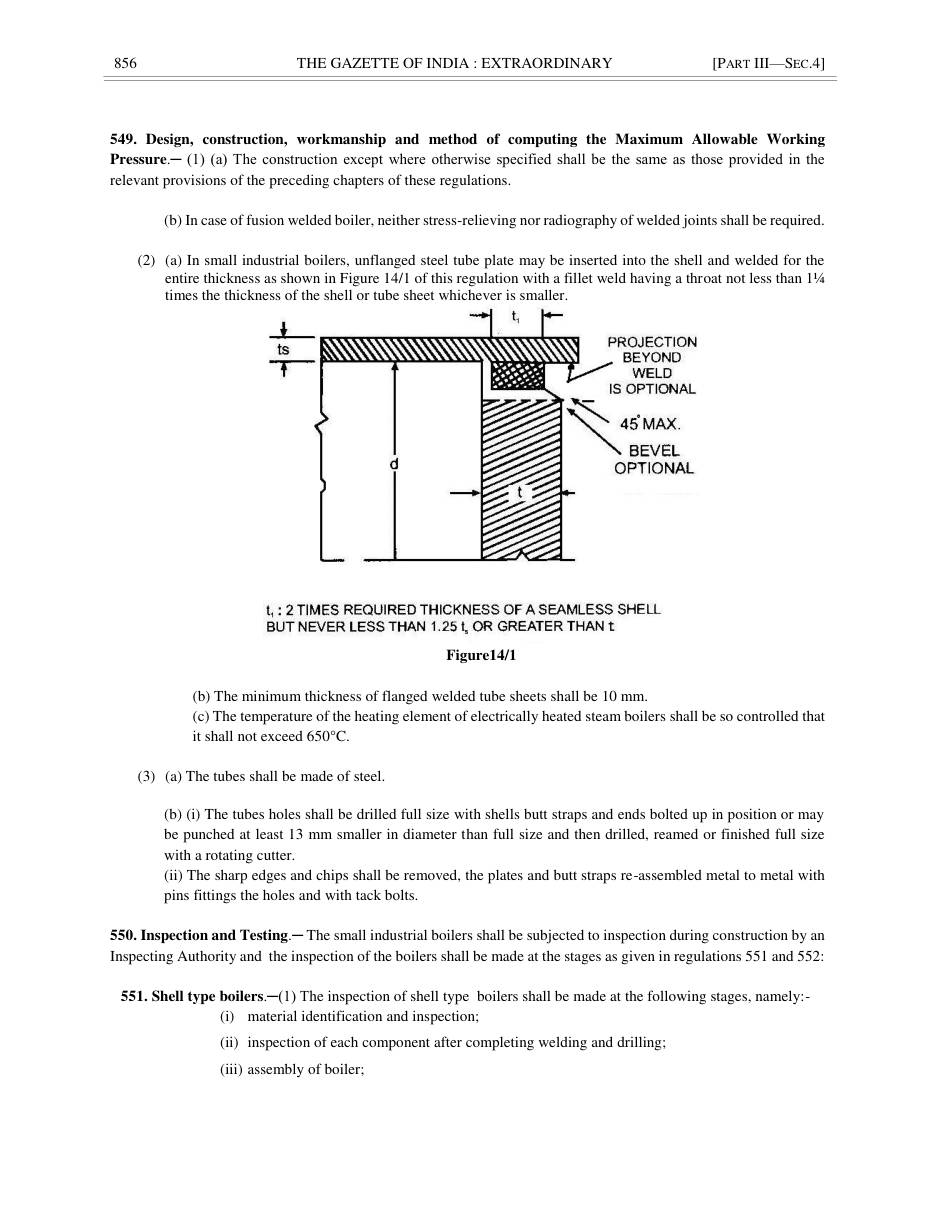
(2)(a) In small industrial boilers, unflanged steel tube plate may be inserted into the shell and welded for the entire thickness as shown in Figure 14/1 of this regulation with a fillet weld having a throat not less than 1¼ times the thickness of the shell or tube sheet whichever is smaller.
Figure14/1
(b)The minimum thickness of flanged welded tube sheets shall be 10 mm.
(c)The temperature of the heating element of electrically heated steam boilers shall be so controlled that it shall not exceed 650°C.
(3)(a) The tubes shall be made of steel.
(b)(i) The tubes holes shall be drilled full size with shells butt straps and ends bolted up in position or may be punched at least 13 mm smaller in diameter than full size and then drilled, reamed or finished full size with a rotating cutter.
(ii)The sharp edges and chips shall be removed, the plates and butt straps re-assembled metal to metal with pins fittings the holes and with tack bolts.
Parts of this extracted text look garbled; read the Gazette page before using any value.
In short
Small industrial boilers are built to the preceding chapters, except where this regulation relaxes or adds requirements for welding, tube plates, electric heating elements and tube holes.
Key points
- (1)(a) Construction follows the relevant provisions of the preceding chapters unless otherwise specified.
- (1)(b) For fusion welded boilers, neither stress-relieving nor radiography of welded joints is required.
- (2)(a) An unflanged steel tube plate may be inserted into the shell and welded through its entire thickness, as shown in Figure 14/1. The fillet weld throat must be not less than 1¼ times the thickness of the shell or tube sheet, whichever is smaller.
- (2)(b) Flanged welded tube sheets must be at least 10 mm thick.
- (2)(c) In electrically heated steam boilers, the heating element temperature must be controlled so that it does not exceed 650°C.
- (3)(a) Tubes must be made of steel.
- (3)(b)(i) Tube holes are either drilled full size with the shells, butt straps and ends bolted up in position, or punched at least 13 mm smaller in diameter than full size and then drilled, reamed or finished full size with a rotating cutter.
- (3)(b)(ii) Sharp edges and chips must be removed. The plates and butt straps are then re-assembled metal to metal, with pins fitting the holes and with tack bolts.
Watch out
- Figure 14/1 does not come through in the extracted text. Check the Gazette page for the joint detail.
Written by IBRsource editors · last edited 2026-11-20. Explanations simplify and are not a design method, testing procedure or authorisation. Requirements come from the complete regulations, the Gazette and approved documentation.
Comparison pending: the IBR 1950 text in force on 30 September 2026 is not yet established for this provision, so no change is claimed (how this works).
Orientation hints (unverified)
These candidates come from automated heading matching against DPIIT's scanned historical print edition of IBR 1950. That edition uses imperial units and riveted-construction provisions, so it is not the operative 2026 predecessor text. Regulation numbers alone never prove equivalence.
| Historical 1950-edition reg. | Heading as OCR'd | Heading similarity | Source image |
|---|---|---|---|
| 416 | Construction and Workmanship | 100% | Chapter X (DPIIT scan), image 5 |
| 624 | Construction and Workmanship | 100% | Chapter XV (DPIIT scan), image 1 |
Amendment history of the candidate IBR 1950 regulations: Reg. 624 (1 amendment)
IBR 1950 regulation 416 as last published in the DPIIT web edition (archived 2022)
Unofficial archived copy, not verified; see the regulation 416 page for its amendments.
| Reg. 413, Reg. 414, Reg. 415, Reg. 416
Reg. 414
Reg. 415
Reg. 416
|
IBR 1950 regulation 624 as last published in the DPIIT web edition (archived 2022)
Unofficial archived copy, not verified; see the regulation 624 page for its amendments.
| Reg. 623, Reg. 624, Reg. 625 | |||||||||||
Reg. 624 Requirements
Reg. 625 Sampling Sampling shall be done following general directions given in 2 of IS:3025-1964*. In particular, the following points shall be observed :
| |||||||||||
Images of the official Gazette pages that contain this regulation. Click to zoom. Compare word by word before relying on the extracted text.
Indian Boiler Regulations, 2026, reg. 549, Regulation 549, Gazette of India, Extraordinary, Part III—Section 4, No. 596, 1 October 2026, printed p.856. https://egazette.gov.in/WriteReadData/2026/276813.pdf (text consulted via IBRsource, 2026-11-23).
The citation refers to the government publication. Cite the Gazette, not this website.