
Indian Boiler Regulations, 2026 · Chapter 15 · Feed Water for Boiler
Regulation 559. Test methods
Not yet checked against the official Gazette; verify before relying on it.
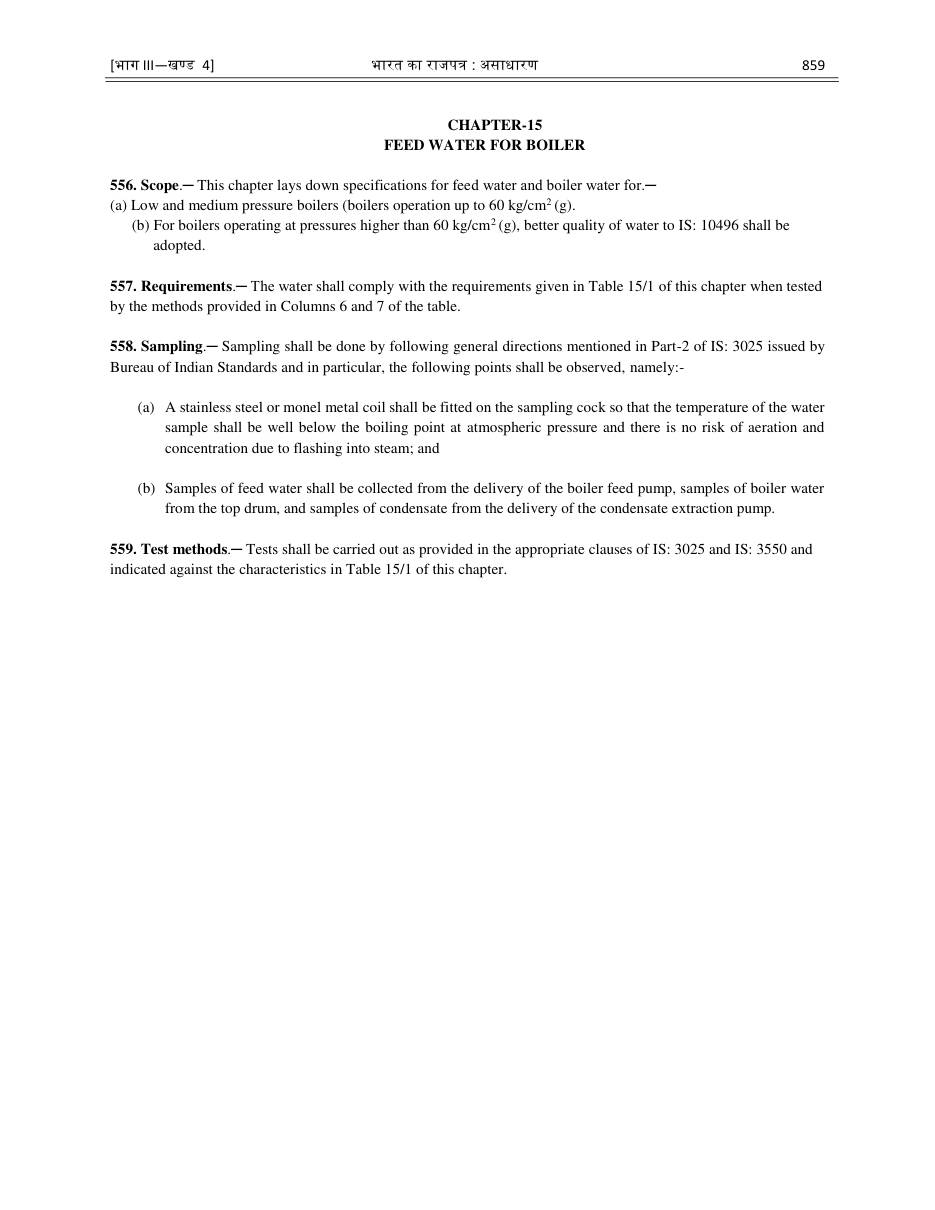
559. Test methods.─ Tests shall be carried out as provided in the appropriate clauses of IS: 3025 and IS: 3550 and indicated against the characteristics in Table 15/1 of this chapter.
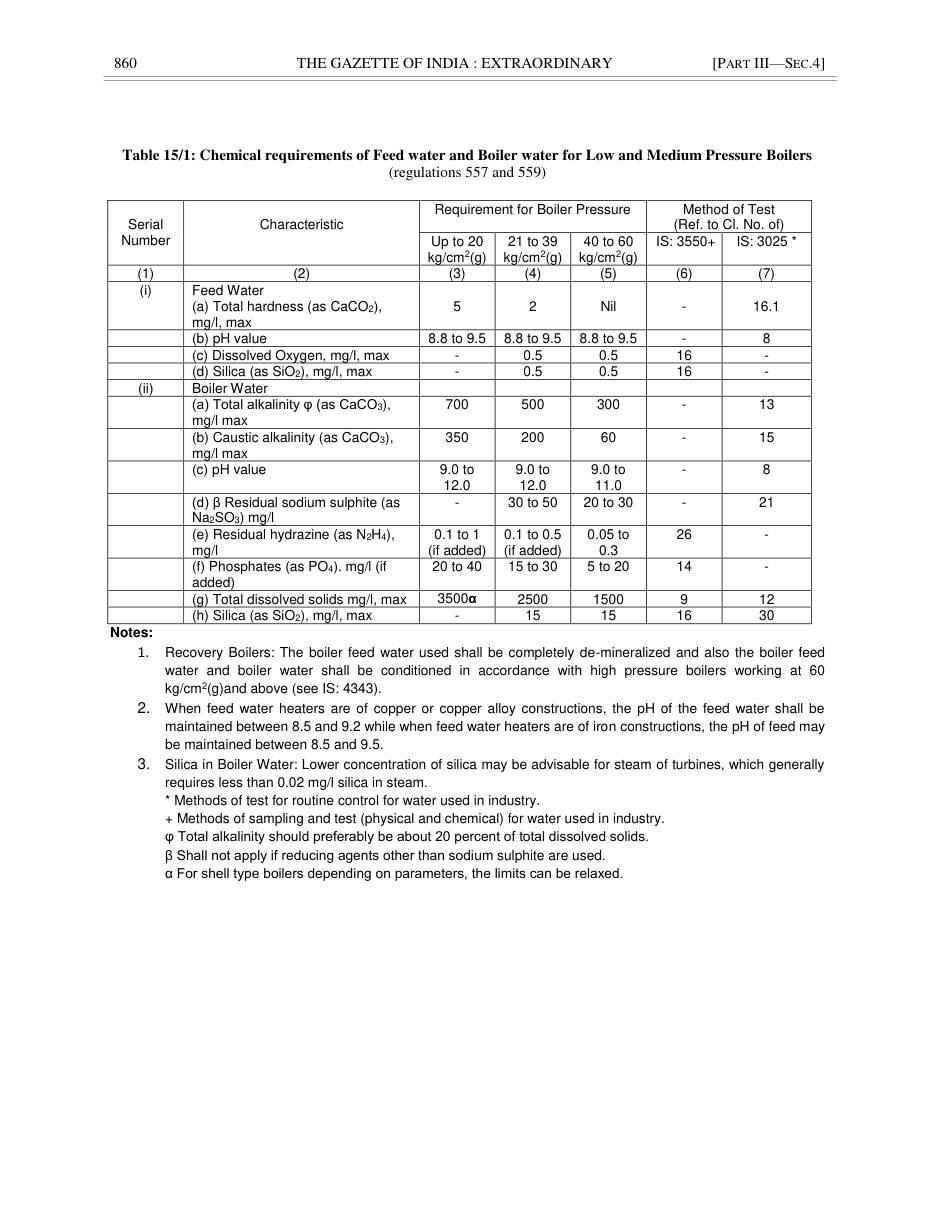
Table 15/1: Chemical requirements of Feed water and Boiler water for Low and Medium Pressure Boilers
(regulations 557 and 559)
| Serial Number | Characteristic | Requirement for Boiler Pressure | Method of Test (Ref. to Cl. No. of) | |||
|---|---|---|---|---|---|---|
| Up to 20 kg/cm2(g) | 21 to 39 kg/cm2(g) | 40 to 60 kg/cm2(g) | IS: 3550+ | IS: 3025 * | ||
| (1) | (2) | (3) | (4) | (5) | (6) | (7) |
| (i) | Feed Water (a) Total hardness (as CaCO2), mg/l, max | 5 | 2 | Nil | - | 16.1 |
| (b) pH value | 8.8 to 9.5 | 8.8 to 9.5 | 8.8 to 9.5 | - | 8 | |
| (c) Dissolved Oxygen, mg/l, max | - | 0.5 | 0.5 | 16 | - | |
| (d) Silica (as SiO2), mg/l, max | - | 0.5 | 0.5 | 16 | - | |
| (ii) | Boiler Water | |||||
| (a) Total alkalinity φ (as CaCO3), mg/l max | 700 | 500 | 300 | - | 13 | |
| (b) Caustic alkalinity (as CaCO3), mg/l max | 350 | 200 | 60 | - | 15 | |
| (c) pH value | 9.0 to 12.0 | 9.0 to 12.0 | 9.0 to 11.0 | - | 8 | |
| (d) β Residual sodium sulphite (as Na2SO3) mg/l | - | 30 to 50 | 20 to 30 | - | 21 | |
| (e) Residual hydrazine (as N2H4), mg/l | 0.1 to 1 (if added) | 0.1 to 0.5 (if added) | 0.05 to 0.3 | 26 | - | |
| (f) Phosphates (as PO4). mg/l (if added) | 20 to 40 | 15 to 30 | 5 to 20 | 14 | - | |
| (g) Total dissolved solids mg/l, max | 3500α | 2500 | 1500 | 9 | 12 | |
| (h) Silica (as SiO2), mg/l, max | - | 15 | 15 | 16 | 30 | |
Table structure read from the Gazette PDF, page 860. Verification status as for the text above.
Show original extracted text (diagnostic, not authoritative)
 Serial              Characteristic                        Requirement for Boiler Pressure           Method of Test
Number                                                                                             (Ref. to Cl. No. of)
                                                          Up to 20 21 to 39 40 to 60            IS: 3550+ IS: 3025 *
                                                          kg/cm2(g) kg/cm2(g) kg/cm2(g)

     (1)                 (2)                              (3)     (4)            (5)            (6)  (7)

     (i)   Feed Water

           (a) Total hardness (as CaCO2),                 5       2              Nil            -    16.1
           mg/l, max

           (b) pH value                                   8.8 to 9.5 8.8 to 9.5 8.8 to 9.5      -    8

           (c) Dissolved Oxygen, mg/l, max                -       0.5            0.5            16   -

           (d) Silica (as SiO2), mg/l, max                -       0.5            0.5            16   -

     (ii)  Boiler Water

           (a) Total alkalinity φ (as CaCO3),             700     500            300            -    13

           mg/l max

           (b) Caustic alkalinity (as CaCO3),             350     200            60             -    15

           mg/l max

           (c) pH value                                   9.0 to  9.0 to         9.0 to         -    8

                                                          12.0    12.0           11.0

           (d) β Residual sodium sulphite (as             -       30 to 50 20 to 30             -    21

           Na2SO3) mg/l

           (e) Residual hydrazine (as N2H4),              0.1 to 1 0.1 to 0.5 0.05 to           26   -

           mg/l                                           (if added) (if added)  0.3

           (f) Phosphates (as PO4). mg/l (if              20 to 40 15 to 30 5 to 20             14   -

           added)

           (g) Total dissolved solids mg/l, max 3500α             2500           1500           9    12

           (h) Silica (as SiO2), mg/l, max                -       15             15             16   30
Notes:
1. Recovery Boilers: The boiler feed water used shall be completely de-mineralized and also the boiler feed water and boiler water shall be conditioned in accordance with high pressure boilers working at 60 kg/cm2(g)and above (see IS: 4343).
2. When feed water heaters are of copper or copper alloy constructions, the pH of the feed water shall be maintained between 8.5 and 9.2 while when feed water heaters are of iron constructions, the pH of feed may be maintained between 8.5 and 9.5.
3. Silica in Boiler Water: Lower concentration of silica may be advisable for steam of turbines, which generally requires less than 0.02 mg/l silica in steam.
* Methods of test for routine control for water used in industry.
+ Methods of sampling and test (physical and chemical) for water used in industry.
φ Total alkalinity should preferably be about 20 percent of total dissolved solids.
β Shall not apply if reducing agents other than sodium sulphite are used.
α For shell type boilers depending on parameters, the limits can be relaxed.
Parts of this extracted text look garbled; read the Gazette page before using any value.
Tables and formulae are shown in their extracted layout. Alignment, superscripts and subscripts may be lost. The Gazette page image is authoritative.
In short
Water tests are carried out by the appropriate clauses of IS: 3025 and IS: 3550, as indicated against each characteristic in Table 15/1. The table sets the chemical limits for feed water and boiler water in low and medium pressure boilers.
Key points
- Table 15/1 structure. Limits are given in three boiler pressure bands (columns 3 to 5). Columns 6 and 7 give the clause numbers of IS: 3550 and IS: 3025 for each test.
- Feed water characteristics: total hardness, pH value, dissolved oxygen and silica.
- Boiler water characteristics: total alkalinity, caustic alkalinity, pH value, residual sodium sulphite, residual hydrazine (if added), phosphates (if added), total dissolved solids and silica.
- For the limits themselves, see the Official text tab and the Gazette page.
Notes to the table
- Note 1, recovery boilers: feed water must be completely de-mineralized, and feed water and boiler water conditioned as for high pressure boilers working at 60 kg/cm2(g) and above (see IS: 4343).
- Note 2, feed water heaters: with copper or copper alloy heaters, feed water pH is kept between 8.5 and 9.2. With iron heaters it may be kept between 8.5 and 9.5.
- Note 3, silica: a lower silica concentration in boiler water may be advisable for steam for turbines.
- The footnote marked β says the residual sodium sulphite limit does not apply if reducing agents other than sodium sulphite are used.
- The footnote marked α says the total dissolved solids limit for shell type boilers can be relaxed depending on parameters.
Watch out
- The extracted table is spread over several lines and some entries may be misaligned. Check the Gazette page for the exact values in each pressure band.
Written by IBRsource editors · last edited 2026-11-20. Explanations simplify and are not a design method, testing procedure or authorisation. Requirements come from the complete regulations, the Gazette and approved documentation.
Comparison pending: the IBR 1950 text in force on 30 September 2026 is not yet established for this provision, so no change is claimed (how this works).
Orientation hints (unverified)
These candidates come from automated heading matching against DPIIT's scanned historical print edition of IBR 1950. That edition uses imperial units and riveted-construction provisions, so it is not the operative 2026 predecessor text. Regulation numbers alone never prove equivalence.
No candidate heading found in the historical print edition.
Images of the official Gazette pages that contain this regulation. Click to zoom. Compare word by word before relying on the extracted text.
Indian Boiler Regulations, 2026, reg. 559, Regulation 559, Gazette of India, Extraordinary, Part III—Section 4, No. 596, 1 October 2026, printed p.859–861. https://egazette.gov.in/WriteReadData/2026/276813.pdf (text consulted via IBRsource, 2026-11-23).
The citation refers to the government publication. Cite the Gazette, not this website.