Indian Boiler Regulations, 2026
Appendix B — TRANSVERSE RUPTURE STRESS (MODULUS OF RUPTURE)
Not yet checked against the official Gazette; verify before relying on it.
Open the official Gazette at this appendix
APPENDIX-B
TRANSVERSE RUPTURE STRESS (MODULUS OF RUPTURE)
The transverse strength of cast iron may be expressed by a figure shown as the Transverse Rupture Stress; this figure is obtained by dividing the maximum bending moment at failure by the modulus of the section. Thus, the Transverse Rupture Stress is the maximum stress which would have existed if the material had behaved in accordance with the assumptions made in the ordinary theory of bending, and in that event it would be independent of the size and shape of the section. Bars fractured in transverse, however, are stressed beyond the elastic limit, and under these conditions the theory of bending no longer holds good. Furthermore, the influence of rate of cooling in cast metals is such that the Transverse Rupture Stress of a Thick Bar is less than that of a thinner bar of the same metal. The Transverse Rupture Stress, therefore, is not strictly independent of the size and metal. The Transverse Rupture Stress, therefore, is not strictly independent of the size and shape, of the section, but nevertheless forces a convenient way of expressing the result of transverse tests without the necessity for giving full details of bar dimensions. The formula required is obtained as follows:
A bar supported at both ends and centrally loaded with a load ‘W’ is subject to a bending Moment WL/4, ‘L’ being the distance between supports. The resistance offered by the bar may be expressed as fZ, ‘f’ being the stress and ‘Z’ the modulus of the section. At fracture, ‘f’ becomes the breaking stress of Transverse Rupture Stress, and WL/4 = fZ, where f = (LW)/ (4Z). If ‘W’ is in tons and ‘L’ in inches, ‘f’ is in tons per square inch. For a round bar, Z =
0.0982d2, where d diameter in inches.
Since for a standard round bar ‘L’ and ‘Z’ are constant, the value WL/4Z is fixed and hence the Transverse Rupture Stress f = KW, where ‘K’ is a constant.
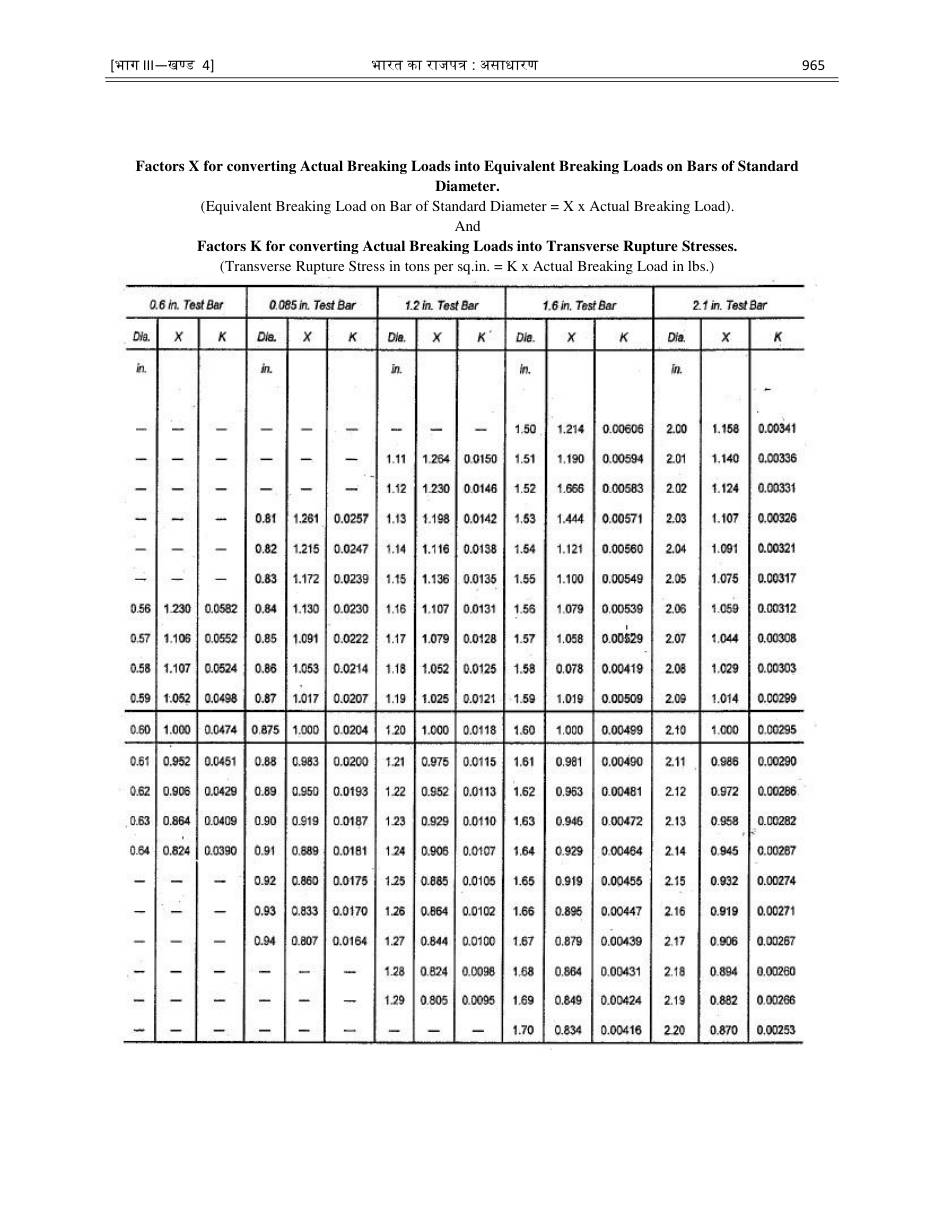
The factor ‘K’ for converting actual breaking loads into Transverse Rupture Stress are given in the following tables both for the Standard test bars and the test bars varying within the limits of regulation 65. In the same table are given factors for converting actual breaking loads into equivalent breaking loads on the bars of Standard diameter.
Factors X for converting Actual Breaking Loads into Equivalent Breaking Loads on Bars of Standard Diameter.
(Equivalent Breaking Load on Bar of Standard Diameter = X x Actual Breaking Load). And
Factors K for converting Actual Breaking Loads into Transverse Rupture Stresses. (Transverse Rupture Stress in tons per sq.in. = K x Actual Breaking Load in lbs.)
Gazette pages